



Beobachtung melden im Fish Watcher
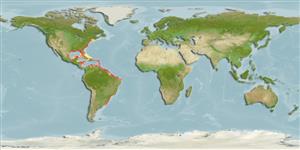
| Native range | All suitable habitat | Point map | Year 2050 |
|
| This map was computer-generated and has not yet been reviewed. |
| Anchoa hepsetus AquaMaps Data sources: GBIF OBIS |
Hochladen Photos und videos
Bilder | Google Bild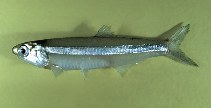 Anchoa hepsetus
Photo von Flescher, D.
Bilder | Google Bild
Photo von Flescher, D.
Klassifizierung / Names Namen | Synonyme | Catalog of Fishes(Gattung, Arten) | ITIS | CoL | WoRMS | Cloffa
> Clupeiformes (Herrings) > Engraulidae (Anchovies) > Engraulinae
Etymology: Anchoa: Italian ancioa = anchovy (Ref. 45335).
More on author: Linnaeus.
Etymology: Anchoa: Italian ancioa = anchovy (Ref. 45335).
More on author: Linnaeus.
Umwelt: Milieu / Klimazone / Tiefenbereich / Verbreitungsgebiet Ökologie
seewasser; süßwasser; brackwasser pelagic-neritic; anadrom (Ref. 126106); tiefenbereich 1 - 70 m (Ref. 189). Subtropical; 44°N - 36°S, 98°W - 32°W (Ref. 189)
Verbreitung Territorien | FAO Gebiete | Ökosysteme | Vorkommen | Punkt Karte | Einführungen | Faunafri
Western Atlantic: Massachusetts, USA perhaps occasionally straying north to Maine or even Nova Scotia (Canada), south to Fort Pierce, Florida (but not Florida Keys) and at least northern Gulf of Mexico; also from Gulf of Venezuela south to Uruguay. Replaced by Anchoa colonensis in the West Indies.
Größe / Gewicht / Alter
Geschlechtsreife: Lm ? range ? - ? cm
Max length : 15.3 cm TL Männchen/unbestimmt; (Ref. 37032); common length : 11.0 cm TL Männchen/unbestimmt; (Ref. 5217)
Max length : 15.3 cm TL Männchen/unbestimmt; (Ref. 37032); common length : 11.0 cm TL Männchen/unbestimmt; (Ref. 5217)
Kurzbeschreibung Bestimmungsschlüssel | Morphologie | Morphometrie
Rückenflossenstacheln (insgesamt) : 0; Rückenflossenweichstrahlen (insgesamt) : 14 - 17; Afterflossenstacheln: 0; Afterflossenweichstrahlen: 20 - 24. Snout pointed, about 3/4 eye diameter; maxilla long, tips pointed, reaching beyond hind border of pre-operculum, almost to gill opening; gill cover canals of panamensis-type. Anal fin origin below about midpoint of dorsal fin base. Anus nearer to anal fin origin than to pelvic fin tips. Silver stripe along flank (a dark line above) of uniform width, narrowed immediately behind band (Ref. 189). Back greenish, some yellowish on head. Melanophores outline all dorsal scales (Ref. 7251).
Body shape (shape guide): elongated; Cross section: oval.
Body shape (shape guide): elongated; Cross section: oval.
Adults form dense schools, often in shallow waters close to shore. They are able to tolerate a wide range of salinities, from hypersaline to almost fresh. Adults feed on copepods when young, then on gastropods, foraminifers and an occasional ostracods and annelid. Breeding was recorded in April through to July at Beaufort, North Carolina. Breeding takes place in harbors, estuaries and sounds. Eggs are elliptical, transparent, without oil globule, the yolk appearing `cellular' (Ref. 189). Great variation. Principal parasites are nematodes and cestodes (Scolex polymorphus and Rhynchobothrium sp.) and trematodes (Distomum appendiculatum and Distomum sp). Marketed as food (Ref. 37032).
Lebenszyklus und Paarungsverhalten Geschlechtsreife | Fortpflanzung | Ablaichen | Eier | Fruchtbarkeit | Larven
Spawn in school (Ref. 205).
Hauptreferenz
Laden Sie Ihre Referenzen hoch | Referenzen | Koordinator | Partner
Whitehead, P.J.P., G.J. Nelson and T. Wongratana, 1988. FAO Species Catalogue. Vol. 7. Clupeoid fishes of the world (Suborder Clupeoidei). An annotated and illustrated catalogue of the herrings, sardines, pilchards, sprats, shads, anchovies and wolf-herrings. FAO Fish. Synop. 125(7/2):305-579. Rome: FAO. (Ref. 189)
IUCN Rote Liste Status (Ref. 130435: Version 2025-2 (Global))
nicht bedroht (LC) ; Date assessed: 24 August 2012
CITES
Not Evaluated
Bedrohung für Menschen
Harmless
Nutzung durch Menschen
Fischereien: weniger kommerziell; Köder: usually
FAO - Fischereien: landungen; Publication: search | FishSource | Das Meer um uns herum
Mehr Information
Trophische Ökologie
Lebensmittel (Beutetiere)
Nahrungszusammensetzung
Nahrungsaufnahme
Lebensmittelrationen
Räuber
Lebensmittel (Beutetiere)
Nahrungszusammensetzung
Nahrungsaufnahme
Lebensmittelrationen
Räuber
Populationsdynamik
Wachstumsparameter
Max. Alter/Größen
Länge-Gewicht-Rel.
Länge-Länge-Verhältnis.
Längenhäufigkeiten
Massenkonvertierung
Rekrutierung
Dichte
Wachstumsparameter
Max. Alter/Größen
Länge-Gewicht-Rel.
Länge-Länge-Verhältnis.
Längenhäufigkeiten
Massenkonvertierung
Rekrutierung
Dichte
Lebenszyklus
Fortpflanzung
Geschlechtsreife
Reifung/Kiemen rel.
Fruchtbarkeit
Ablaichen
Laichaggregationen
Eier
Eientwicklung
Larven
Larven Pop.Dyn.
Fortpflanzung
Geschlechtsreife
Reifung/Kiemen rel.
Fruchtbarkeit
Ablaichen
Laichaggregationen
Eier
Eientwicklung
Larven
Larven Pop.Dyn.
Anatomie
Kiemenoberfläche
Gehirn
Otolith
Kiemenoberfläche
Gehirn
Otolith
Physiologie
Körperliche Zusammensetzung
Nährstoffe
Sauerstoffverbrauch
Schwimmart
Schwimmgeschwindigkeit
Visuelle Pigmente
Fischgeräusche
Krankheiten und Parasiten
Toxizität (LC50s)
Körperliche Zusammensetzung
Nährstoffe
Sauerstoffverbrauch
Schwimmart
Schwimmgeschwindigkeit
Visuelle Pigmente
Fischgeräusche
Krankheiten und Parasiten
Toxizität (LC50s)
Genetik
Genom
Genetik
Heterozygotie
Vererbbarkeit
Genetische Vielfalt
Genom
Genetik
Heterozygotie
Vererbbarkeit
Genetische Vielfalt
Menschenbezogen
Aquakultur-Systeme
Aquakultur Profile
Zuchtlinien
Ciguatera-Fälle
Briefmarken, Münzen, Verschiedenes.
Aquakultur-Systeme
Aquakultur Profile
Zuchtlinien
Ciguatera-Fälle
Briefmarken, Münzen, Verschiedenes.
Tools
E-Book | Feldführer | Bestimmungsschlüssel | Längenhäufigkeits Tool | Lebensdaten Tool | Punkt Karte |
Catch-MSY |
Zusatzinformationen
Download XML
Zusammenfassung | Punktdaten | Namen | Photos
Internet Quellen
AFORO (otoliths) | Aquatic Commons | BHL | Cloffa | Websites from users | FishWatcher Einträge suchen | CISTI | Catalog of Fishes: Gattung, Arten | DiscoverLife | ECOTOX | FAO - Fischereien: landungen; Publication: search | Faunafri | Fishipedia | Fishtrace | GloBI | Google Books | Google Scholar | Google | IGFA World Record | Nationale Datenbanken | OceanAdapt | OneZoom | Open Tree of Life | Otolith Atlas of Taiwan Fishes | PubMed | Reef Life Survey | Socotra Atlas | TreeBase | Tree of Life | Wikipedia: Gehe zu, Suchen | World Records Freshwater Fishing | Zoologischer Rekord
Schätzungen auf der Grundlage von Modellen
Bevorzugte Temperatur (Ref. 123201): 15 - 28, mean 24.4 °C (based on 480 cells).
Phylogenetischer Diversitätsindex (Ref. 82804): PD50 = 0.5000 [Uniqueness, from 0.5 = low to 2.0 = high].
Bayesian length-weight: a=0.00513 (0.00409 - 0.00644), b=3.16 (3.12 - 3.20), in cm total length, based on LWR estimates for this species (Ref. 93245).
Trophische Ebene (Ref. 69278): 3.3 ±0.0 se; based on diet studies.
Widerstandsfähigkeit (Ref. 120179): hoch, Verdopplung der Population dauert weniger als 15 Monate. (tm=1; Fec=5700).
Nährstoffe (Ref. 124155): Calcium = 187 [107, 388] mg/100g; Iron = 1.73 [0.91, 3.05] mg/100g; Protein = 18.1 [15.8, 20.8] %; Omega3 = 0.514 [0.268, 0.972] g/100g; Selenium = 20.3 [9.1, 47.5] μg/100g; VitaminA = 11.2 [3.4, 32.7] μg/100g; Zinc = 1.4 [1.0, 2.1] mg/100g (wet weight); based on nutrient studies.