



Ajouter votre observation dans Fish Watcher
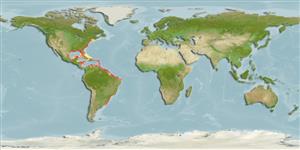
| Native range | All suitable habitat | Point map | Year 2050 |
|
| This map was computer-generated and has not yet been reviewed. |
| Anchoa hepsetus AquaMaps Data sources: GBIF OBIS |
Envoyez vos Photos et vidéos
Images | Images Google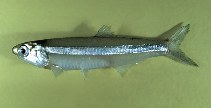 Anchoa hepsetus
Photo de Flescher, D.
Images | Images Google
Photo de Flescher, D.
Classification / Noms Noms communs | Synonymes | Catalog of Fishes(Genre, Espèce) | ITIS | CoL | WoRMS | Cloffa
> Clupeiformes (Herrings) > Engraulidae (Anchovies) > Engraulinae
Etymology: Anchoa: Italian ancioa = anchovy (Ref. 45335).
More on author: Linnaeus.
Etymology: Anchoa: Italian ancioa = anchovy (Ref. 45335).
More on author: Linnaeus.
Environnement : milieu / zone climatique / profondeur / gamme de distribution Écologie
marin; eau douce; saumâtre pelagic-neritic; anadrome (Ref. 126106); profondeur 1 - 70 m (Ref. 189). Subtropical; 44°N - 36°S, 98°W - 32°W (Ref. 189)
Distribution Territoires | Zones FAO | Écosystèmes | Occurrences | Carte par point | Introductions | Faunafri
Western Atlantic: Massachusetts, USA perhaps occasionally straying north to Maine or even Nova Scotia (Canada), south to Fort Pierce, Florida (but not Florida Keys) and at least northern Gulf of Mexico; also from Gulf of Venezuela south to Uruguay. Replaced by Anchoa colonensis in the West Indies.
Taille / Poids / Âge
Maturité: Lm ? range ? - ? cm
Max length : 15.3 cm TL mâle / non sexé; (Ref. 37032); common length : 11.0 cm TL mâle / non sexé; (Ref. 5217)
Max length : 15.3 cm TL mâle / non sexé; (Ref. 37032); common length : 11.0 cm TL mâle / non sexé; (Ref. 5217)
Description synthétique Clés d'identification | Morphologie | Morphométrie
Épines dorsales (Total) : 0; Rayons mous dorsaux (Total) : 14 - 17; Épines anales: 0; Rayons mous anaux: 20 - 24. Snout pointed, about 3/4 eye diameter; maxilla long, tips pointed, reaching beyond hind border of pre-operculum, almost to gill opening; gill cover canals of panamensis-type. Anal fin origin below about midpoint of dorsal fin base. Anus nearer to anal fin origin than to pelvic fin tips. Silver stripe along flank (a dark line above) of uniform width, narrowed immediately behind band (Ref. 189). Back greenish, some yellowish on head. Melanophores outline all dorsal scales (Ref. 7251).
Body shape (shape guide): elongated; Cross section: oval.
Body shape (shape guide): elongated; Cross section: oval.
Adults form dense schools, often in shallow waters close to shore. They are able to tolerate a wide range of salinities, from hypersaline to almost fresh. Adults feed on copepods when young, then on gastropods, foraminifers and an occasional ostracods and annelid. Breeding was recorded in April through to July at Beaufort, North Carolina. Breeding takes place in harbors, estuaries and sounds. Eggs are elliptical, transparent, without oil globule, the yolk appearing `cellular' (Ref. 189). Great variation. Principal parasites are nematodes and cestodes (Scolex polymorphus and Rhynchobothrium sp.) and trematodes (Distomum appendiculatum and Distomum sp). Marketed as food (Ref. 37032).
Cycle de vie et comportement reproducteur Maturité | Reproduction | Frai | Œufs | Fécondité | Larves
Spawn in school (Ref. 205).
Référence principale
Téléchargez vos références | Références | Coordinateur | Collaborateurs
Whitehead, P.J.P., G.J. Nelson and T. Wongratana, 1988. FAO Species Catalogue. Vol. 7. Clupeoid fishes of the world (Suborder Clupeoidei). An annotated and illustrated catalogue of the herrings, sardines, pilchards, sprats, shads, anchovies and wolf-herrings. FAO Fish. Synop. 125(7/2):305-579. Rome: FAO. (Ref. 189)
Statut dans la liste rouge de l'IUCN (Ref. 130435: Version 2025-2 (Global))
Préoccupation mineure (LC) ; Date assessed: 24 August 2012
CITES
Not Evaluated
Menace pour l'homme
Harmless
Utilisations par l'homme
Pêcheries: intérêt commercial mineur; appât: usually
FAO - pêcheries: débarquements; Publication: search | FishSource | Sea Around Us
Plus d'informations
Écologie trophique
Aliments (proies)
Composition du régime alimentaire
Consommation alimentaire
Rations alimentaires
Prédateurs
Aliments (proies)
Composition du régime alimentaire
Consommation alimentaire
Rations alimentaires
Prédateurs
Dynamique des populations
Paramètres de croissance
Âges / tailles maximales
Longueur-poids rel.
Rel. longueur-longueur.
Fréquences de longueurs
Conversion de masse
Recrutement
Abondance
Paramètres de croissance
Âges / tailles maximales
Longueur-poids rel.
Rel. longueur-longueur.
Fréquences de longueurs
Conversion de masse
Recrutement
Abondance
Cycle de vie
Reproduction
Maturité
Maturité/épines rel.
Fécondité
Frai
Agrégats de frai
Œufs
Développement de l'œuf
Larves
Dynamique des populations larvaires
Reproduction
Maturité
Maturité/épines rel.
Fécondité
Frai
Agrégats de frai
Œufs
Développement de l'œuf
Larves
Dynamique des populations larvaires
Anatomie
Surface branchiale
Cerveau
Otolithe
Surface branchiale
Cerveau
Otolithe
Physiologie
Composition corporelle
Nutriments
Consommation d'oxygène
Type de natation
Vitesse de nage
Pigments visuels
Son de poisson
Maladies et parasites
Toxicité (CL50)
Composition corporelle
Nutriments
Consommation d'oxygène
Type de natation
Vitesse de nage
Pigments visuels
Son de poisson
Maladies et parasites
Toxicité (CL50)
Génétique
génôme
Génétique
Hétérozygotie
Héritabilité
Diversité génétique
génôme
Génétique
Hétérozygotie
Héritabilité
Diversité génétique
Liées à l'homme
Systèmes d'aquaculture
Profils d'aquaculture
Souches
Cas de ciguatera
Timbres, pièces de monnaie, divers
Systèmes d'aquaculture
Profils d'aquaculture
Souches
Cas de ciguatera
Timbres, pièces de monnaie, divers
Outils
E-book | Guide de terrain | Clés d'identification | Générateur de fréquences de longueur | Outil de dynamique de population | Carte par point |
Capture-MSY |
Articles particuliers
Télécharger en XML
Sources Internet
AFORO (otoliths) | Aquatic Commons | BHL | Cloffa | Websites from users | FishWatcher | CISTI | Catalog of Fishes: Genre, Espèce | DiscoverLife | ECOTOX | FAO - pêcheries: débarquements; Publication: search | Faunafri | Fishipedia | Fishtrace | GloBI | Google Books | Google Scholar | Google | IGFA World Record | Bases de données nationales | OceanAdapt | OneZoom | Open Tree of Life | Otolith Atlas of Taiwan Fishes | PubMed | Reef Life Survey | Socotra Atlas | TreeBase | Arbre de Vie | Wikipedia: aller à, chercher | World Records Freshwater Fishing | Zoological Record
Estimations basées sur des modèles
Température préférée (Réf. 123201): 15 - 28, mean 24.4 °C (based on 480 cells).
Indice de diversité phylogénétique (Réf. 82804): PD50 = 0.5000 [Uniqueness, from 0.5 = low to 2.0 = high].
Bayesian length-weight: a=0.00513 (0.00409 - 0.00644), b=3.16 (3.12 - 3.20), in cm total length, based on LWR estimates for this species (Ref. 93245).
Niveau trophique (Réf. 69278): 3.3 ±0.0 se; based on diet studies.
Résilience (Réf. 120179): Haut, temps minimum de doublement de population inférieur à 15 mois (tm=1; Fec=5700).
Nutriments (Ref. 124155): Calcium = 187 [107, 388] mg/100g; Iron = 1.73 [0.91, 3.05] mg/100g; Protein = 18.1 [15.8, 20.8] %; Omega3 = 0.514 [0.268, 0.972] g/100g; Selenium = 20.3 [9.1, 47.5] μg/100g; VitaminA = 11.2 [3.4, 32.7] μg/100g; Zinc = 1.4 [1.0, 2.1] mg/100g (wet weight); based on nutrient studies.