



Parexocoetus brachypterus (Richardson, 1846)
Sailfin flyingfish
Adicionar sua observação em Fish Watcher
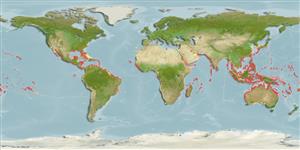
| Native range | All suitable habitat | Point map | Year 2050 |
|
| This map was computer-generated and has not yet been reviewed. |
| Parexocoetus brachypterus AquaMaps Data sources: GBIF OBIS |
Carregue seu(sua) Fotos e vídeos
Fotos | Imagem do Google Parexocoetus brachypterus
Foto de Randall, J.E.
Fotos | Imagem do Google
Foto de Randall, J.E.
Classificação / Nomes Nomes comuns | Sinônimos | Catalog of Fishes(Gênero, Espécies) | ITIS | CoL | WoRMS | Cloffa
> Beloniformes (Needle fishes) > Exocoetidae (Flyingfishes)
Etymology: Parexocoetus: Greek, para in the side of + Greek, exos = outside + Greek, koite = hole (Ref. 45335).
More on author: Richardson.
Etymology: Parexocoetus: Greek, para in the side of + Greek, exos = outside + Greek, koite = hole (Ref. 45335).
More on author: Richardson.
Meio ambiente: milieu / Zona climática / intervalo de profundidade / faixa de distribuição Ecologia
marinhas pelagic-neritic; oceanódromo (Ref. 51243); intervalo de profundidade 0 - 20 m. Subtropical; 37°N - 35°S, 34°E -
Distribuição Territórios | Áreas da FAO | Ecossistemas | Ocorrências | Mapa de pontos | Introduções | Faunafri
Western Atlantic: northeastern Florida, USA and the Bahamas to Brazil (Ref. 7251); common in Caribbean Sea and Lesser Antilles area; less common in the Gulf of Mexico, the Gulf Stream and the western Sargasso Sea (Ref. 3720). Eastern Atlantic: Guinea to Angola (Ref. 4498). Indo-Pacific: widespread from East Africa, including the Red Sea (Ref. 26165) to southern Japan, Hawaii, the Marquesas, and Queensland (Australia); separate population in the eastern tropical Pacific (Bay of Panama).
Comprimento de primeira maturação / Tamanho / Peso / Idade
Maturidade: Lm 12.0, range 11 - 13 cm
Max length : 20.0 cm TL macho/indeterminado; (Ref. 5217); common length : 16.0 cm TL macho/indeterminado; (Ref. 5217)
Max length : 20.0 cm TL macho/indeterminado; (Ref. 5217); common length : 16.0 cm TL macho/indeterminado; (Ref. 5217)
Descrição suscinta Chaves de identificação | Morfologia | Morfometria
Espinhos dorsais (total) : 0; Raios dorsais (total) : 12 - 14; Espinhos anais: 0; Raios anais : 12 - 14. Body iridescent greenish blue dorsally, silvery white ventrally; dorsal black except for base and posterior rays which are pale; pelvic fins greyish, other fins transparent (Ref. 2797).
Body shape (shape guide): elongated.
Body shape (shape guide): elongated.
Occurs in coastal waters (Ref. 9300), rare in the open ocean (Ref. 9839). Capable of leaping out of the water and gliding for considerable distances above the surface. 3-4 individuals aggregate during breeding (Ref. 47825). Carnivorous (Ref. 9137). Not important as food fish, but occasionally taken by fisheries.
Ciclo de vida ou comportamento de acasalamento Maturidade | Reprodução | Desova | Ovos | Fecundidade | Larvas
During breeding, a spawning aggregation composed at least of 3-4 individuals, probably 2-3 males to 1 female, were observed jumping and flying over the water surface, exuding ripe eggs and sperm in the process.
Spawning on surface substrate (e.g. flotsam) when present is the usual reproductive mode but other modes may be employed if this substrate is not available. The fertilised eggs may remain suspended in the water surface during its development with the help of the small filaments on the egg surface and the adhesive filaments holding the egg mass together, by increasing the surface to volume ratio of the eggs, which aids in propping the eggs up in the water column. The eggs may also be suspended upon current or become benthic.
Referência principal
Carregar suas referências | Referências | Coordenador : Parin, Nikolay V. | Colaboradores
Parin, N.V., 1996. On the species composition of flying fishes (Exocoetidae) in the West-Central part of tropical Pacific. J. Ichthyol. 36(5):357-364. (Ref. 27313)
CITES
Not Evaluated
Ameaça para os humanos
Harmless
Uso pelos humanos
Pescarias: pouco comercial
FAO - Publication: search | FishSource |
Mais informação
Ecologia Trófica
Itens alimentares (presas)
Composição da dieta
Consumo alimentar
Rações alimentares
Predadores
Itens alimentares (presas)
Composição da dieta
Consumo alimentar
Rações alimentares
Predadores
Dinâmica populacional
Parâmetros de crescimento
Idade máxima / tamanhos
Relação comprimento-peso.
Relação comprimento-comprimento.
Frequências de comprimento
Conversão de massa
Recrutamento
Abundância
Parâmetros de crescimento
Idade máxima / tamanhos
Relação comprimento-peso.
Relação comprimento-comprimento.
Frequências de comprimento
Conversão de massa
Recrutamento
Abundância
Ciclo de vida
Reprodução
Maturidade
Maturidade/Rel. das guelras
Fecundidade
Desova
Agregações de desova
Ovos
Desenvolvimento dos ovos
Larvas
Dinâmica larval
Reprodução
Maturidade
Maturidade/Rel. das guelras
Fecundidade
Desova
Agregações de desova
Ovos
Desenvolvimento dos ovos
Larvas
Dinâmica larval
Fisiologia
Composição corporal
Nutrientes
Consumo de oxigênio
Tipo de natação
Velocidade de natação
Pigmentos visuais
Som de peixe
Doenças e Parasitas
Toxicidade (LC50s)
Composição corporal
Nutrientes
Consumo de oxigênio
Tipo de natação
Velocidade de natação
Pigmentos visuais
Som de peixe
Doenças e Parasitas
Toxicidade (LC50s)
Genética
genoma
Genética
Heterozigosidade
Hereditariedade
Diversidade genética
genoma
Genética
Heterozigosidade
Hereditariedade
Diversidade genética
Relacionado a humanos
Sistemas de aquicultura
Perfis para aquacultura
Estirpes
Casos de Ciguatera
Selos, moedas, diversos.
Sistemas de aquicultura
Perfis para aquacultura
Estirpes
Casos de Ciguatera
Selos, moedas, diversos.
Ferramentas
Livro eletrônico | Guia de campo | Chaves de identificação | Ferramenta auxiliar de frequências de comprimento | Ferramenta sobre a história de vida | Mapa de pontos |
Catch-MSY |
Relatórios especiais
Checar Manutenção em Aquário | Checar Planilhas de Fatos sobre as Espécies | Checar Planilhas de Fatos sobre Aquicultura
Baixar XML
Fontes da internet
AFORO (otoliths) | Aquatic Commons | BHL | Cloffa | Websites from users | Checar Observador de Peixes (FishWatcher) | CISTI | Catalog of Fishes: Gênero, Espécies | DiscoverLife | ECOTOX | FAO - Publication: search | Faunafri | Fishipedia | Fishtrace | GloBI | Google Books | Google Scholar | Google | IGFA World Record | Bases de dados nacionais | OneZoom | Open Tree of Life | Otolith Atlas of Taiwan Fishes | PubMed | Reef Life Survey | Socotra Atlas | TreeBase | Árvore da vida | Wikipedia: Ir para, procura | World Records Freshwater Fishing | Registro zoológico
Estimativas baseadas em modelos
Temperatura preferida (Ref. 123201): 23.3 - 29.2, mean 27.8 °C (based on 4764 cells).
Índice de diversidade filogenética (Ref. 82804): PD50 = 0.6250 [Uniqueness, from 0.5 = low to 2.0 = high].
Bayesian length-weight: a=0.00646 (0.00293 - 0.01422), b=3.04 (2.85 - 3.23), in cm total length, based on LWR estimates for this (Sub)family-body shape (Ref. 93245).
Nível Trófico (Ref. 69278): 3.4 ±0.45 se; based on food items.
Resiliência (Ref. 120179): Elevada, tempo mínimo de duplicação da população menor que 15 meses (Preliminary K or Fecundity.).
Nutrientes (Ref. 124155): Calcium = 479 [160, 1,136] mg/100g; Iron = 3.29 [1.39, 7.43] mg/100g; Protein = 17.6 [15.4, 19.7] %; Omega3 = 0.339 [0.115, 1.121] g/100g; Selenium = 32.4 [11.1, 88.9] μg/100g; VitaminA = 9 [2, 49] μg/100g; Zinc = 1.45 [0.85, 2.51] mg/100g (wet weight);