Lutjanus synagris, Lane snapper : fisheries, gamefish, aquarium

Lutjanus synagris (Linnaeus, 1758)

Lane snapper
Añada su observación en Fish Watcher
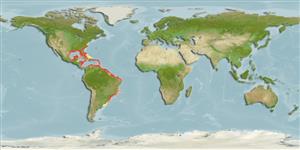
Native range | All suitable habitat | Point map | Year 2050
This map was computer-generated and has not yet been reviewed.
Lutjanus synagris   AquaMaps   Data sources: GBIF OBIS
Sube tu fotos y Vídeos
Imágenes | Vídeos | Sonidos | Google image

Clasificación / Nombres Nombres comunes | Sinónimos | Catalog of Fishes(Género, Especie) | ITIS | CoL | WoRMS | Cloffa

> Eupercaria/misc (Various families in series Eupercaria) > Lutjanidae (Snappers) > Lutjaninae
Etymology: Lutjanus: Malay, ikan lutjan, name of a fish.
More on author: Linnaeus.

Entorno: milieu / zona climática / rango de profundidad / gama de distribución Ecología

marino asociado a arrecife; rango de profundidad 10 - 400 m (Ref. 9626), usually 21 - 70 m (Ref. 9626). Subtropical; 38°N - 38°S, 98°W - 31°W (Ref. 55253)

Distribución Territorios | Áreas FAO | Ecosistemas | Ocurrencias, apariciones | Mapa de puntos | Introducciones | Faunafri

Western Atlantic: Bermuda (Anderson, pers. comm.) and North Carolina, USA to southeastern Brazil, including Gulf of Mexico and Caribbean Sea (Ref. 9626). Most abundant around the Antilles, on the Campeche Bank, off Panama and the northern coast of South America. Lutjanus ambiguus (Poey, 1860), an intergeneric hybrid with Ocyurus chrysurus (Bloch) as demonstrated by Loftus (1992: Ref. 33006), followed by McEachran &. Fechhelm (2005: Ref. 78464).

Longitud en la primera madurez / Tamaño / Peso / Edad

Madurez: Lm 23.4, range 16 - 21.5 cm
Max length : 60.0 cm TL macho / no sexado; (Ref. 40637); common length : 25.0 cm TL macho / no sexado; (Ref. 55); peso máximo publicado: 3.5 kg (Ref. 40637); edad máxima reportada: 10 años (Ref. 3090)

Descripción breve Claves de identificación | Morfología | Morfometría

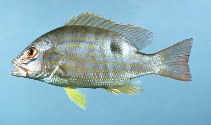
Espinas dorsales (total) : 10; Radios blandos dorsales (total) : 12 - 13; Espinas anales: 3; Radios blandos anales: 8 - 9. Preopercular notch and knob weak. Pectoral fins short, not reaching level of anus. Scale rows on back rising obliquely above lateral line. Back and upper side pink to reddish, with a green tinge and diffused darker vertical bars. The lower sides and belly silvery with a yellow tinge. A series of 8 - 10 horizontal yellow or golden stripes on sides. A diffused black spot mainly above the lateral line and below the anterior portion of the soft dorsal-fin rays.
Body shape (shape guide): fusiform / normal; Cross section: oval.

Biología     Glosario (por ej. epibenthic)

Adults are found over all types of bottom, but mainly around coral reefs and on vegetated sandy areas. In turbid as well as clear water (Ref. 9710). They often form large aggregations, especially during the breeding season. Feed at night on small fishes, bottom-living crabs, shrimps, worms, gastropods and cephalopods. Good food fish, it is marketed fresh.

Ciclo vital y comportamiento de apareamiento Madurez | Reproducción | Puesta | Huevos | Fecundidad | Larva

Often form large aggregations, especially during the breeding season.

Referencia principal Suba sus referencias | Referencias | Coordinador | Colaboradores

Allen, G.R., 1985. FAO Species Catalogue. Vol. 6. Snappers of the world. An annotated and illustrated catalogue of lutjanid species known to date. FAO Fish. Synop. 125(6):208 p. Rome: FAO. (Ref. 55)

Situación en la Lista Roja de la UICN (Ref. 130435: Version 2025-2)

  Near Threatened (NT) ; Date assessed: 10 October 2015

CITES

Not Evaluated

CMS (Ref. 116361)

Not Evaluated

Amenaza para el ser humano

  Reports of ciguatera poisoning (Ref. 30303)


Usos humanos

Pesquerías: comercial; pesca deportiva: si; Acuario: Acuarios públicos
FAO - pesquerías: desembarques; Publication: search | FishSource | Sea Around Us

Más información

Ciclo de vida
Reproducción
Madurez
Madurez/Gills rel.
Fecundidad
Puesta
Agregaciones de desove
Huevos
Desarrollo de los huevos
Larva
Dinámica larvaria
Distribución
Territorios
Áreas FAO
Ecosistemas
Ocurrencias, apariciones
Introducciones
BRUVS - Vídeos
Anatomía
Superficie branquial
Cerebro
Otolito
Fisiología
Composición corporal
Nutrientes
Consumo del oxígeno
Tipo de natación
Velocidad de natación
Pigmentos visuales
Sonido de peces
Enfermedades y parásitos
Toxicidad (CL50)
Genética
Genoma
Genética
Heterocigosidad
heritabilidad
Diversidad genética
Relacionados con el ser humano
Sistemas de acuicultura
Perfiles de acuicultura
Razas
Ciguatera cases
Sellos, monedas, varios
Divulgación
Colaboradores
Referencias
Referencias

Herramientas

Informes especiales

Descargar XML

Fuentes de Internet

Estimaciones basadas en modelos

Temperatura preferida (Referencia 123201): 19.7 - 27.5, mean 24.7 °C (based on 260 cells).
Índice de diversidad filogenética (Referencia 82804):  PD50 = 0.5000   [Uniqueness, from 0.5 = low to 2.0 = high].
Bayesian length-weight: a=0.01514 (0.01359 - 0.01685), b=2.96 (2.94 - 2.98), in cm total length, based on LWR estimates for this species (Ref. 93245).
Nivel trófico (Referencia 69278):  3.8   ±0.2 se; based on diet studies.
Generation time: 5.0 (4.3 - 5.5) years. Estimated as median ln(3)/K based on 26 growth studies.
Resiliencia (Referencia 120179):  Bajo, población duplicada en un tiempo mínimo de 4.5-14 años (K=0.13-0.26; tm=2; tmax=19; Fec>10,000).
Prior r = 0.87, 95% CL = 0.57 - 1.30, Based on 6 data-limited stock assessments.
Vulnerabilidad pesquera (Ref. 59153):  Moderate vulnerability (37 of 100). 🛈
Vulnerabilidad climática (Ref. 125649):  High to very high vulnerability (74 of 100). 🛈
Categoría de precios (Ref. 80766):   Medium.
Nutrientes (Ref. 124155):  Calcium = 18.2 [9.6, 27.7] mg/100g; Iron = 0.312 [0.183, 0.527] mg/100g; Protein = 19.1 [17.6, 20.5] %; Omega3 = 0.23 [0.14, 0.37] g/100g; Selenium = 43.6 [23.5, 75.3] μg/100g; VitaminA = 70.1 [12.9, 318.5] μg/100g; Zinc = 0.272 [0.198, 0.406] mg/100g (wet weight); based on nutrient studies.