



Add your observation in Fish Watcher
| Native range | All suitable habitat | Point map | Year 2050 |

|
| This map was computer-generated and has not yet been reviewed. |
| Larimus breviceps AquaMaps Data sources: GBIF OBIS |
Upload your photos and videos
Pictures | Sounds | Google image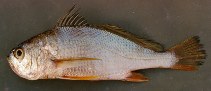 Larimus breviceps
Picture by Vianna, M.
Pictures | Sounds | Google image
Picture by Vianna, M.
Classification / Names Common names | Synonyms | Catalog of Fishes(genus, species) | ITIS | CoL | WoRMS | Cloffa
Teleostei (teleosts) > Eupercaria/misc (Various families in series Eupercaria) > Sciaenidae (Drums or croakers)
More on author: Cuvier.
More on author: Cuvier.
Environment: milieu / climate zone / depth range / distribution range Ecology
Marine; brackish; demersal; depth range 1 - 60 m (Ref. 9626). Tropical; 21°N - 26°S, 90°W - 34°W
Distribution Territories | FAO areas | Ecosystems | Occurrences | Point map | Introductions | Faunafri
Western Atlantic: Antilles and Costa Rica to Rio de Janeiro, Brazil. Also Honduras (Ref. 26938).
Length at first maturity / Size / Weight / Age
Maturity: Lm 11.1 range ? - ? cm
Max length : 31.0 cm TL male/unsexed; (Ref. 5217); common length : 20.0 cm TL male/unsexed; (Ref. 3702); max. published weight: 500.00 g (Ref. 5217)
Max length : 31.0 cm TL male/unsexed; (Ref. 5217); common length : 20.0 cm TL male/unsexed; (Ref. 3702); max. published weight: 500.00 g (Ref. 5217)
Short description Identification keys | Morphology | Morphometrics
Dorsal spines (total): 11; Dorsal soft rays (total): 24 - 26; Anal spines: 2; Anal soft rays: 7 - 8. Colour silvery grey, darker above. A dark spot at bases of pectoral fins. Pelvic and anal fins often yellowish. A medium-sized to small fish, short and robust. Mouth very large, strongly oblique, lower jaw projecting. Teeth very small and sharp, set in 1 or 2 rows along edges of jaws. Chin without barbels, but with 4 minute pores. Snout with 5 marginal pores, no rostral pores. Gas bladder with a pair of small, horn-like anterior appendages. Sagitta (large earstone) thick and short (Ref 51721).
Body shape (shape guide): fusiform / normal.
Body shape (shape guide): fusiform / normal.
Inhabits coastal waters, usually found over mud and sandy mud bottoms (Ref. 3702). Also in estuaries (Ref. 3702). Important food fish.
Life cycle and mating behavior Maturity | Reproduction | Spawning | Eggs | Fecundity | Larvae
Main reference
Upload your references | References | Coordinator | Collaborators
Cervigón, F., 1993. Los peces marinos de Venezuela. Volume 2. Fundación Científica Los Roques, Caracas,Venezuela. 497 p. (Ref. 9626)
IUCN Red List Status (Ref. 130435: Version 2025-2 (Global))
Least Concern (LC) ; Date assessed: 09 October 2019
CITES
Not Evaluated
Threat to humans
Harmless
Human uses
Fisheries: commercial; bait: occasionally
FAO - Publication: search | FishSource | Sea Around Us
More information
Population dynamics
Growth parameters
Max. ages / sizes
Length-weight rel.
Length-length rel.
Length-frequencies
Mass conversion
Recruitment
Abundance
Growth parameters
Max. ages / sizes
Length-weight rel.
Length-length rel.
Length-frequencies
Mass conversion
Recruitment
Abundance
Anatomy
Gill area
Brain
Otolith
Gill area
Brain
Otolith
Physiology
Body composition
Nutrients
Oxygen consumption
Swimming type
Swimming speed
Visual pigments
Fish sound
Diseases & Parasites
Toxicity (LC50s)
Body composition
Nutrients
Oxygen consumption
Swimming type
Swimming speed
Visual pigments
Fish sound
Diseases & Parasites
Toxicity (LC50s)
Human related
Aquaculture systems
Aquaculture profiles
Strains
Ciguatera cases
Stamps, coins, misc.
Aquaculture systems
Aquaculture profiles
Strains
Ciguatera cases
Stamps, coins, misc.
Tools
E-book | Field guide | Identification keys | Length-frequency wizard | Life-history tool | Point map |
Catch-MSY |
Special reports
Download XML
Internet sources
AFORO (otoliths) | Aquatic Commons | BHL | Cloffa | Websites from users | Check FishWatcher | CISTI | Catalog of Fishes: genus, species | DiscoverLife | ECOTOX | FAO - Publication: search | Faunafri | Fishipedia | Fishtrace | GloBI | Google Books | Google Scholar | Google | IGFA World Record | OneZoom | Open Tree of Life | Otolith Atlas of Taiwan Fishes | PubMed | Reef Life Survey | Socotra Atlas | TreeBase | Tree of Life | Wikipedia: Go, Search | | Zoobank | Zoological Record
Estimates based on models
|
Phylogenetic diversity index (Ref. 82804) |
PD50 = 0.5156 [Uniqueness, from 0.5 = low to 2.0 = high]. |
| Bayesian length-weight | a=0.00891 (0.00822 - 0.00966), b=3.09 (3.07 - 3.11), in cm total length, based on LWR estimates for this species (Ref. 93245). |
|
Trophic level (Ref. 69278) |
3.5 ±0.6 se; based on diet studies. |
| Generation time | 2.0 ( na - na) years. Estimated as median ln(3)/K based on 1 growth studies. |
|
Resilience (Ref. 120179) |
High, minimum population doubling time less than 15 months (K=0.55;). |
|
Fishing Vulnerability (Ref. 59153) |
Low vulnerability (25 of 100). 🛈 |
|
Price category (Ref. 80766) |
Medium. |
|
Nutrients (Ref. 124155) |
Calcium = 177 [103, 341] mg/100g; Iron = 1.15 [0.62, 2.00] mg/100g; Protein = 19.1 [18.0, 20.1] %; Omega3 = 0.248 [0.133, 0.412] g/100g; Selenium = 49.5 [27.5, 92.7] μg/100g; VitaminA = 20.4 [8.2, 54.9] μg/100g; Zinc = 1.45 [1.06, 2.05] mg/100g (wet weight); |