



Hochladen Photos und videos
Bilder | Google Bild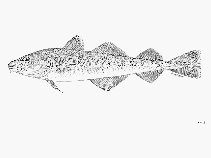 Eleginus nawaga
Photo von FAO
Bilder | Google Bild
Photo von FAO
Klassifizierung / Names Namen | Synonyme | Catalog of Fishes(Gattung, Arten) | ITIS | CoL | WoRMS | Cloffa
> Gadiformes (Cods) > Gadidae (Cods and haddocks)
Etymology: Eleginus: Greek, eleginos, -ou = a fish of the Nile (Ref. 45335).
More on author: Walbaum.
Etymology: Eleginus: Greek, eleginos, -ou = a fish of the Nile (Ref. 45335).
More on author: Walbaum.
Umwelt: Milieu / Klimazone / Tiefenbereich / Verbreitungsgebiet Ökologie
seewasser; süßwasser; brackwasser demersal; amphidrom; tiefenbereich 10 - ? m (Ref. 1371). Polar; 74°N - 62°N, 33°E - 83°E (Ref. 1371)
Verbreitung Territorien | FAO Gebiete | Ökosysteme | Vorkommen | Punkt Karte | Einführungen | Faunafri
Arctic: White, Barents and Kara seas and from the Kola Bay to the Ob inlet.
Größe / Gewicht / Alter
Geschlechtsreife: Lm ? range ? - ? cm
Max length : 42.0 cm TL Männchen/unbestimmt; (Ref. 1371); max. veröff. Alter: 12 Jahre (Ref. 72462)
Max length : 42.0 cm TL Männchen/unbestimmt; (Ref. 1371); max. veröff. Alter: 12 Jahre (Ref. 72462)
Kurzbeschreibung Bestimmungsschlüssel | Morphologie | Morphometrie
Rückenflossenstacheln (insgesamt) : 0; Afterflossenstacheln: 0. Lateral line continuous to about the origin of the second dorsal fin. Head with no lateral line pores. Expanded parapophyses swollen and hollow, beginning on about vertebral centrum 5, containing outpouchings of the swim bladder. Brownish dorsally, becoming paler ventrally; with small dark blotches.
Body shape (shape guide): fusiform / normal; Cross section: oval.
Body shape (shape guide): fusiform / normal; Cross section: oval.
Lives in the coastal sublittoral zone of the White Sea and Arctic coasts of Europe where it reflects a broad adaptation to the ecological conditions of the Arctic (Ref. 1371). Found at shallow depths, along shores with soft, muddy bottoms, close to the ice and on the continental shelf (Ref. 1371). Often caught in greatly freshened and at times completely fresh water, entering mouths and tidal zones of rivers and traveling upstream (Ref. 1371). Feeds mainly on crustaceans and worms, but takes small fishes (Ref. 1371). Taxonomic problems to be solved.
Lebenszyklus und Paarungsverhalten Geschlechtsreife | Fortpflanzung | Ablaichen | Eier | Fruchtbarkeit | Larven
Females produce about 6,000-90,000 eggs per year. From the shores, enters river mouths over sandy or rocky bottoms for spawning. Spawning sites are distributed in channels between islands or in depressions between the shore and shallow banks with strong tidal currents.
Hauptreferenz
Laden Sie Ihre Referenzen hoch | Referenzen | Koordinator | Partner
Cohen, D.M., T. Inada, T. Iwamoto and N. Scialabba, 1990. FAO species catalogue. Vol. 10. Gadiform fishes of the world (Order Gadiformes). An annotated and illustrated catalogue of cods, hakes, grenadiers and other gadiform fishes known to date. FAO Fish. Synop. 125(10). Rome: FAO. 442 p. (Ref. 1371)
CITES
Not Evaluated
Bedrohung für Menschen
Harmless
Nutzung durch Menschen
Fischereien: kommerziell
FAO - Fischereien: landungen; Publication: search | FishSource | Das Meer um uns herum
Mehr Information
Trophische Ökologie
Lebensmittel (Beutetiere)
Nahrungszusammensetzung
Nahrungsaufnahme
Lebensmittelrationen
Räuber
Lebensmittel (Beutetiere)
Nahrungszusammensetzung
Nahrungsaufnahme
Lebensmittelrationen
Räuber
Populationsdynamik
Wachstumsparameter
Max. Alter/Größen
Länge-Gewicht-Rel.
Länge-Länge-Verhältnis.
Längenhäufigkeiten
Massenkonvertierung
Rekrutierung
Dichte
Wachstumsparameter
Max. Alter/Größen
Länge-Gewicht-Rel.
Länge-Länge-Verhältnis.
Längenhäufigkeiten
Massenkonvertierung
Rekrutierung
Dichte
Lebenszyklus
Fortpflanzung
Geschlechtsreife
Reifung/Kiemen rel.
Fruchtbarkeit
Ablaichen
Laichaggregationen
Eier
Eientwicklung
Larven
Larven Pop.Dyn.
Fortpflanzung
Geschlechtsreife
Reifung/Kiemen rel.
Fruchtbarkeit
Ablaichen
Laichaggregationen
Eier
Eientwicklung
Larven
Larven Pop.Dyn.
Physiologie
Körperliche Zusammensetzung
Nährstoffe
Sauerstoffverbrauch
Schwimmart
Schwimmgeschwindigkeit
Visuelle Pigmente
Fischgeräusche
Krankheiten und Parasiten
Toxizität (LC50s)
Körperliche Zusammensetzung
Nährstoffe
Sauerstoffverbrauch
Schwimmart
Schwimmgeschwindigkeit
Visuelle Pigmente
Fischgeräusche
Krankheiten und Parasiten
Toxizität (LC50s)
Menschenbezogen
Aquakultur-Systeme
Aquakultur Profile
Zuchtlinien
Ciguatera-Fälle
Briefmarken, Münzen, Verschiedenes.
Aquakultur-Systeme
Aquakultur Profile
Zuchtlinien
Ciguatera-Fälle
Briefmarken, Münzen, Verschiedenes.
Tools
E-Book | Feldführer | Bestimmungsschlüssel | Längenhäufigkeits Tool | Lebensdaten Tool | Punkt Karte |
Catch-MSY |
Zusatzinformationen
Download XML
Zusammenfassung | Punktdaten | Namen | Photos
Internet Quellen
AFORO (otoliths) | Aquatic Commons | BHL | Cloffa | Websites from users | FishWatcher Einträge suchen | CISTI | Catalog of Fishes: Gattung, Arten | DiscoverLife | ECOTOX | FAO - Fischereien: landungen; Publication: search | Faunafri | Fishipedia | Fishtrace | GloBI | Google Books | Google Scholar | Google | IGFA World Record | OneZoom | Open Tree of Life | Otolith Atlas of Taiwan Fishes | PubMed | Reef Life Survey | Socotra Atlas | TreeBase | Tree of Life | Wikipedia: Gehe zu, Suchen | World Records Freshwater Fishing | Zoologischer Rekord
Schätzungen auf der Grundlage von Modellen
Bevorzugte Temperatur (Ref. 123201): -1.2 - 2, mean 0 °C (based on 80 cells).
Phylogenetischer Diversitätsindex (Ref. 82804): PD50 = 0.7500 [Uniqueness, from 0.5 = low to 2.0 = high].
Bayesian length-weight: a=0.00676 (0.00425 - 0.01076), b=3.08 (2.94 - 3.22), in cm total length, based on LWR estimates for this species & (Sub)family-body (Ref. 93245).
Trophische Ebene (Ref. 69278): 4.2 ±0.73 se; based on food items.
Widerstandsfähigkeit (Ref. 120179): mittel, Verdopplung der Population dauert 1,4 - 4,4 Jahre. (tm=3-4; Fec=20,000).
Nährstoffe (Ref. 124155): Calcium = 26.5 [13.8, 73.2] mg/100g; Iron = 0.464 [0.230, 0.997] mg/100g; Protein = 17.4 [16.0, 18.9] %; Omega3 = 0.397 [0.193, 0.852] g/100g; Selenium = 12.7 [4.9, 28.1] μg/100g; VitaminA = 19.1 [3.5, 101.3] μg/100g; Zinc = 0.435 [0.276, 0.672] mg/100g (wet weight);