



Synodontis membranaceus (Geoffroy Saint-Hilaire, 1809)
Adicionar o seu Fotografias e vídeos
Fotografias | Imagem do Google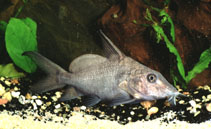 Synodontis membranaceus
Fotografia de Hippocampus-Bildarchiv
Fotografias | Imagem do Google
Fotografia de Hippocampus-Bildarchiv
Classificação / Nomes Nomes comuns | Sinónimos | Catalog of Fishes(Género, Espécies) | ITIS | CoL | WoRMS | Cloffa
> Siluriformes (Catfishes) > Mochokidae (Squeakers or upside-down catfishes) > Mochokinae
Etymology: Synodontis: Greek, syn, symphysis = grown together + Greek, odous = teeth (Ref. 45335).
Etymology: Synodontis: Greek, syn, symphysis = grown together + Greek, odous = teeth (Ref. 45335).
Taxonomic Remarks
Reassigned to Synodontis based on a phylogenetic study by Vigliotta (2008: Ref. 79014). This species is placed in the genus Hemisynodontis in Eschmeyer (CofF ver. May 2011: Ref. 86870).
Ambiente: milieu / zona climática / intervalo de profundidade / gama de distribuição Ecologia
; Água doce bentopelágico; pH range: 6.8 - 7.2; dH range: ? - 25; potamódromo (Ref. 138143). Tropical; 22°C - 25°C (Ref. 2060); 35°N - 4°N
Distribuição Territórios | Áreas FAO | Ecossistemas | Ocorrências | Mapa dos pontos | Introduções | Faunafri
Africa: Nile basin (Ref. 3202, 28714), Senegal, Gambia, Volta, Niger (including Benue) and Chad (Ref. 7362, 57223).
Comprimento na primeira maturidade / Tamanho / Peso / Idade
Descrição breve Chaves de identificação | Morfologia | Morfometria
Espinhos dorsais (total) : 1; Espinhos anais: 0. Diagnosis: gill slits extending downwards beyond pelvic-fin insertions to the midline of isthmus; maxillary barbels not longer than head, lacking tubercles and ramifications, but with a broad, black membrane extending over their entire length; mandibular barbels with a broad black membrane; outer and inner mandibular barbels with few and simple ramifications, and membranous at tips; mandibular teeth short, numbering 8-16; pectoral-fin spines more strongly denticulate on inner than on outer margin; dorsal-fin spine smooth, except for weak serrations present on posterior margin in some specimens; humeral process deep, short, granular and not keeled ventrally; adipose fin high, long and contiguous to rayed dorsal fin (Ref. 57223).
Coloration: typically inverted colour, the back being uniformly whitish-grey and the belly black; fins greyish, without spots; maxillary and mandibular barbels (particularly the outer pair) bordered by a broad, black membrane (Ref. 57223).
Body shape (shape guide): fusiform / normal.
Body shape (shape guide): fusiform / normal.
Adults occur in deep water close to the shore. Omnivore, that feeds on plankton and detritus (Ref. 13868). May also feed on surface insects, chironomid larvae, benthic crustaceans, and mollusks (Ref. 28714). Oviparous (Ref. 205). Maximum size reported as 50.0cm (length type not given)(Ref. 31256).
Ciclo de vida e comportamento de acasalamento Maturidade | Reprodução | Desova | Ovos | Fecundidade | Larvas
Referência principal
Carregar as suas referências | Referências | Coordenador | Colaboradores
Paugy, D. and T.R. Roberts, 2003. Mochokidae. p. 195-268 In C. Lévêque, D. Paugy and G.G. Teugels (eds.) Faune des poissons d'eaux douce et saumâtres de l'Afrique de l'Ouest, Tome 2. Coll. Faune et Flore tropicales 40. Musée Royal de l'Afrique Centrale, Tervuren, Belgique, Museum National d'Histoire Naturalle, Paris, France and Institut de Recherche pour le Développement, Paris, France. 815 p. (Ref. 57223)
Categoria na Lista Vermelha da IUCN (Ref. 130435: Version 2025-2 (Global))
Preocupação menor (LC) ; Date assessed: 15 April 2020
CITES
Not Evaluated
Ameaça para o homem
Harmless
Utilização humana
Pescarias: espécies comerciais
FAO - Publication: search | FishSource |
Mais informação
Ecologia Trófica
Produtos alimentares (presas)
Composição da dieta
Consumo alimentar
Rações alimentares
Predadores
Produtos alimentares (presas)
Composição da dieta
Consumo alimentar
Rações alimentares
Predadores
Dinâmica das populações
Parâmetros de crescimento
Idades / tamanhos máximos
Comprimento-peso rel.
Comprimento-comprimento rel.
Frequência de comprimento
Conversão de massa
Recrutamento
Abundância
Parâmetros de crescimento
Idades / tamanhos máximos
Comprimento-peso rel.
Comprimento-comprimento rel.
Frequência de comprimento
Conversão de massa
Recrutamento
Abundância
Ciclo de vida
Reprodução
Maturidade
Maturidade/Rel. das guelras
Fecundidade
Desova
Agregações de desova
Ovos
Desenvolvimento dos ovos
Larvas
Dinâmica larvar
Reprodução
Maturidade
Maturidade/Rel. das guelras
Fecundidade
Desova
Agregações de desova
Ovos
Desenvolvimento dos ovos
Larvas
Dinâmica larvar
Anatomia
Área branquial
Cérebro
Otólitos
Área branquial
Cérebro
Otólitos
Fisiologia
Composição corporal
Nutrientes
Consumo de oxigénio
Tipo de natação
Velocidade de natação
Pigmentos visuais
Som de peixe
Doenças e Parasitas
Toxicidade (LC50s)
Composição corporal
Nutrientes
Consumo de oxigénio
Tipo de natação
Velocidade de natação
Pigmentos visuais
Som de peixe
Doenças e Parasitas
Toxicidade (LC50s)
Relacionado com o ser humano
Sistemas de aquacultura
Perfis para aquacultura
Estirpes
Casos de Ciguatera
Selos, moedas, diversos.
Sistemas de aquacultura
Perfis para aquacultura
Estirpes
Casos de Ciguatera
Selos, moedas, diversos.
Ferramentas
Questionário orgânico | E-book | Guia de campo | Chaves de identificação | Ferramenta auxiliar de frequências de comprimento | Ferramenta sobre a história de vida | Mapa dos pontos |
Captura-MSY |
Relatórios especiais
Descarregue XML
Fontes da internet
AFORO (otoliths) | Aquatic Commons | BHL | Cloffa | Websites from users | Consultar FishWatcher | CISTI | Catalog of Fishes: Género, Espécies | DiscoverLife | ECOTOX | FAO - Publication: search | Faunafri | Fishipedia | Fishtrace | GloBI | Google Books | Google Scholar | Google | IGFA World Record | OneZoom | Open Tree of Life | Otolith Atlas of Taiwan Fishes | Aquários públicos | PubMed | Reef Life Survey | Socotra Atlas | TreeBase | Árvore da vida | Wikipedia: ir para, procurar | World Records Freshwater Fishing | Registo zoológico
Estimativas baseadas em modelos
Índice de diversidade filogenética (Ref. 82804): PD50 = 0.5000 [Uniqueness, from 0.5 = low to 2.0 = high].
Bayesian length-weight: a=0.01445 (0.00908 - 0.02301), b=2.93 (2.80 - 3.06), in cm total length, based on LWR estimates for this species & Genus-body shape (Ref. 93245).
Nível Trófico (Ref. 69278): 3.1 ±0.40 se; based on food items.
Resiliência (Ref. 120179): Médio, tempo mínimo de duplicação da população 1,4 - 4,4 anos (K=0.14-0.55).