



Synodontis membranaceus (Geoffroy Saint-Hilaire, 1809)
Carica il tuo foto e Video
Immagini | Google image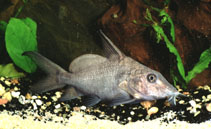 Synodontis membranaceus
Immagine di Hippocampus-Bildarchiv
Immagini | Google image
Immagine di Hippocampus-Bildarchiv
Classificazione / Nomi Nomi Comuni | Sinonimi | Catalog of Fishes(Genere, Specie) | ITIS | CoL | WoRMS | Cloffa
> Siluriformes (Catfishes) > Mochokidae (Squeakers or upside-down catfishes) > Mochokinae
Etymology: Synodontis: Greek, syn, symphysis = grown together + Greek, odous = teeth (Ref. 45335).
Etymology: Synodontis: Greek, syn, symphysis = grown together + Greek, odous = teeth (Ref. 45335).
Taxonomic Remarks
Reassigned to Synodontis based on a phylogenetic study by Vigliotta (2008: Ref. 79014). This species is placed in the genus Hemisynodontis in Eschmeyer (CofF ver. May 2011: Ref. 86870).
Ambiente: milieu / zona climatica / distribuzione batimetrica / gamma di distribuzione Ecologia
; acqua dolce benthopelagico; pH range: 6.8 - 7.2; dH range: ? - 25; potamodromo (Ref. 138143). Tropical; 22°C - 25°C (Ref. 2060); 35°N - 4°N
Distribuzione Territories | Aree FAO | Ecosistemi | Presenze | Mappa dei ritrovamenti | Introduzioni | Faunafri
Africa: Nile basin (Ref. 3202, 28714), Senegal, Gambia, Volta, Niger (including Benue) and Chad (Ref. 7362, 57223).
Lunghezza alla prima maturità / Dimensione / Peso / Età
Breve descrizione Chiavi di identificazione | Morfologia | Morfometria
Spine dorsali (totale) : 1; Spine anali: 0. Diagnosis: gill slits extending downwards beyond pelvic-fin insertions to the midline of isthmus; maxillary barbels not longer than head, lacking tubercles and ramifications, but with a broad, black membrane extending over their entire length; mandibular barbels with a broad black membrane; outer and inner mandibular barbels with few and simple ramifications, and membranous at tips; mandibular teeth short, numbering 8-16; pectoral-fin spines more strongly denticulate on inner than on outer margin; dorsal-fin spine smooth, except for weak serrations present on posterior margin in some specimens; humeral process deep, short, granular and not keeled ventrally; adipose fin high, long and contiguous to rayed dorsal fin (Ref. 57223).
Coloration: typically inverted colour, the back being uniformly whitish-grey and the belly black; fins greyish, without spots; maxillary and mandibular barbels (particularly the outer pair) bordered by a broad, black membrane (Ref. 57223).
Body shape (shape guide): fusiform / normal.
Body shape (shape guide): fusiform / normal.
Adults occur in deep water close to the shore. Omnivore, that feeds on plankton and detritus (Ref. 13868). May also feed on surface insects, chironomid larvae, benthic crustaceans, and mollusks (Ref. 28714). Oviparous (Ref. 205). Maximum size reported as 50.0cm (length type not given)(Ref. 31256).
Ciclo vitale e comportamento di accoppiamento Maturità | Riproduzione | Deposizione | Uova | Fecondità | Larve
Riferimento principale
Caricare le referenze | Bibliografia | Coordinatore | Collaboratori
Paugy, D. and T.R. Roberts, 2003. Mochokidae. p. 195-268 In C. Lévêque, D. Paugy and G.G. Teugels (eds.) Faune des poissons d'eaux douce et saumâtres de l'Afrique de l'Ouest, Tome 2. Coll. Faune et Flore tropicales 40. Musée Royal de l'Afrique Centrale, Tervuren, Belgique, Museum National d'Histoire Naturalle, Paris, France and Institut de Recherche pour le Développement, Paris, France. 815 p. (Ref. 57223)
Stato della Lista Rossa IUCN (Ref. 130435: Version 2025-2 (Global))
Least Concern (LC) ; Date assessed: 15 April 2020
CITES
Not Evaluated
Minaccia per l'uomo
Harmless
Usi umani
Pesca: commerciale
FAO - Publication: search | FishSource |
Informazioni ulteriori
Ecologia trofica
Articoli alimentari (prede)
Alimentazione
Consumo di cibo
Razioni alimentari
Predatori
Articoli alimentari (prede)
Alimentazione
Consumo di cibo
Razioni alimentari
Predatori
Dinamica della popolazione
Parametri di crescita
Età massima / dimensioni massime
Rapporto lunghezza-peso.
Lunghezza-lunghezza rel.
Lunghezza-frequenze
Conversione di massa
Reclutamento
Abbondanza
Parametri di crescita
Età massima / dimensioni massime
Rapporto lunghezza-peso.
Lunghezza-lunghezza rel.
Lunghezza-frequenze
Conversione di massa
Reclutamento
Abbondanza
Ciclo di vita
Riproduzione
Maturità
Maturità/Gli occhielli sono relativi.
Fecondità
Deposizione
Aggregazioni riproduttive
Uova
Sviluppo delle uova
Larve
Dinamica popolazioni larvali
Riproduzione
Maturità
Maturità/Gli occhielli sono relativi.
Fecondità
Deposizione
Aggregazioni riproduttive
Uova
Sviluppo delle uova
Larve
Dinamica popolazioni larvali
Anatomia
Area branchiale
Cervello
Otolite
Area branchiale
Cervello
Otolite
Fisiologia
Composizione corporea
Nutrienti
Consumo di ossigeno
Tipo di nuoto
Velocità di nuoto
Pigmenti visivi
Suono del pesce
Malattie e parassiti
Tossicità (LC50)
Composizione corporea
Nutrienti
Consumo di ossigeno
Tipo di nuoto
Velocità di nuoto
Pigmenti visivi
Suono del pesce
Malattie e parassiti
Tossicità (LC50)
Legato all'uomo
Sistemi di acquacoltura
Profili di acquacoltura
Varietà
Casi di Ciguatera
Francobolli, monete, materiale vario.
Sistemi di acquacoltura
Profili di acquacoltura
Varietà
Casi di Ciguatera
Francobolli, monete, materiale vario.
Strumenti
Quiz organico | Libro elettronico | Giuda pratica | Chiavi di identificazione | Generatore frequenze di lunghezza | Strumento Parametri Biologici | Mappa dei ritrovamenti |
Cattura-MSY |
Rapporti speciali
Controllo della manutenzione dell'acquario | Verificare la presenza di schede informative sulle specie | Verifica delle schede informative sull'acquacoltura
Scarica XML
Fonti Internet
AFORO (otoliths) | Aquatic Commons | BHL | Cloffa | Websites from users | Check FishWatcher | CISTI | Catalog of Fishes: Genere, Specie | DiscoverLife | ECOTOX | FAO - Publication: search | Faunafri | Fishipedia | Fishtrace | GloBI | Google Books | Google Scholar | Google | IGFA World Record | OneZoom | Open Tree of Life | Otolith Atlas of Taiwan Fishes | Acquari pubblici | PubMed | Reef Life Survey | Socotra Atlas | TreeBase | Tree of Life | Wikipedia: Go, ricerca | World Records Freshwater Fishing | Record zoologico
Stime basate su modelli
Indice di diversità filogenetica (Fonte Biblio. 82804): PD50 = 0.5000 [Uniqueness, from 0.5 = low to 2.0 = high].
Bayesian length-weight: a=0.01445 (0.00908 - 0.02301), b=2.93 (2.80 - 3.06), in cm total length, based on LWR estimates for this species & Genus-body shape (Ref. 93245).
Livello trofico (Fonte Biblio. 69278): 3.1 ±0.40 se; based on food items.
Resilienza (Fonte Biblio. 120179): Medio, tempo minimo di raddoppiamento della popolazione 1.4 - 4.4 anni (K=0.14-0.55).