This website uses cookies to enhance your browsing experience and ensure the functionality of our site. For more detailed information about the types of cookies we use and how we protect your privacy, please visit our Privacy Information page.
×
Cookie Settings
This website uses different types of cookies to enhance your experience. Please select your preferences below:
Elasmobranquios (tiburones y rayas) (sharks and rays) > Carcharhiniformes (Ground sharks) > Carcharhinidae (Requiem sharks)
Etymology: Negaprion:negatus (L.), to deny; prion (Gr.), saw, referring to lack of saw-like serrations on teeth cusps (See ETYFish); acutidens:acutus (L.), sharp or pointed; dens, from dentis (L.), tooth, probably referring to pyramid-like teeth (“dünnen spitzen Pyramiden”) (See ETYFish). More on author: Rüppell.
Entorno: milieu / zona climática / rango de profundidad / gama de distribución Ecología
marino; salobre asociado a arrecife; oceano-estuarine (Ref. 129182); rango de profundidad 0 - 92 m (Ref. 244). Tropical; 30°N - 32°S, 32°E - 140°W (Ref. 244)
Indo-Pacific: Red Sea and South Africa (including Mauritius, Seychelles, Madagascar) to Philippines, north to Viet Nam, south to Australia. Also from Palau, Marshall Islands, and Tahiti. Recorded from Taiwan (Ref. 4868).
Longitud en la primera madurez / Tamaño / Peso / Edad
Madurez: Lm230.0, range 220 - 240 cm Max length : 380 cm TL macho / no sexado; (Ref. 5213)
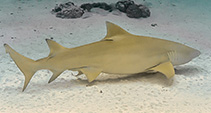
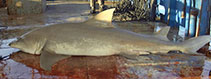
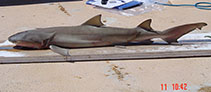
Espinas dorsales (total) : 0; Espinas anales: 0. A large, stocky, yellowish shark with a broad, blunt snout, narrow, smooth-cusped teeth in both jaws, and equal-sized dorsal fins (Ref. 5578). Yellowish brown above, paler below (Ref. 9997). With two nearly equally large dorsal fins (Ref. 37816). Body shape (shape guide): fusiform / normal.
Adults are found on continental and insular shelves and terraces (Ref. 244). And are common on coral reefs (Ref. 5578). Juveniles are confined to shallow inshore areas, with preference for sandy lagoons and turbid, mangrove swamps (Refs. 6871, 129182). Adults feed on smaller sharks, stingrays and on benthic bony fishes (Ref. 5578). Viviparous (Ref. 50449). Dangerous if provoked (Ref. 244). 1 to 11 of 45 cm young are born per litter (Ref. 1602). Meat is utilized fresh and dried salted for human consumption, fins for shark-fin soup base, and liver oil for vitamins (Ref. 244).
Viviparous, placental (Ref. 50449), 1-14 per litter (Ref. 6871). Gestation period 10-11 months (Ref. 5578; Ref.58048). Size at birth about 50 to 70 cm TL (Ref. 9997); 45-80 cm TL (Ref.58048). Distinct pairing with embrace (Ref. 205). Mating and pupping take place during late spring and early summer (Ref. 37816).
Compagno, L.J.V., 1984. FAO Species Catalogue. Vol. 4. Sharks of the world. An annotated and illustrated catalogue of shark species known to date. Part 2 - Carcharhiniformes. FAO Fish. Synop. 125(4/2):251-655. Rome: FAO. (Ref. 244)
Situación en la Lista Roja de la UICN (Ref. 130435: Version 2025-2 (Global))
Fisiología Composición corporal Nutrientes Consumo del oxígeno Tipo de natación Velocidad de natación Pigmentos visuales Sonido de peces Enfermedades y parásitos Toxicidad (CL50)