



Загрузить свой Фото и Видео
изображения | Изображение на Google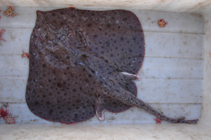 Rajella leopardus
Изображение сделано Le Noury, P.
изображения | Изображение на Google
Изображение сделано Le Noury, P.
Классификация / Имена народные названия | синонимы | Catalog of Fishes(род, виды) | ITIS | CoL | WoRMS | Cloffa
Пластиножаберные (акулы и скаты) (sharks and rays) > Rajiformes (Skates and rays) > Rajidae (Skates)
Etymology: Rajella: Latin, raja, -ae = a sting ray (Raja sp.) (Ref. 45335).
Etymology: Rajella: Latin, raja, -ae = a sting ray (Raja sp.) (Ref. 45335).
Taxonomic Remarks
Specific name amended to R. leoparda in accordance with ICZN Article 34.2 by Weigmann et al., 2014 (Ref.96993).
Окружающая среда: среда / климатическая зона / пределы глубины / диапазон распространения экология
морской батидемерсальный; пределы глубины 130 - 1920 m (Ref. 106604). Deep-water; - 36°S
распространение Территории | регионы FAO | Экосистемы | места находок | карта точек | интродукции | Faunafri
Eastern Atlantic: off eastern and western South Africa to off Mauritania
Размер / Вес / Возраст
Краткое описание определительные ключи | морфология | морфометрия
Large skate with a moderately long snout, small eyes, and a flat disc; tail about as long as body; small inconspicuous, light thorns on upper surface including snout (Ref. 5578). Medium grey to brownish dorsally, often with dark spots; white or mottled with dusky patches ventrally (Ref. 5578).
Body shape (shape guide): other.
Body shape (shape guide): other.
Found in deeper shelf and slope waters (Ref. 4426). Feed on bottom crustaceans, dragonets, rattails, hake, lanternfish, sea pens, cuttlefish and polychaete worms (Ref. 5578). Oviparous. Distinct pairing with embrace. Young may tend to follow large objects, such as their mother (Ref. 205). Eggs are oblong capsules with stiff pointed horns at the corners deposited in sandy or muddy flats (Ref. 205). Egg capsules are 7.4 cm long and 7.4 cm wide (Ref. 41249). Caught by hake trawlers (Ref. 5578).
Жизненный цикл и брачное поведение половая зрелость | размножение | нерест | икра | Плодовитость | личинки
Oviparous, paired eggs are laid. Embryos feed solely on yolk (Ref. 50449). Distinct pairing with embrace. Young may tend to follow large objects, such as their mother (Ref. 205).
Основная ссылка
Загрузите свои рекомендации | ссылки | координатор : McEachran, John | соавторы
McEachran, J.D. and K.A. Dunn, 1998. Phylogenetic analysis of skates, a morphologically conservative clade of elasmobranchs (Chondrichthyes: Rajidae). Copeia 1998(2):271-290. (Ref. 27314)
Статус Красного Списка МСОП (Ref. 130435: Version 2025-2 (Global))
Не вызывающий беспокойства (LC) ; Date assessed: 31 August 2020
CITES
Not Evaluated
Угроза для людей
Harmless
Использование человеком
рыболовство: коммерческий
FAO - Publication: search | FishSource |
дополнительная информация
Трофическая экология
Пищевые предметы (добыча)
состав пищи
потребление пищи
Продовольственные пайки
хищники
Пищевые предметы (добыча)
состав пищи
потребление пищи
Продовольственные пайки
хищники
Динамика численности населения
Параметры роста
Макс. возраст / размер
Отношение длины к весу.
Отношение длины к длине.
Размерный состав
Преобразование массы
пополнение
численность
Параметры роста
Макс. возраст / размер
Отношение длины к весу.
Отношение длины к длине.
Размерный состав
Преобразование массы
пополнение
численность
Жизненный цикл
размножение
половая зрелость
Зрелость/Жиры относительно.
Плодовитость
нерест
Нерестовые скопления
икра
Развитие икры
личинки
динамика численности личинок
размножение
половая зрелость
Зрелость/Жиры относительно.
Плодовитость
нерест
Нерестовые скопления
икра
Развитие икры
личинки
динамика численности личинок
Анатомия
жаберная область
Мозг
Отолит
жаберная область
Мозг
Отолит
Физиология
Состав тела
Питательные вещества
Потребление кислорода
Тип плавания
Скорость плавания
Зрительные пигменты
Звук рыбы
Болезни и паразиты
Токсичность (LC50s)
Состав тела
Питательные вещества
Потребление кислорода
Тип плавания
Скорость плавания
Зрительные пигменты
Звук рыбы
Болезни и паразиты
Токсичность (LC50s)
генетика
Геном
генетика
Гетерозиготность
наследуемость
Генетическое разнообразие
Геном
генетика
Гетерозиготность
наследуемость
Генетическое разнообразие
Связанные с человеком
Системы аквакультуры
особенности рыбоводства
степень растяжения
Случаи заболевания сигуатерой
Марки, монеты и прочее.
Системы аквакультуры
особенности рыбоводства
степень растяжения
Случаи заболевания сигуатерой
Марки, монеты и прочее.
инструменты
Специальные отчеты
Проверить содержание в аквариумах | Проверить опубликованные видовые данные | Проверить опубликованные данные по аквакультуре
Скачать в формате XML
ресурсы в Интернет
AFORO (otoliths) | Aquatic Commons | BHL | Cloffa | Websites from users | Проверить FishWatcher | CISTI | Catalog of Fishes: род, виды | DiscoverLife | ECOTOX | FAO - Publication: search | Faunafri | Fishipedia | Fishtrace | GloBI | Google Books | Google Scholar | Google | IGFA World Record | OneZoom | Open Tree of Life | Otolith Atlas of Taiwan Fishes | PubMed | Reef Life Survey | Socotra Atlas | TreeBase | Tree of Life | Wikipedia: Вперёд, поиск | World Records Freshwater Fishing | Зоологическая летопись
Оценки, основанные на моделях
Предпочтительная температура (ссылка 123201): 4.1 - 11.9, mean 6.9 °C (based on 47 cells).
Индекс филогенетического разнообразия (ссылка 82804): PD50 = 0.5000 [Uniqueness, from 0.5 = low to 2.0 = high].
Bayesian length-weight: a=0.00316 (0.00192 - 0.00522), b=3.32 (3.18 - 3.46), in cm total length, based on LWR estimates for this species & (Sub)family-body (Ref. 93245).
Трофический уровень (ссылка 69278): 3.9 ±0.63 se; based on food items.
устойчивость к внешним воздействиям (ссылка 120179): низкий, минимальное время удвоения популяции 4.5-14 лет (Fec assumed to be <100).
Питательные вещества (Ref. 124155): Calcium = 9.71 [1.80, 49.75] mg/100g; Iron = 0.404 [0.092, 1.262] mg/100g; Protein = 16.5 [13.7, 19.1] %; Omega3 = 0.644 [0.200, 2.420] g/100g; Selenium = 14.5 [3.8, 46.2] μg/100g; VitaminA = 13 [3, 56] μg/100g; Zinc = 0.299 [0.147, 0.566] mg/100g (wet weight);