



Envoyez vos Photos et vidéos
Images | Images Google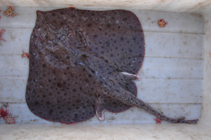 Rajella leopardus
Photo de Le Noury, P.
Images | Images Google
Photo de Le Noury, P.
Classification / Noms Noms communs | Synonymes | Catalog of Fishes(Genre, Espèce) | ITIS | CoL | WoRMS | Cloffa
Élasmobranches (requins et raies) (sharks and rays) > Rajiformes (Skates and rays) > Rajidae (Skates)
Etymology: Rajella: Latin, raja, -ae = a sting ray (Raja sp.) (Ref. 45335).
Etymology: Rajella: Latin, raja, -ae = a sting ray (Raja sp.) (Ref. 45335).
Taxonomic Remarks
Specific name amended to R. leoparda in accordance with ICZN Article 34.2 by Weigmann et al., 2014 (Ref.96993).
Environnement : milieu / zone climatique / profondeur / gamme de distribution Écologie
marin bathydémersal; profondeur 130 - 1920 m (Ref. 106604). Deep-water; - 36°S
Distribution Territoires | Zones FAO | Écosystèmes | Occurrences | Carte par point | Introductions | Faunafri
Eastern Atlantic: off eastern and western South Africa to off Mauritania
Taille / Poids / Âge
Description synthétique Clés d'identification | Morphologie | Morphométrie
Large skate with a moderately long snout, small eyes, and a flat disc; tail about as long as body; small inconspicuous, light thorns on upper surface including snout (Ref. 5578). Medium grey to brownish dorsally, often with dark spots; white or mottled with dusky patches ventrally (Ref. 5578).
Body shape (shape guide): other.
Body shape (shape guide): other.
Found in deeper shelf and slope waters (Ref. 4426). Feed on bottom crustaceans, dragonets, rattails, hake, lanternfish, sea pens, cuttlefish and polychaete worms (Ref. 5578). Oviparous. Distinct pairing with embrace. Young may tend to follow large objects, such as their mother (Ref. 205). Eggs are oblong capsules with stiff pointed horns at the corners deposited in sandy or muddy flats (Ref. 205). Egg capsules are 7.4 cm long and 7.4 cm wide (Ref. 41249). Caught by hake trawlers (Ref. 5578).
Cycle de vie et comportement reproducteur Maturité | Reproduction | Frai | Œufs | Fécondité | Larves
Oviparous, paired eggs are laid. Embryos feed solely on yolk (Ref. 50449). Distinct pairing with embrace. Young may tend to follow large objects, such as their mother (Ref. 205).
Référence principale
Téléchargez vos références | Références | Coordinateur : McEachran, John | Collaborateurs
McEachran, J.D. and K.A. Dunn, 1998. Phylogenetic analysis of skates, a morphologically conservative clade of elasmobranchs (Chondrichthyes: Rajidae). Copeia 1998(2):271-290. (Ref. 27314)
Statut dans la liste rouge de l'IUCN (Ref. 130435: Version 2025-2 (Global))
Préoccupation mineure (LC) ; Date assessed: 31 August 2020
CITES
Not Evaluated
Menace pour l'homme
Harmless
Utilisations par l'homme
Pêcheries: commercial
FAO - Publication: search | FishSource |
Plus d'informations
Écologie trophique
Aliments (proies)
Composition du régime alimentaire
Consommation alimentaire
Rations alimentaires
Prédateurs
Aliments (proies)
Composition du régime alimentaire
Consommation alimentaire
Rations alimentaires
Prédateurs
Dynamique des populations
Paramètres de croissance
Âges / tailles maximales
Longueur-poids rel.
Rel. longueur-longueur.
Fréquences de longueurs
Conversion de masse
Recrutement
Abondance
Paramètres de croissance
Âges / tailles maximales
Longueur-poids rel.
Rel. longueur-longueur.
Fréquences de longueurs
Conversion de masse
Recrutement
Abondance
Cycle de vie
Reproduction
Maturité
Maturité/épines rel.
Fécondité
Frai
Agrégats de frai
Œufs
Développement de l'œuf
Larves
Dynamique des populations larvaires
Reproduction
Maturité
Maturité/épines rel.
Fécondité
Frai
Agrégats de frai
Œufs
Développement de l'œuf
Larves
Dynamique des populations larvaires
Anatomie
Surface branchiale
Cerveau
Otolithe
Surface branchiale
Cerveau
Otolithe
Physiologie
Composition corporelle
Nutriments
Consommation d'oxygène
Type de natation
Vitesse de nage
Pigments visuels
Son de poisson
Maladies et parasites
Toxicité (CL50)
Composition corporelle
Nutriments
Consommation d'oxygène
Type de natation
Vitesse de nage
Pigments visuels
Son de poisson
Maladies et parasites
Toxicité (CL50)
Génétique
génôme
Génétique
Hétérozygotie
Héritabilité
Diversité génétique
génôme
Génétique
Hétérozygotie
Héritabilité
Diversité génétique
Liées à l'homme
Systèmes d'aquaculture
Profils d'aquaculture
Souches
Cas de ciguatera
Timbres, pièces de monnaie, divers
Systèmes d'aquaculture
Profils d'aquaculture
Souches
Cas de ciguatera
Timbres, pièces de monnaie, divers
Outils
E-book | Guide de terrain | Générateur de fréquences de longueur | Outil de dynamique de population | Carte par point |
Capture-MSY |
Articles particuliers
Télécharger en XML
Sources Internet
AFORO (otoliths) | Aquatic Commons | BHL | Cloffa | Websites from users | FishWatcher | CISTI | Catalog of Fishes: Genre, Espèce | DiscoverLife | ECOTOX | FAO - Publication: search | Faunafri | Fishipedia | Fishtrace | GloBI | Google Books | Google Scholar | Google | IGFA World Record | OneZoom | Open Tree of Life | Otolith Atlas of Taiwan Fishes | PubMed | Reef Life Survey | Socotra Atlas | TreeBase | Arbre de Vie | Wikipedia: aller à, chercher | World Records Freshwater Fishing | Zoological Record
Estimations basées sur des modèles
Température préférée (Réf. 123201): 4.1 - 11.9, mean 6.9 °C (based on 47 cells).
Indice de diversité phylogénétique (Réf. 82804): PD50 = 0.5000 [Uniqueness, from 0.5 = low to 2.0 = high].
Bayesian length-weight: a=0.00316 (0.00192 - 0.00522), b=3.32 (3.18 - 3.46), in cm total length, based on LWR estimates for this species & (Sub)family-body (Ref. 93245).
Niveau trophique (Réf. 69278): 3.9 ±0.63 se; based on food items.
Résilience (Réf. 120179): Faible, temps minimum de doublement de population : 4,5 à 14 années (Fec assumed to be <100).
Nutriments (Ref. 124155): Calcium = 9.71 [1.80, 49.75] mg/100g; Iron = 0.404 [0.092, 1.262] mg/100g; Protein = 16.5 [13.7, 19.1] %; Omega3 = 0.644 [0.200, 2.420] g/100g; Selenium = 14.5 [3.8, 46.2] μg/100g; VitaminA = 13 [3, 56] μg/100g; Zinc = 0.299 [0.147, 0.566] mg/100g (wet weight);