



Solea senegalensis Kaup, 1858
Senegalese sole
Beobachtung melden im Fish Watcher
| Native range | All suitable habitat | Point map | Year 2050 |

|
| This map was computer-generated and has not yet been reviewed. |
| Solea senegalensis AquaMaps Data sources: GBIF OBIS |
Hochladen Photos und videos
Bilder | Briefmarken, Münzen, Verschiedenes. | Google Bild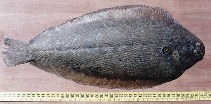 Solea senegalensis
Female Photo von Canosa, C. & B.F. Souto
Bilder | Briefmarken, Münzen, Verschiedenes. | Google Bild
Female Photo von Canosa, C. & B.F. Souto
Klassifizierung / Names Namen | Synonyme | Catalog of Fishes(Gattung, Arten) | ITIS | CoL | WoRMS | Cloffa
> Pleuronectiformes (Flatfishes) > Soleidae (Soles)
Etymology: Solea: Latin, solea = sandal (shoe); refered to the flat shape of the fish (Ref. 45335).
More on author: Kaup.
Etymology: Solea: Latin, solea = sandal (shoe); refered to the flat shape of the fish (Ref. 45335).
More on author: Kaup.
Umwelt: Milieu / Klimazone / Tiefenbereich / Verbreitungsgebiet Ökologie
seewasser demersal; tiefenbereich 12 - 100 m (Ref. 5304). Tropical; 47°N - 16°S, 19°W - 14°E
Verbreitung Territorien | FAO Gebiete | Ökosysteme | Vorkommen | Punkt Karte | Einführungen | Faunafri
Eastern Atlantic: Mainly Central Atlantic (from France to Angola). Western Mediterranean: Herculean migrant (entered the Mediterranean via Gibraltar) (Ref. 43448).
Größe / Gewicht / Alter
Geschlechtsreife: Lm ? range ? - ? cm
Max length : 60.0 cm SL Männchen/unbestimmt; (Ref. 5304); common length : 45.0 cm TL Männchen/unbestimmt; (Ref. 26999)
Max length : 60.0 cm SL Männchen/unbestimmt; (Ref. 5304); common length : 45.0 cm TL Männchen/unbestimmt; (Ref. 26999)
Kurzbeschreibung Bestimmungsschlüssel | Morphologie | Morphometrie
Rückenflossenstacheln (insgesamt) : 0; Rückenflossenweichstrahlen (insgesamt) : 72 - 95; Afterflossenstacheln: 0; Afterflossenweichstrahlen: 60 - 75; Wirbelzahl: 44 - 46. Last ray of dorsal and anal fins joined by a low membrane to the base of the caudal fin. Supratemporal branch of lateral line forming an arch. Anterior nostril on the blind side not enlarged, its diameter about half that of the eye; it is situated rather close to the front margin of head, the distance slightly greater than that separating the nostril from the mouth cleft, 1:1-1.4. Length of scales above nasal tube on ocular side much less than the length of the tube. Gill rakers like short knobs on first gill arch on ocular side. Pectoral fin on the ocular side with a black botch over the whole middle and distal part of the fin; blind side whitish (Ref. 32649).
Body shape (shape guide): short and / or deep.
Body shape (shape guide): short and / or deep.
Flatfish with oval and asymmetric body (eyes on the right side). Interradial membrane on the pectoral fin on the eye
side is of black colour(A). This feature distinguishes it from common sole (Solea soled), which has a big black compact spot on the posterior side of this fin. In the Atlantic, from the Gulf of Biscay to the coasts of Senegal. Less frequent in the Western Meditarranean.
A predominantly littoral species. Benthonic marine species living in sandy or muddy bottoms, off coastal areas up to
100 m depth and in brackish lakes.Feeds basically on benthonic invertebrate, such as larvae from polychaets and
bivalve molluscs. Also on small crustaceans.Sexual maturity is reached when size is 30 cm. Spawning happens beween the months of March until June. Maximum depth reported taken from Ref. 127989.
Lebenszyklus und Paarungsverhalten Geschlechtsreife | Fortpflanzung | Ablaichen | Eier | Fruchtbarkeit | Larven
Hauptreferenz
Laden Sie Ihre Referenzen hoch | Referenzen | Koordinator | Partner
Desoutter, M., 1990. Soleidae. p. 1037-1049. In J.C. Quero, J.C. Hureau, C. Karrer, A. Post and L. Saldanha (eds.) Check-list of the fishes of the eastern tropical Atlantic (CLOFETA). JNICT, Lisbon; SEI, Paris; and UNESCO, Paris. Vol. 2. (Ref. 5304)
IUCN Rote Liste Status (Ref. 130435: Version 2025-2 (Global))
Daten mangelhaft (DD) ; Date assessed: 15 July 2014
CITES
Not Evaluated
Bedrohung für Menschen
Harmless
Nutzung durch Menschen
Fischereien: kommerziell; Aquakultur: experimental
FAO - Aquakultur-Systeme: produktion; ; Publication: search | FishSource | Das Meer um uns herum
Mehr Information
Trophische Ökologie
Lebensmittel (Beutetiere)
Nahrungszusammensetzung
Nahrungsaufnahme
Lebensmittelrationen
Räuber
Lebensmittel (Beutetiere)
Nahrungszusammensetzung
Nahrungsaufnahme
Lebensmittelrationen
Räuber
Populationsdynamik
Wachstumsparameter
Max. Alter/Größen
Länge-Gewicht-Rel.
Länge-Länge-Verhältnis.
Längenhäufigkeiten
Massenkonvertierung
Rekrutierung
Dichte
Wachstumsparameter
Max. Alter/Größen
Länge-Gewicht-Rel.
Länge-Länge-Verhältnis.
Längenhäufigkeiten
Massenkonvertierung
Rekrutierung
Dichte
Lebenszyklus
Fortpflanzung
Geschlechtsreife
Reifung/Kiemen rel.
Fruchtbarkeit
Ablaichen
Laichaggregationen
Eier
Eientwicklung
Larven
Larven Pop.Dyn.
Fortpflanzung
Geschlechtsreife
Reifung/Kiemen rel.
Fruchtbarkeit
Ablaichen
Laichaggregationen
Eier
Eientwicklung
Larven
Larven Pop.Dyn.
Anatomie
Kiemenoberfläche
Gehirn
Otolith
Kiemenoberfläche
Gehirn
Otolith
Physiologie
Körperliche Zusammensetzung
Nährstoffe
Sauerstoffverbrauch
Schwimmart
Schwimmgeschwindigkeit
Visuelle Pigmente
Fischgeräusche
Krankheiten und Parasiten
Toxizität (LC50s)
Körperliche Zusammensetzung
Nährstoffe
Sauerstoffverbrauch
Schwimmart
Schwimmgeschwindigkeit
Visuelle Pigmente
Fischgeräusche
Krankheiten und Parasiten
Toxizität (LC50s)
Genetik
Genom
Genetik
Heterozygotie
Vererbbarkeit
Genetische Vielfalt
Genom
Genetik
Heterozygotie
Vererbbarkeit
Genetische Vielfalt
Menschenbezogen
Aquakultur-Systeme
Aquakultur Profile
Zuchtlinien
Ciguatera-Fälle
Briefmarken, Münzen, Verschiedenes.
Aquakultur-Systeme
Aquakultur Profile
Zuchtlinien
Ciguatera-Fälle
Briefmarken, Münzen, Verschiedenes.
Tools
Bio-Quiz | E-Book | Feldführer | Längenhäufigkeits Tool | Lebensdaten Tool | Punkt Karte |
Catch-MSY |
Zusatzinformationen
Download XML
Zusammenfassung | Punktdaten | Namen | Photos
Internet Quellen
AFORO (otoliths) | Alien/Invasive Species database | Aquatic Commons | BHL | Cloffa | Websites from users | FishWatcher Einträge suchen | CISTI | Catalog of Fishes: Gattung, Arten | DiscoverLife | ECOTOX | FAO - Aquakultur-Systeme: produktion; ; Publication: search | Faunafri | Fishipedia | Fishtrace | GloBI | Google Books | Google Scholar | Google | IGFA World Record | Nationale Datenbanken | OneZoom | Open Tree of Life | Otolith Atlas of Taiwan Fishes | Öffentliche Aquarien | PubMed | Reef Life Survey | Socotra Atlas | TreeBase | Tree of Life | Wikipedia: Gehe zu, Suchen | World Records Freshwater Fishing | Zoobank | Zoologischer Rekord
Schätzungen auf der Grundlage von Modellen
Bevorzugte Temperatur (Ref. 123201): 13.6 - 21.6, mean 18.6 °C (based on 46 cells).
Phylogenetischer Diversitätsindex (Ref. 82804): PD50 = 0.5020 [Uniqueness, from 0.5 = low to 2.0 = high].
Bayesian length-weight: a=0.00813 (0.00533 - 0.01241), b=3.06 (2.94 - 3.18), in cm total length, based on LWR estimates for this species & Genus-body shape (Ref. 93245).
Trophische Ebene (Ref. 69278): 3.3 ±0.45 se; based on food items.
Generation time: 6.2 ( na - na) years. Estimated as median ln(3)/K based on 2 growth studies.
Widerstandsfähigkeit (Ref. 120179): mittel, Verdopplung der Population dauert 1,4 - 4,4 Jahre. (Preliminary K or Fecundity.).
Nährstoffe (Ref. 124155): Calcium = 125 [47, 316] mg/100g; Iron = 0.902 [0.386, 1.792] mg/100g; Protein = 17.3 [15.4, 19.2] %; Omega3 = 0.124 [0.066, 0.233] g/100g; Selenium = 29.6 [10.7, 97.8] μg/100g; VitaminA = 11.9 [3.4, 40.5] μg/100g; Zinc = 0.654 [0.349, 1.413] mg/100g (wet weight); based on nutrient studies.