



Carcharhinus plumbeus (Nardo, 1827)
Sandbar shark
Adicionar sua observação em Fish Watcher
| Native range | All suitable habitat | Point map | Year 2050 |

|
| This map was computer-generated and has not yet been reviewed. |
| Carcharhinus plumbeus AquaMaps Data sources: GBIF OBIS |
Carregue seu(sua) Fotos e vídeos
Fotos | vídeos | Imagem do Google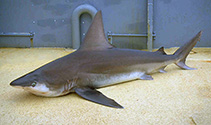 Carcharhinus plumbeus
Foto de McAuley, R.
Fotos | vídeos | Imagem do Google
Foto de McAuley, R.
Classificação / Nomes Nomes comuns | Sinônimos | Catalog of Fishes(Gênero, Espécies) | ITIS | CoL | WoRMS | Cloffa
Elasmobranchii (tubarões e raias) (sharks and rays) > Carcharhiniformes (Ground sharks) > Carcharhinidae (Requiem sharks)
Etymology: Carcharhinus: karcharos (Gr.), sharp or jagged; rhinus, an ancient name for sharks, from rhine (Gr.), rasp, both words alluding to a shark's jagged, rasp-like skin (See ETYFish); plumbeus: Latin for “of lead,” i.e., lead-colored, referring to its gray-brown coloration above (See ETYFish).
More on author: Nardo.
Etymology: Carcharhinus: karcharos (Gr.), sharp or jagged; rhinus, an ancient name for sharks, from rhine (Gr.), rasp, both words alluding to a shark's jagged, rasp-like skin (See ETYFish); plumbeus: Latin for “of lead,” i.e., lead-colored, referring to its gray-brown coloration above (See ETYFish).
More on author: Nardo.
Meio ambiente: milieu / Zona climática / intervalo de profundidade / faixa de distribuição Ecologia
marinhas; estuarina bentopelágico; oceanódromo (Ref. 51243); intervalo de profundidade 0 - 500 m (Ref. 100719), usually 20 - 65 m (Ref. 55188). Subtropical; 23°C - 27°C (Ref. 244); 45°N - 41°S, 98°W - 154°W (Ref. 55188)
Distribuição Territórios | Áreas da FAO | Ecossistemas | Ocorrências | Mapa de pontos | Introduções | Faunafri
Widespread in tropical and warm-temperate waters worldwide.
Comprimento de primeira maturação / Tamanho / Peso / Idade
Maturidade: Lm 166.3, range 126 - 183 cm
Max length : 300 cm TL macho/indeterminado; (Ref. 124786); common length : 200 cm TL macho/indeterminado; (Ref. 9987); peso máx. publicado: 117.9 kg (Ref. 4699); idade máx. registrada: 34 anos (Ref. 92315)
Max length : 300 cm TL macho/indeterminado; (Ref. 124786); common length : 200 cm TL macho/indeterminado; (Ref. 9987); peso máx. publicado: 117.9 kg (Ref. 4699); idade máx. registrada: 34 anos (Ref. 92315)
Descrição suscinta Chaves de identificação | Morfologia | Morfometria
Espinhos dorsais (total) : 0; Espinhos anais: 0. A stout shark with a moderately long, rounded snout, high, triangular, saw-edged upper teeth, and an interdorsal ridge; 1st dorsal fin very large and erect (Ref. 5578). Grey-brown or bronzy with no prominent markings, white below (Ref. 5578). Fins plain or with slightly dusky tips (Ref. 5485).
Body shape (shape guide): fusiform / normal.
Body shape (shape guide): fusiform / normal.
Found inshore and offshore, on continental and insular shelves and adjacent deep water (Ref. 244). Common at bays, river mouths and in harbors; avoids sandy beaches and the surf zone, coral reefs and rough bottom, and surface waters (Ref. 244). Coastal-pelagic, but usually bottom associated at 1-280 m (Ref. 58302). Sometimes in oceanic waters (Ref. 9997). Known to make extended seasonal migrations in some parts of its range (Ref. 6871). Feeds mainly on bony fishes, also small sharks, cephalopods, and shrimps (Ref. 5578), rays and gastropods (Ref. 5213). Youngs feed heavily on crustaceans such as blue crabd and mantis shrimp (Ref. 93252). Viviparous (Ref. 50449). Sexual dimorphism is evident in thickness of skin layer of maturing and adult females (Ref. 49562). Females live as long as 21 year; males 15 years (Ref. 27549). Populations are segregated by age. Young readily kept in aquaria (Ref. 244). Utilized for human consumption, for leather and oil (Ref. 244). Marketed fresh, smoked, dried-salted and frozen; fins are valued for soup (Ref. 9987). Used in Chinese medicine (Ref. 12166). Records to 300 cm TL uncertain (Ref. 9997). TL to 300 cm (Ref. 26938). Angling: an inshore fish and a good light-tackle fighter (Ref. 84357).
Ciclo de vida ou comportamento de acasalamento Maturidade | Reprodução | Desova | Ovos | Fecundidade | Larvas
Viviparous (Ref. 26281), placental (Ref. 50449), 1-14 pups in a litter; 56-75 cm at birth (Ref. 2334); gestation period of 12 months (Ref.58048). Distinct pairing with embrace (Ref. 205). Sexual dimorphism is evident in the thicker skin layer of maturing and adult females (Ref. 49562). This thickened skin may serve as protection from the 'bites' the female species receive from the males during precopulation and in the rugged conditions of the rock and coral environment where they live (Ref. 49562). Pups are born from Feb. to April in Northeastern Taiwan (Ref. 37027).
Referência principal
Carregar suas referências | Referências | Coordenador : Compagno, Leonard J.V. | Colaboradores
Compagno, L.J.V., 1984. FAO Species Catalogue. Vol. 4. Sharks of the world. An annotated and illustrated catalogue of shark species known to date. Part 2 - Carcharhiniformes. FAO Fish. Synop. 125(4/2):251-655. Rome: FAO. (Ref. 244)
Status na Lista Vermelha da UICN (Ref. 130435: Version 2025-2 (Global))
Em perigo (EN) (A2bd); Date assessed: 03 December 2020
Ameaça para os humanos
Harmless (Ref. 9997)
Uso pelos humanos
Pescarias: espécies comerciais; peixe esportivo: sim
FAO - pescarias: desembarques, perfil da espécie; Publication: search | FishSource | Sea Around Us
Mais informação
Ecologia Trófica
Itens alimentares (presas)
Composição da dieta
Consumo alimentar
Rações alimentares
Predadores
Itens alimentares (presas)
Composição da dieta
Consumo alimentar
Rações alimentares
Predadores
Dinâmica populacional
Parâmetros de crescimento
Idade máxima / tamanhos
Relação comprimento-peso.
Relação comprimento-comprimento.
Frequências de comprimento
Conversão de massa
Recrutamento
Abundância
Parâmetros de crescimento
Idade máxima / tamanhos
Relação comprimento-peso.
Relação comprimento-comprimento.
Frequências de comprimento
Conversão de massa
Recrutamento
Abundância
Ciclo de vida
Reprodução
Maturidade
Maturidade/Rel. das guelras
Fecundidade
Desova
Agregações de desova
Ovos
Desenvolvimento dos ovos
Larvas
Dinâmica larval
Reprodução
Maturidade
Maturidade/Rel. das guelras
Fecundidade
Desova
Agregações de desova
Ovos
Desenvolvimento dos ovos
Larvas
Dinâmica larval
Fisiologia
Composição corporal
Nutrientes
Consumo de oxigênio
Tipo de natação
Velocidade de natação
Pigmentos visuais
Som de peixe
Doenças e Parasitas
Toxicidade (LC50s)
Composição corporal
Nutrientes
Consumo de oxigênio
Tipo de natação
Velocidade de natação
Pigmentos visuais
Som de peixe
Doenças e Parasitas
Toxicidade (LC50s)
Relacionado a humanos
Sistemas de aquicultura
Perfis para aquacultura
Estirpes
Casos de Ciguatera
Selos, moedas, diversos.
Sistemas de aquicultura
Perfis para aquacultura
Estirpes
Casos de Ciguatera
Selos, moedas, diversos.
Ferramentas
Questionário orgânico | Livro eletrônico | Guia de campo | Chaves de identificação | Ferramenta auxiliar de frequências de comprimento | Ferramenta sobre a história de vida | Mapa de pontos |
Catch-MSY |
Relatórios especiais
Checar Manutenção em Aquário | Checar Planilhas de Fatos sobre as Espécies | Checar Planilhas de Fatos sobre Aquicultura
Baixar XML
Fontes da internet
AFORO (otoliths) | Aquatic Commons | BHL | Cloffa | Websites from users | Checar Observador de Peixes (FishWatcher) | CISTI | Catalog of Fishes: Gênero, Espécies | DiscoverLife | DORIS | ECOTOX | FAO - pescarias: desembarques, perfil da espécie; Publication: search | Faunafri | Fishipedia | Fishtrace | GloBI | GoMexSI (interaction data) | Google Books | Google Scholar | Google | IGFA World Record | Bases de dados nacionais | OneZoom | Open Tree of Life | Otolith Atlas of Taiwan Fishes | Aquários públicos | PubMed | Reef Life Survey | Socotra Atlas | TreeBase | Árvore da vida | Wikipedia: Ir para, procura | World Records Freshwater Fishing | Registro zoológico
Estimativas baseadas em modelos
Temperatura preferida (Ref. 123201): 16.6 - 28.9, mean 27 °C (based on 3224 cells).
Índice de diversidade filogenética (Ref. 82804): PD50 = 0.5000 [Uniqueness, from 0.5 = low to 2.0 = high].
Bayesian length-weight: a=0.00479 (0.00393 - 0.00582), b=3.07 (3.03 - 3.11), in cm total length, based on LWR estimates for this species (Ref. 93245).
Nível Trófico (Ref. 69278): 4.5 ±0.0 se; based on diet studies.
Resiliência (Ref. 120179): Baixo, tempo mínimo de duplicação da população 4,5 - 14 anos (rm=0.028; K=0.05-0.09; tm=12-16; tmax=34; Fec=5-12).
Prior r = 0.07, 95% CL = 0.05 - 0.10, Based on 1 full stock assessment.
Nutrientes (Ref. 124155): Calcium = 7.18 [1.02, 43.19] mg/100g; Iron = 0.476 [0.121, 1.485] mg/100g; Protein = 21.4 [18.5, 23.8] %; Omega3 = 0.302 [0.118, 0.686] g/100g; Selenium = 28.7 [8.8, 93.0] μg/100g; VitaminA = 19.2 [5.6, 67.9] μg/100g; Zinc = 0.54 [0.25, 1.03] mg/100g (wet weight);