



Protopterus dolloi Boulenger, 1900
Slender lungfish
Ladda upp din foton och Videor
Bilder | Google image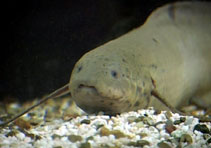 Protopterus dolloi
Bild av Bekins, R.
Bilder | Google image
Bild av Bekins, R.
Klassificering / Namn Populärnamn | synonymer | Catalog of Fishes(Släkte, Arter) | ITIS | CoL | WoRMS | Cloffa
> Ceratodontiformes (Australian lungfishes) > Protopteridae (African lungfishes)
Etymology: Protopterus: Greek, pro = first, in front of + Greek, pteron = wing, fin (Ref. 45335); dolloi: Named after Louis Dollo, for his work on the phylogeny of the lungfishes (Ref. 41613).
Eponymy: Dr Louis Antoine Marie Joséph Dollo (1857–1931) was a French-born Belgian palaeontologist, known for his work on fossil reptiles. [...] (Ref. 128868), visit book page.
More on author: Boulenger.
Etymology: Protopterus: Greek, pro = first, in front of + Greek, pteron = wing, fin (Ref. 45335); dolloi: Named after Louis Dollo, for his work on the phylogeny of the lungfishes (Ref. 41613).
Eponymy: Dr Louis Antoine Marie Joséph Dollo (1857–1931) was a French-born Belgian palaeontologist, known for his work on fossil reptiles. [...] (Ref. 128868), visit book page.
More on author: Boulenger.
Miljö: miljö / Klimatzon / djupintervall / distributionsområde Ekologi
; sötvatten bottenlevande. Tropical
Utbredning Territorier | FAO områden | Ekosystem | Förekomster | Prickkarta | Utplanteringar | Faunafri
Africa: widespread in the lower and middle Congo River basin (Ref. 3498, 40587, 81627, 104724). Also known from the Ogowe, Kouilou-Niari and Loeme rivers (Ref. 3498, 40587, 81627).
Storlek / Vikt / Ålder
Könsmognad: Lm ? range ? - ? cm
Max length : 130 cm TL hane/ej könsbestämd; (Ref. 3498); publicerad maxvikt: 11.0 kg (Ref. 41589)
Max length : 130 cm TL hane/ej könsbestämd; (Ref. 3498); publicerad maxvikt: 11.0 kg (Ref. 41589)
Kort beskrivning Bestämningsnycklar | Morfologi | Morfometri
Diagnosis: Body cylindrical and more elongate than in other Protopterus species (Ref. 81627). Pectoral and pelvic fins filamentous (Ref. 40587). About 85-95 scales on the longitudinal line between operculum and anus (Ref. 104724).
Body shape (shape guide): elongated; Cross section: circular.
Body shape (shape guide): elongated; Cross section: circular.
Obligate air-breathing (Ref. 126274); Protopterus dolloi is not aestivating in cocoons during the dry-season, because the habitat in which it lives is never completely dry (Ref. 81627); although it never lost the capability to aestivate (Ref. 40587). Therefore, the tunnel which it digs is not for hibernation but functions as a protected chamber during reproduction, which takes place in the dry season (Ref. 81627). The male guards the eggs and larvae in the nest, which is built in the mud of the swamps, while the females can be found in the open water of the rivers (Ref. 41587, 81627). The food of Protopterus dolloi are fishes and insects, but during the time of reproduction its food is more vegetarian (Ref. 40587, 46852).
Livscykel och parningsbeteende Könsmognad | Reproduktion | Lek | Ägg | Fekunditet | Larver
Nests are found from June until October; the male guards the eggs and young (Ref. 40587).
Huvudreferens
Ladda upp dina referenser | referenser | Koordinator | Medarbetare
Boden, G., 2007. Protopteridae. p. 165-167. In M.L.J. Stiassny, G.G. Teugels and C.D. Hopkins (eds.) The fresh and brackish water fishes of Lower Guinea, West-Central Africa. Volume I. Collection Faune et Flore tropicales 42. Institut de Recherche pour le Développement, Paris, France, Muséum National d’Histoire Naturelle, Paris, France, and Musée Royal de l’Afrique Centrale, Tervuren, Belgium. 800 pp. (Ref. 81627)
Status på IUCN:s rödlista (Ref. 130435: Version 2025-2 (Global))
Least Concern (LC) ; Date assessed: 16 February 2009
CITES
Not Evaluated
Hot mot människor
Harmless
Mänskliga användningsområden
Fiskeri: mindre kommeriell
FAO - Publication: search | FishSource |
Ytterligare information
Populationsdynamik
Tillväxtparametrar
Max. åldrar / storlekar
Längd-vikt rel.
Längd-längd rel.
Längd-frekvenser
Massakonvertering
Rekrytering
Abundans
Tillväxtparametrar
Max. åldrar / storlekar
Längd-vikt rel.
Längd-längd rel.
Längd-frekvenser
Massakonvertering
Rekrytering
Abundans
Livscykel
Reproduktion
Könsmognad
Mognad/Gills rel.
Fekunditet
Lek
Lekande aggregat
Ägg
Utveckling av ägg
Larver
Larvdynamik
Reproduktion
Könsmognad
Mognad/Gills rel.
Fekunditet
Lek
Lekande aggregat
Ägg
Utveckling av ägg
Larver
Larvdynamik
Anatomi
Gälyta
Hjärna
Otolit
Gälyta
Hjärna
Otolit
Fysiologi
Kroppssammansättning
Näringsämnen
Syreförbrukning
Typ av simning
Simhastighet
Visuella pigment
Ljud från fisk
Sjukdomar & Parasiter
Toxicitet (LC50)
Kroppssammansättning
Näringsämnen
Syreförbrukning
Typ av simning
Simhastighet
Visuella pigment
Ljud från fisk
Sjukdomar & Parasiter
Toxicitet (LC50)
Människorelaterad
Vattenbrukssystem
Vattenbruksprofiler
Avelslinjer
Ciguatera-fall
Frimärken, mynt, diverse.
Vattenbrukssystem
Vattenbruksprofiler
Avelslinjer
Ciguatera-fall
Frimärken, mynt, diverse.
Verktyg
Organisk frågesport | E-bok | Fälthandbok | Längdfördelnings-verktyg | Livshistorie-verktyg | Prickkarta |
Fångst-MSY |
Särskilda rapporter
Kontrollera för underhåll av akvarium | Kontrollera om det finns faktablad om arter | Kontrollera om det finns faktablad om vattenbruk
Ladda ner XML
Internet-källor
AFORO (otoliths) | Aquatic Commons | BHL | Cloffa | Websites from users | Check FishWatcher | CISTI | Catalog of Fishes: Släkte, Arter | DiscoverLife | ECOTOX | FAO - Publication: search | Faunafri | Fishipedia | Fishtrace | GloBI | Google Books | Google Scholar | Google | IGFA World Record | OneZoom | Open Tree of Life | Otolith Atlas of Taiwan Fishes | Offentliga akvarier | PubMed | Reef Life Survey | Socotra Atlas | TreeBase | Tree of Life | Wikipedia: Go, sök | World Records Freshwater Fishing | Zoobank | Zoologiskt register
Uppskattningar baserade på modeller
Index för fylogenetisk mångfald (Ref. 82804): PD50 = 0.6562 [Uniqueness, from 0.5 = low to 2.0 = high].
Bayesian length-weight: a=0.00380 (0.00151 - 0.00959), b=3.10 (2.88 - 3.32), in cm total length, based on LWR estimates for this (Sub)family-body shape (Ref. 93245).
Trofisk nivå (Ref. 69278): 3.2 ±0.40 se; based on food items.
Resiliens (Ref. 120179): Mycket låg, lägsta populationsfördubblingstid mer än 14 år (Assuming tmax > 30).
Näringsämnen (Ref. 124155): Calcium = 34.6 [7.9, 105.9] mg/100g; Iron = 0.98 [0.38, 4.94] mg/100g; Protein = 3.18 [0.00, 7.00] %; Omega3 = 0.247 [0.082, 0.731] g/100g; Selenium = 78.3 [23.7, 253.2] μg/100g; VitaminA = 18.9 [6.9, 48.5] μg/100g; Zinc = 1.29 [0.66, 2.50] mg/100g (wet weight);