



Protopterus dolloi Boulenger, 1900
Slender lungfish
Envoyez vos Photos et vidéos
Images | Images Google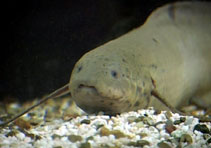 Protopterus dolloi
Photo de Bekins, R.
Images | Images Google
Photo de Bekins, R.
Classification / Noms Noms communs | Synonymes | Catalog of Fishes(Genre, Espèce) | ITIS | CoL | WoRMS | Cloffa
> Ceratodontiformes (Australian lungfishes) > Protopteridae (African lungfishes)
Etymology: Protopterus: Greek, pro = first, in front of + Greek, pteron = wing, fin (Ref. 45335); dolloi: Named after Louis Dollo, for his work on the phylogeny of the lungfishes (Ref. 41613).
Eponymy: Dr Louis Antoine Marie Joséph Dollo (1857–1931) was a French-born Belgian palaeontologist, known for his work on fossil reptiles. [...] (Ref. 128868), visit book page.
More on author: Boulenger.
Etymology: Protopterus: Greek, pro = first, in front of + Greek, pteron = wing, fin (Ref. 45335); dolloi: Named after Louis Dollo, for his work on the phylogeny of the lungfishes (Ref. 41613).
Eponymy: Dr Louis Antoine Marie Joséph Dollo (1857–1931) was a French-born Belgian palaeontologist, known for his work on fossil reptiles. [...] (Ref. 128868), visit book page.
More on author: Boulenger.
Environnement : milieu / zone climatique / profondeur / gamme de distribution Écologie
; eau douce démersal. Tropical
Distribution Territoires | Zones FAO | Écosystèmes | Occurrences | Carte par point | Introductions | Faunafri
Africa: widespread in the lower and middle Congo River basin (Ref. 3498, 40587, 81627, 104724). Also known from the Ogowe, Kouilou-Niari and Loeme rivers (Ref. 3498, 40587, 81627).
Taille / Poids / Âge
Maturité: Lm ? range ? - ? cm
Max length : 130 cm TL mâle / non sexé; (Ref. 3498); poids max. publié: 11.0 kg (Ref. 41589)
Max length : 130 cm TL mâle / non sexé; (Ref. 3498); poids max. publié: 11.0 kg (Ref. 41589)
Description synthétique Clés d'identification | Morphologie | Morphométrie
Diagnosis: Body cylindrical and more elongate than in other Protopterus species (Ref. 81627). Pectoral and pelvic fins filamentous (Ref. 40587). About 85-95 scales on the longitudinal line between operculum and anus (Ref. 104724).
Body shape (shape guide): elongated; Cross section: circular.
Body shape (shape guide): elongated; Cross section: circular.
Obligate air-breathing (Ref. 126274); Protopterus dolloi is not aestivating in cocoons during the dry-season, because the habitat in which it lives is never completely dry (Ref. 81627); although it never lost the capability to aestivate (Ref. 40587). Therefore, the tunnel which it digs is not for hibernation but functions as a protected chamber during reproduction, which takes place in the dry season (Ref. 81627). The male guards the eggs and larvae in the nest, which is built in the mud of the swamps, while the females can be found in the open water of the rivers (Ref. 41587, 81627). The food of Protopterus dolloi are fishes and insects, but during the time of reproduction its food is more vegetarian (Ref. 40587, 46852).
Cycle de vie et comportement reproducteur Maturité | Reproduction | Frai | Œufs | Fécondité | Larves
Nests are found from June until October; the male guards the eggs and young (Ref. 40587).
Référence principale
Téléchargez vos références | Références | Coordinateur | Collaborateurs
Boden, G., 2007. Protopteridae. p. 165-167. In M.L.J. Stiassny, G.G. Teugels and C.D. Hopkins (eds.) The fresh and brackish water fishes of Lower Guinea, West-Central Africa. Volume I. Collection Faune et Flore tropicales 42. Institut de Recherche pour le Développement, Paris, France, Muséum National d’Histoire Naturelle, Paris, France, and Musée Royal de l’Afrique Centrale, Tervuren, Belgium. 800 pp. (Ref. 81627)
Statut dans la liste rouge de l'IUCN (Ref. 130435: Version 2025-2 (Global))
Préoccupation mineure (LC) ; Date assessed: 16 February 2009
CITES
Not Evaluated
Menace pour l'homme
Harmless
Utilisations par l'homme
Pêcheries: intérêt commercial mineur
FAO - Publication: search | FishSource |
Plus d'informations
Écologie trophique
Aliments (proies)
Composition du régime alimentaire
Consommation alimentaire
Rations alimentaires
Prédateurs
Aliments (proies)
Composition du régime alimentaire
Consommation alimentaire
Rations alimentaires
Prédateurs
Dynamique des populations
Paramètres de croissance
Âges / tailles maximales
Longueur-poids rel.
Rel. longueur-longueur.
Fréquences de longueurs
Conversion de masse
Recrutement
Abondance
Paramètres de croissance
Âges / tailles maximales
Longueur-poids rel.
Rel. longueur-longueur.
Fréquences de longueurs
Conversion de masse
Recrutement
Abondance
Cycle de vie
Reproduction
Maturité
Maturité/épines rel.
Fécondité
Frai
Agrégats de frai
Œufs
Développement de l'œuf
Larves
Dynamique des populations larvaires
Reproduction
Maturité
Maturité/épines rel.
Fécondité
Frai
Agrégats de frai
Œufs
Développement de l'œuf
Larves
Dynamique des populations larvaires
Anatomie
Surface branchiale
Cerveau
Otolithe
Surface branchiale
Cerveau
Otolithe
Physiologie
Composition corporelle
Nutriments
Consommation d'oxygène
Type de natation
Vitesse de nage
Pigments visuels
Son de poisson
Maladies et parasites
Toxicité (CL50)
Composition corporelle
Nutriments
Consommation d'oxygène
Type de natation
Vitesse de nage
Pigments visuels
Son de poisson
Maladies et parasites
Toxicité (CL50)
Liées à l'homme
Systèmes d'aquaculture
Profils d'aquaculture
Souches
Cas de ciguatera
Timbres, pièces de monnaie, divers
Systèmes d'aquaculture
Profils d'aquaculture
Souches
Cas de ciguatera
Timbres, pièces de monnaie, divers
Outils
Quiz bio | E-book | Guide de terrain | Générateur de fréquences de longueur | Outil de dynamique de population | Carte par point |
Capture-MSY |
Articles particuliers
Télécharger en XML
Sources Internet
AFORO (otoliths) | Aquatic Commons | BHL | Cloffa | Websites from users | FishWatcher | CISTI | Catalog of Fishes: Genre, Espèce | DiscoverLife | ECOTOX | FAO - Publication: search | Faunafri | Fishipedia | Fishtrace | GloBI | Google Books | Google Scholar | Google | IGFA World Record | OneZoom | Open Tree of Life | Otolith Atlas of Taiwan Fishes | Aquariums publics | PubMed | Reef Life Survey | Socotra Atlas | TreeBase | Arbre de Vie | Wikipedia: aller à, chercher | World Records Freshwater Fishing | Zoobank | Zoological Record
Estimations basées sur des modèles
Indice de diversité phylogénétique (Réf. 82804): PD50 = 0.6562 [Uniqueness, from 0.5 = low to 2.0 = high].
Bayesian length-weight: a=0.00380 (0.00151 - 0.00959), b=3.10 (2.88 - 3.32), in cm total length, based on LWR estimates for this (Sub)family-body shape (Ref. 93245).
Niveau trophique (Réf. 69278): 3.2 ±0.40 se; based on food items.
Résilience (Réf. 120179): Très faible, temps minimum de doublement de population supérieur à 14 ans (Assuming tmax > 30).
Nutriments (Ref. 124155): Calcium = 34.6 [7.9, 105.9] mg/100g; Iron = 0.98 [0.38, 4.94] mg/100g; Protein = 3.18 [0.00, 7.00] %; Omega3 = 0.247 [0.082, 0.731] g/100g; Selenium = 78.3 [23.7, 253.2] μg/100g; VitaminA = 18.9 [6.9, 48.5] μg/100g; Zinc = 1.29 [0.66, 2.50] mg/100g (wet weight);