



Rhina ancylostomus Bloch & Schneider, 1801
Bowmouth guitarfish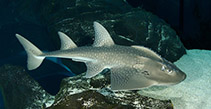
Klassifizierung / Names Namen | Synonyme | Catalog of Fishes(Gattung, Arten) | ITIS | CoL | WoRMS | Cloffa
Elasmobranchii (Haie und Rochen) (sharks and rays) > Rhinopristiformes (Shovelnose rays) > Rhinidae (Wedgefishes)
Etymology: Rhina: Greek, rhinos = nose (Ref. 45335).
More on authors: Bloch & Schneider.
Etymology: Rhina: Greek, rhinos = nose (Ref. 45335).
More on authors: Bloch & Schneider.
Taxonomic Remarks
Spelling following ECoF.
Umwelt: Milieu / Klimazone / Tiefenbereich / Verbreitungsgebiet Ökologie
seewasser riff-verbunden; tiefenbereich 3 - 90 m (Ref. 30573). Tropical; 42°N - 34°S, 30°E - 170°E (Ref. 114953)
Verbreitung Territorien | FAO Gebiete | Ökosysteme | Vorkommen | Punkt Karte | Einführungen | Faunafri
Indo-West Pacific, from South Africa (Natal coast), Mozambique, East Africa, Seychelles, the Red Sea, Arabia, Oman, the Persian Gulf, India, Sri Lanka, Malaysia, Indonesia (Borneo), Philippines, New Guinea, Thailand, Viet Nam, China, Taiwan Province of China, Korea, Japan, and Australia.
Länge bei der ersten Reifung / Größe / Gewicht / Alter
Geschlechtsreife: Lm 164.0, range 150 - 178 cm
Max length : 300 cm TL Männchen/unbestimmt; (Ref. 58784); max. veröff. Gewicht: 135.0 kg (Ref. 9987)
Max length : 300 cm TL Männchen/unbestimmt; (Ref. 58784); max. veröff. Gewicht: 135.0 kg (Ref. 9987)
Kurzbeschreibung Bestimmungsschlüssel | Morphologie | Morphometrie
An unmistakable guitarfish with a broad, rounded snout, large, high pectoral fins, and heavy ridges of spiky thorns over the eyes and on the back and shoulders; jaws with heavily ridged, crushing teeth in undulating rows (Ref. 5578). Grey or brownish above (Ref. 5578), white below; numerous white spots dorsally on fins, body and tail; black spots on head and shoulders but no eyespots or ocelli (Ref. 3919).
Body shape (shape guide): elongated.
Body shape (shape guide): elongated.
Inhabits coastal areas and offshore coral reefs, close inshore (Ref. 9915). Found on sand and mud bottoms (Ref. 12951). Sometimes found in the water column (Ref. 12951). Feeds on demersal bony fishes (e.g. croakers), crustaceans (crabs, prawns), bivalves, and cephalopods (Ref. 9915, 114953). Ovoviviparous (Ref. 50449). Produces litters of 2-11 pups (Ref. 114953). A row of large spines present above the eye, on the center of the nape, and on the shoulder have a defensive function (can be used for butting). Caught commonly by demersal tangle net, and occasionally trawl and longline fisheries (Ref.58048). Considered as to be a problem in trawls because it is very rough and spiky, difficult to handle and can be hazardous, thus they create a nuisance to trawl fishers as they are difficult to remove and their roughness can damage smaller species in the catch (Ref. 9915, 93660). Utilized fresh and dried-salted; the pectoral fins are the only part which is eaten (Ref. 9987).
Lebenszyklus und Paarungsverhalten Geschlechtsreife | Fortpflanzung | Ablaichen | Eier | Fruchtbarkeit | Larven
Exhibit ovoviparity (aplacental viviparity), with embryos feeding initially on yolk, then receiving additional nourishment from the mother by indirect absorption of uterine fluid enriched with mucus, fat or protein through specialised structures (Ref. 50449). With 4 in a litter (Ref. 12951). Size at birth 45 cm (Ref. 12951).
Hauptreferenz
Laden Sie Ihre Referenzen hoch | Referenzen | Koordinator | Partner
Compagno, L.J.V. and P.R. Last, 1999. Rhinidae (=Rhynchobatidae). Wedgefishes. p. 1418-1422. In K.E. Carpenter and V. Niem (eds.) FAO identification guide for fishery purposes. The Living Marine Resources of the Western Central Pacific. FAO, Rome. (Ref. 9915)
IUCN Rote Liste Status (Ref. 130435: Version 2025-2 (Global))
vom Aussterben bedroht (CR) (A2bd); Date assessed: 03 December 2018
Bedrohung für Menschen
Other (Ref. 637)
Nutzung durch Menschen
Fischereien: kommerziell
FAO - Publication: search | FishSource |
Mehr Information
Trophische Ökologie
Lebensmittel (Beutetiere)
Nahrungszusammensetzung
Nahrungsaufnahme
Lebensmittelrationen
Räuber
Lebensmittel (Beutetiere)
Nahrungszusammensetzung
Nahrungsaufnahme
Lebensmittelrationen
Räuber
Populationsdynamik
Wachstumsparameter
Max. Alter/Größen
Länge-Gewicht-Rel.
Länge-Länge-Verhältnis.
Längenhäufigkeiten
Massenkonvertierung
Rekrutierung
Dichte
Wachstumsparameter
Max. Alter/Größen
Länge-Gewicht-Rel.
Länge-Länge-Verhältnis.
Längenhäufigkeiten
Massenkonvertierung
Rekrutierung
Dichte
Lebenszyklus
Fortpflanzung
Geschlechtsreife
Reifung/Kiemen rel.
Fruchtbarkeit
Ablaichen
Laichaggregationen
Eier
Eientwicklung
Larven
Larven Pop.Dyn.
Fortpflanzung
Geschlechtsreife
Reifung/Kiemen rel.
Fruchtbarkeit
Ablaichen
Laichaggregationen
Eier
Eientwicklung
Larven
Larven Pop.Dyn.
Anatomie
Kiemenoberfläche
Gehirn
Otolith
Kiemenoberfläche
Gehirn
Otolith
Physiologie
Körperliche Zusammensetzung
Nährstoffe
Sauerstoffverbrauch
Schwimmart
Schwimmgeschwindigkeit
Visuelle Pigmente
Fischgeräusche
Krankheiten und Parasiten
Toxizität (LC50s)
Körperliche Zusammensetzung
Nährstoffe
Sauerstoffverbrauch
Schwimmart
Schwimmgeschwindigkeit
Visuelle Pigmente
Fischgeräusche
Krankheiten und Parasiten
Toxizität (LC50s)
Menschenbezogen
Aquakultur-Systeme
Aquakultur Profile
Zuchtlinien
Ciguatera-Fälle
Briefmarken, Münzen, Verschiedenes.
Aquakultur-Systeme
Aquakultur Profile
Zuchtlinien
Ciguatera-Fälle
Briefmarken, Münzen, Verschiedenes.
Tools
E-Book | Feldführer | Bestimmungsschlüssel | Längenhäufigkeits Tool | Lebensdaten Tool | Punkt Karte |
Catch-MSY |
Zusatzinformationen
Download XML
Zusammenfassung | Punktdaten | Namen | Photos
Internet Quellen
AFORO (otoliths) | Aquatic Commons | BHL | Cloffa | Websites from users | FishWatcher Einträge suchen | CISTI | Catalog of Fishes: Gattung, Arten | DiscoverLife | ECOTOX | FAO - Publication: search | Faunafri | Fishipedia | Fishtrace | GloBI | Google Books | Google Scholar | Google | IGFA World Record | Nationale Datenbanken | OneZoom | Open Tree of Life | Otolith Atlas of Taiwan Fishes | PubMed | Reef Life Survey | Socotra Atlas | TreeBase | Tree of Life | Wikipedia: Gehe zu, Suchen | World Records Freshwater Fishing | Zoobank | Zoologischer Rekord
Schätzungen auf der Grundlage von Modellen
Bevorzugte Temperatur (Ref. 123201): 24.4 - 29.1, mean 28.1 °C (based on 1422 cells).
Phylogenetischer Diversitätsindex (Ref. 82804): PD50 = 1.0005 [Uniqueness, from 0.5 = low to 2.0 = high].
Bayesian length-weight: a=0.00372 (0.00166 - 0.00830), b=3.11 (2.91 - 3.31), in cm total length, based on LWR estimates for this (Sub)family-body shape (Ref. 93245).
Trophische Ebene (Ref. 69278): 3.6 ±0.50 se; based on food items.
Widerstandsfähigkeit (Ref. 120179): sehr niedrig, Verdopplung der Population dauert mehr als 14 Jahre. (Fec=4).
Nährstoffe (Ref. 124155): Calcium = 6.66 [1.37, 27.05] mg/100g; Iron = 0.311 [0.072, 0.881] mg/100g; Protein = 19.5 [17.3, 21.6] %; Omega3 = 0.0694 [, ] g/100g; Selenium = 45.3 [13.9, 139.1] μg/100g; VitaminA = 26.1 [8.3, 82.9] μg/100g; Zinc = 0.722 [0.351, 1.434] mg/100g (wet weight);