



Carcharhinus falciformis (Bibron, 1839)
Silky shark
Beobachtung melden im Fish Watcher
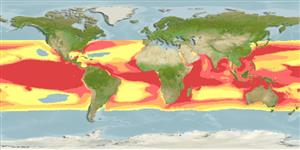
| Native range | All suitable habitat | Point map | Year 2050 |
|
| This map was computer-generated and has not yet been reviewed. |
| Carcharhinus falciformis AquaMaps Data sources: GBIF OBIS |
Hochladen Photos und videos
Bilder | videos | Google Bild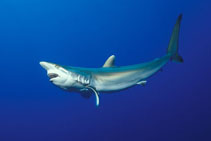 Carcharhinus falciformis
Photo von Furlan, B.
Bilder | videos | Google Bild
Photo von Furlan, B.
Klassifizierung / Names Namen | Synonyme | Catalog of Fishes(Gattung, Arten) | ITIS | CoL | WoRMS | Cloffa
Elasmobranchii (Haie und Rochen) (sharks and rays) > Carcharhiniformes (Ground sharks) > Carcharhinidae (Requiem sharks)
Etymology: Carcharhinus: karcharos (Gr.), sharp or jagged; rhinus, an ancient name for sharks, from rhine (Gr.), rasp, both words alluding to a shark's jagged, rasp-like skin (See ETYFish); falciformis: falx (L.), scythe or sickle; forma (L.), shape or form, referring to sickle-like shape of pectoral fins [authorship often attributed to Müller & Henle, who published Bibron’s description] (See ETYFish).
Etymology: Carcharhinus: karcharos (Gr.), sharp or jagged; rhinus, an ancient name for sharks, from rhine (Gr.), rasp, both words alluding to a shark's jagged, rasp-like skin (See ETYFish); falciformis: falx (L.), scythe or sickle; forma (L.), shape or form, referring to sickle-like shape of pectoral fins [authorship often attributed to Müller & Henle, who published Bibron’s description] (See ETYFish).
Umwelt: Milieu / Klimazone / Tiefenbereich / Verbreitungsgebiet Ökologie
seewasser riff-verbunden; ozeanodrom (Ref. 87829); tiefenbereich 0 - 4000 m (Ref. 55180), usually 0 - 500 m (Ref. 6871). Subtropical; 42°N - 43°S, 180°W - 180°E (Ref. 55180)
Verbreitung Territorien | FAO Gebiete | Ökosysteme | Vorkommen | Punkt Karte | Einführungen | Faunafri
Circumtropical. Western Atlantic: Massachusetts, USA to southern Brazil, including the Gulf of Mexico and the Caribbean Sea to Uruguay (Ref. 244, 58839). Eastern Atlantic: Spain, Madeira to northern Angola; St. Paul's Rocks (Ref. 13121); Cape Verde (Ref. 34514). Indo-Pacific: scattered records from the Red Sea and Natal, South Africa (Ref. 5578) to China, New Zealand, and the Caroline, Hawaiian, Phoenix and Line islands. Eastern Pacific: southern Baja California, Mexico to northern Chile. Highly migratory species.
Länge bei der ersten Reifung / Größe / Gewicht / Alter
Geschlechtsreife: Lm 219.1, range 180 - 260 cm
Max length : 350 cm TL Männchen/unbestimmt; (Ref. 9997); common length : 250 cm TL Männchen/unbestimmt; (Ref. 9997); max. veröff. Gewicht: 346.0 kg (Ref. 40637); max. veröff. Alter: 25 Jahre (Ref. 31395)
Max length : 350 cm TL Männchen/unbestimmt; (Ref. 9997); common length : 250 cm TL Männchen/unbestimmt; (Ref. 9997); max. veröff. Gewicht: 346.0 kg (Ref. 40637); max. veröff. Alter: 25 Jahre (Ref. 31395)
Kurzbeschreibung Bestimmungsschlüssel | Morphologie | Morphometrie
Rückenflossenstacheln (insgesamt) : 0; Afterflossenstacheln: 0. A large, slim shark with a moderately long, flat and rounded snout, large eyes, small jaws, and oblique-cusped teeth with serrations; 2nd dorsal fin low and with greatly elongated rear tip (Ref. 5578). Grey or bluish-grey above, white below; no conspicuous fin markings (Ref. 5578). Only Carcharhinus species with an interdorsal ridge that has the dorsal fin origin behind the free rear tip of the pectoral fin (Ref. 26938).
Body shape (shape guide): fusiform / normal.
Body shape (shape guide): fusiform / normal.
Found abundantly near the edge of continental and insular shelves, but also in the open sea and occasionally inshore (Ref. 244). Often found in deepwater reefs and near insular slopes (Ref. 244). Littoral and epipelagic, in the open sea or near the bottom at 18-500 m (Ref. 58302). It is quick-moving and aggressive (Ref. 244). Solitary (Ref. 26340); often associated with schools of tuna (Ref. 244). Feeds mainly on fishes, but also squid, paper nautiluses, and pelagic crabs (Ref. 244; 37816). Viviparous (Ref. 50449). Regarded as dangerous to humans (Ref. 9997). Flesh utilized fresh and dried-salted for human consumption; its hide for leather; its fin for shark-fin soup; its liver for oil (Ref. 244). 2 to 14 young, 73 to 87 cm, are born per litter (Ref. 1602).
Lebenszyklus und Paarungsverhalten Geschlechtsreife | Fortpflanzung | Ablaichen | Eier | Fruchtbarkeit | Larven
Viviparous, placental (Ref. 50449). 2-15 pups (Ref. 6871, 37816) born at 57-87 cm TL (Ref. 9997); 1-16 pups born at 55-72 cm TL. Females appear to breed every year, but there appears to be no reproductive seasonality (Ref. 58048). Distinct pairing with embrace (Ref. 205).
Hauptreferenz
Laden Sie Ihre Referenzen hoch | Referenzen | Koordinator : Compagno, Leonard J.V. | Partner
Compagno, L.J.V., 1984. FAO Species Catalogue. Vol. 4. Sharks of the world. An annotated and illustrated catalogue of shark species known to date. Part 2 - Carcharhiniformes. FAO Fish. Synop. 125(4/2):251-655. Rome: FAO. (Ref. 244)
IUCN Rote Liste Status (Ref. 130435: Version 2025-2 (Global))
Verwundbar (VU) (A2bd); Date assessed: 26 September 2017
Bedrohung für Menschen
Traumatogenic (Ref. 9997)
Nutzung durch Menschen
Fischereien: hoch kommerziell
FAO - Fischereien: landungen, Artbeschreibung; Publication: search | FishSource | Das Meer um uns herum
Mehr Information
Trophische Ökologie
Lebensmittel (Beutetiere)
Nahrungszusammensetzung
Nahrungsaufnahme
Lebensmittelrationen
Räuber
Lebensmittel (Beutetiere)
Nahrungszusammensetzung
Nahrungsaufnahme
Lebensmittelrationen
Räuber
Populationsdynamik
Wachstumsparameter
Max. Alter/Größen
Länge-Gewicht-Rel.
Länge-Länge-Verhältnis.
Längenhäufigkeiten
Massenkonvertierung
Rekrutierung
Dichte
Wachstumsparameter
Max. Alter/Größen
Länge-Gewicht-Rel.
Länge-Länge-Verhältnis.
Längenhäufigkeiten
Massenkonvertierung
Rekrutierung
Dichte
Lebenszyklus
Fortpflanzung
Geschlechtsreife
Reifung/Kiemen rel.
Fruchtbarkeit
Ablaichen
Laichaggregationen
Eier
Eientwicklung
Larven
Larven Pop.Dyn.
Fortpflanzung
Geschlechtsreife
Reifung/Kiemen rel.
Fruchtbarkeit
Ablaichen
Laichaggregationen
Eier
Eientwicklung
Larven
Larven Pop.Dyn.
Physiologie
Körperliche Zusammensetzung
Nährstoffe
Sauerstoffverbrauch
Schwimmart
Schwimmgeschwindigkeit
Visuelle Pigmente
Fischgeräusche
Krankheiten und Parasiten
Toxizität (LC50s)
Körperliche Zusammensetzung
Nährstoffe
Sauerstoffverbrauch
Schwimmart
Schwimmgeschwindigkeit
Visuelle Pigmente
Fischgeräusche
Krankheiten und Parasiten
Toxizität (LC50s)
Menschenbezogen
Aquakultur-Systeme
Aquakultur Profile
Zuchtlinien
Ciguatera-Fälle
Briefmarken, Münzen, Verschiedenes.
Aquakultur-Systeme
Aquakultur Profile
Zuchtlinien
Ciguatera-Fälle
Briefmarken, Münzen, Verschiedenes.
Tools
Bio-Quiz | E-Book | Feldführer | Bestimmungsschlüssel | Längenhäufigkeits Tool | Lebensdaten Tool | Punkt Karte |
Catch-MSY |
Zusatzinformationen
Download XML
Zusammenfassung | Punktdaten | Namen | Photos
Internet Quellen
AFORO (otoliths) | Alien/Invasive Species database | Aquatic Commons | BHL | Cloffa | Websites from users | FishWatcher Einträge suchen | CISTI | Catalog of Fishes: Gattung, Arten | DiscoverLife | ECOTOX | FAO - Fischereien: landungen, Artbeschreibung; Publication: search | Faunafri | Fishipedia | Fishtrace | GloBI | GoMexSI (interaction data) | Google Books | Google Scholar | Google | IGFA World Record | Nationale Datenbanken | OneZoom | Open Tree of Life | Otolith Atlas of Taiwan Fishes | PubMed | Reef Life Survey | Socotra Atlas | TreeBase | Tree of Life | Wikipedia: Gehe zu, Suchen | World Records Freshwater Fishing | Zoologischer Rekord
Schätzungen auf der Grundlage von Modellen
Bevorzugte Temperatur (Ref. 123201): 12 - 28.9, mean 26.7 °C (based on 8170 cells).
Phylogenetischer Diversitätsindex (Ref. 82804): PD50 = 0.5000 [Uniqueness, from 0.5 = low to 2.0 = high].
Bayesian length-weight: a=0.00501 (0.00408 - 0.00616), b=3.07 (3.03 - 3.11), in cm total length, based on LWR estimates for this species (Ref. 93245).
Trophische Ebene (Ref. 69278): 4.5 ±0.0 se; based on diet studies.
Generation time: 9.2 (7.4 - 13.1) years. Estimated as median ln(3)/K based on 14 growth studies.
Widerstandsfähigkeit (Ref. 120179): niedrig, Verdopplung der Population dauert 4,5 - 14 Jahre. (rm=0.054; K=0.05-0.15; tm=6-10; tmax=25; Fec=2-14).
Prior r = 0.06, 95% CL = 0.04 - 0.09, Based on 3 data-limited stock assessments.
Nährstoffe (Ref. 124155): Calcium = 2.41 [0.46, 12.84] mg/100g; Iron = 0.321 [0.080, 0.980] mg/100g; Protein = 22.8 [19.9, 25.0] %; Omega3 = 0.211 [0.078, 0.542] g/100g; Selenium = 34.5 [10.6, 105.0] μg/100g; VitaminA = 23 [7, 76] μg/100g; Zinc = 0.281 [0.138, 0.566] mg/100g (wet weight);