



Carcharhinus borneensis (Bleeker, 1858)
Borneo shark
Beobachtung melden im Fish Watcher
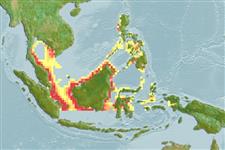
| Native range | All suitable habitat | Point map | Year 2050 |
|
| This map was computer-generated and has not yet been reviewed. |
| Carcharhinus borneensis AquaMaps Data sources: GBIF OBIS |
Hochladen Photos und videos
Bilder | Google Bild Carcharhinus borneensis
Photo von FAO
Bilder | Google Bild
Photo von FAO
Klassifizierung / Names Namen | Synonyme | Catalog of Fishes(Gattung, Arten) | ITIS | CoL | WoRMS | Cloffa
Elasmobranchii (Haie und Rochen) (sharks and rays) > Carcharhiniformes (Ground sharks) > Carcharhinidae (Requiem sharks)
Etymology: Carcharhinus: karcharos (Gr.), sharp or jagged; rhinus, an ancient name for sharks, from rhine (Gr.), rasp, both words alluding to a shark's jagged, rasp-like skin (See ETYFish); borneensis: -ensis, Latin suffix denoting place: Borneo, Indonesia, where type locality (off Singkawang, West Kalimantan) is situated (See ETYFish).
More on author: Bleeker.
Etymology: Carcharhinus: karcharos (Gr.), sharp or jagged; rhinus, an ancient name for sharks, from rhine (Gr.), rasp, both words alluding to a shark's jagged, rasp-like skin (See ETYFish); borneensis: -ensis, Latin suffix denoting place: Borneo, Indonesia, where type locality (off Singkawang, West Kalimantan) is situated (See ETYFish).
More on author: Bleeker.
Umwelt: Milieu / Klimazone / Tiefenbereich / Verbreitungsgebiet Ökologie
seewasser demersal. Tropical; 21°N - 4°S
Verbreitung Territorien | FAO Gebiete | Ökosysteme | Vorkommen | Punkt Karte | Einführungen | Faunafri
Western Pacific: Borneo and China. Questionably occurring in Java, Indonesia and the Philippines. Due to its very restricted and very small area of occurrence (Borneo), conservation measures are urgently needed (Ref. 84280).
Größe / Gewicht / Alter
Kurzbeschreibung Bestimmungsschlüssel | Morphologie | Morphometrie
This small species is characterized by the following: snout long and pointed; slender body and tail; alongside each mouth corner is a row of enlarged hyomandibular pores (5-12); upper anterior teeth finely serrated with a single narrow, oblique cusp; distal edge deeply notched and with several cusplets; lower anterior teeth with narrower, similarly oblique cusps; no lateral cusplets; total tooth row counts 23-26/23-25, or 46-50; second dorsal-fin origin well posterior of anal-fin origin, about opposite or just anterior to anal-fin midbase while second dorsal-fin
origin to anal-fin origin 2.2-4.1% TL, 0.4-0.9 times second dorsal-fin base; interdorsal space 20.7-22.7% TL; pelvic fins small, anterior margins 4.4-5.8% TL and 35-42% of pectoral anterior margin; first dorsal fin triangular, with nearly straight posterior margin, free rear tip about opposite pelvic-fin origins, length 14.5-17.6% TL, 1.8-2.4 times height, inner margin 1.9-2.8 in base; second dorsal fin much smaller than first and slightly smaller than anal fin, length 7.5-10.2% TL, base 2.0-3.1 times height; height 21-29% of first dorsal fin height; anal fin height 1.1-1.6 times second dorsal height, base 1.1-1.5 times second dorsal-fin base; total vertebral counts 117-121, monospondylous precaudal counts 33-36, diplospondylous precaudal counts 21-26, diplospondylous caudal counts 56-60, precaudal counts 57-63; colour slate-grey dorsally, whitish ventrally with waterline clearly demarcated along head and body, fins no distinct black markings, pectoral fins and lower caudal lobe with whitish margins (Ref. 84280).
Body shape (shape guide): fusiform / normal.
Body shape (shape guide): fusiform / normal.
A rare species found inshore in coastal areas (Ref. 244). Viviparous (Ref. 50449). Specimens range in length from 23.7-61.8 cm TL. Two specimens collected in the 1800s had fresh umbilical scars at 23.7 and 27.4 cm, indicating that the size at birth is close to these sizes; four specimens of 34.1-37.3 cm had well healed, but still obvious umbilical scars. Five males with lengths of 54.8-57.6 cm were found mature (additional material of mature males with lengths of 59.0-62.0 cm and several pregnant females with lengths of 61.0-65.0 cm). Litter size of pregnant females was 6 (Ref. 84280). Undoubtedly taken in local fisheries (Ref. 244).
Lebenszyklus und Paarungsverhalten Geschlechtsreife | Fortpflanzung | Ablaichen | Eier | Fruchtbarkeit | Larven
Hauptreferenz
Laden Sie Ihre Referenzen hoch | Referenzen | Koordinator : Compagno, Leonard J.V. | Partner
Compagno, L.J.V., 1984. FAO Species Catalogue. Vol. 4. Sharks of the world. An annotated and illustrated catalogue of shark species known to date. Part 2 - Carcharhiniformes. FAO Fish. Synop. 125(4/2):251-655. Rome: FAO. (Ref. 244)
IUCN Rote Liste Status (Ref. 130435: Version 2025-2 (Global))
vom Aussterben bedroht (CR) (A2cd); Date assessed: 31 October 2020
Bedrohung für Menschen
Harmless
Nutzung durch Menschen
Fischereien: kleinfischerei
FAO - Publication: search | FishSource |
Mehr Information
Trophische Ökologie
Lebensmittel (Beutetiere)
Nahrungszusammensetzung
Nahrungsaufnahme
Lebensmittelrationen
Räuber
Lebensmittel (Beutetiere)
Nahrungszusammensetzung
Nahrungsaufnahme
Lebensmittelrationen
Räuber
Ökologie
Ökologie
Ökologie
Populationsdynamik
Wachstumsparameter
Max. Alter/Größen
Länge-Gewicht-Rel.
Länge-Länge-Verhältnis.
Längenhäufigkeiten
Massenkonvertierung
Rekrutierung
Dichte
Wachstumsparameter
Max. Alter/Größen
Länge-Gewicht-Rel.
Länge-Länge-Verhältnis.
Längenhäufigkeiten
Massenkonvertierung
Rekrutierung
Dichte
Lebenszyklus
Fortpflanzung
Geschlechtsreife
Reifung/Kiemen rel.
Fruchtbarkeit
Ablaichen
Laichaggregationen
Eier
Eientwicklung
Larven
Larven Pop.Dyn.
Fortpflanzung
Geschlechtsreife
Reifung/Kiemen rel.
Fruchtbarkeit
Ablaichen
Laichaggregationen
Eier
Eientwicklung
Larven
Larven Pop.Dyn.
Anatomie
Kiemenoberfläche
Gehirn
Otolith
Kiemenoberfläche
Gehirn
Otolith
Physiologie
Körperliche Zusammensetzung
Nährstoffe
Sauerstoffverbrauch
Schwimmart
Schwimmgeschwindigkeit
Visuelle Pigmente
Fischgeräusche
Krankheiten und Parasiten
Toxizität (LC50s)
Körperliche Zusammensetzung
Nährstoffe
Sauerstoffverbrauch
Schwimmart
Schwimmgeschwindigkeit
Visuelle Pigmente
Fischgeräusche
Krankheiten und Parasiten
Toxizität (LC50s)
Genetik
Genom
Genetik
Heterozygotie
Vererbbarkeit
Genetische Vielfalt
Genom
Genetik
Heterozygotie
Vererbbarkeit
Genetische Vielfalt
Menschenbezogen
Aquakultur-Systeme
Aquakultur Profile
Zuchtlinien
Ciguatera-Fälle
Briefmarken, Münzen, Verschiedenes.
Aquakultur-Systeme
Aquakultur Profile
Zuchtlinien
Ciguatera-Fälle
Briefmarken, Münzen, Verschiedenes.
Tools
E-Book | Feldführer | Bestimmungsschlüssel | Längenhäufigkeits Tool | Lebensdaten Tool | Punkt Karte |
Catch-MSY |
Zusatzinformationen
Download XML
Zusammenfassung | Punktdaten | Namen | Photos
Internet Quellen
AFORO (otoliths) | Aquatic Commons | BHL | Cloffa | Websites from users | FishWatcher Einträge suchen | CISTI | Catalog of Fishes: Gattung, Arten | DiscoverLife | ECOTOX | FAO - Publication: search | Faunafri | Fishipedia | Fishtrace | GloBI | Google Books | Google Scholar | Google | IGFA World Record | OneZoom | Open Tree of Life | Otolith Atlas of Taiwan Fishes | PubMed | Reef Life Survey | Socotra Atlas | TreeBase | Tree of Life | Wikipedia: Gehe zu, Suchen | World Records Freshwater Fishing | Zoologischer Rekord
Schätzungen auf der Grundlage von Modellen
Bevorzugte Temperatur (Ref. 123201): 23.7 - 28.3, mean 27.5 °C (based on 219 cells).
Phylogenetischer Diversitätsindex (Ref. 82804): PD50 = 0.5000 [Uniqueness, from 0.5 = low to 2.0 = high].
Bayesian length-weight: a=0.00525 (0.00244 - 0.01130), b=3.07 (2.90 - 3.24), in cm total length, based on LWR estimates for this Genus-body shape (Ref. 93245).
Trophische Ebene (Ref. 69278): 3.9 ±0.6 se; based on size and trophs of closest relatives
Widerstandsfähigkeit (Ref. 120179): sehr niedrig, Verdopplung der Population dauert mehr als 14 Jahre. (Fec assumed to be <10).