



Carcharhinus borneensis (Bleeker, 1858)
Borneo shark
Ajouter votre observation dans Fish Watcher
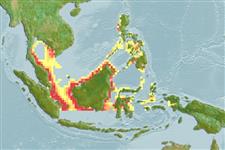
| Native range | All suitable habitat | Point map | Year 2050 |
|
| This map was computer-generated and has not yet been reviewed. |
| Carcharhinus borneensis AquaMaps Data sources: GBIF OBIS |
Envoyez vos Photos et vidéos
Images | Images Google Carcharhinus borneensis
Photo de FAO
Images | Images Google
Photo de FAO
Classification / Noms Noms communs | Synonymes | Catalog of Fishes(Genre, Espèce) | ITIS | CoL | WoRMS | Cloffa
Élasmobranches (requins et raies) (sharks and rays) > Carcharhiniformes (Ground sharks) > Carcharhinidae (Requiem sharks)
Etymology: Carcharhinus: karcharos (Gr.), sharp or jagged; rhinus, an ancient name for sharks, from rhine (Gr.), rasp, both words alluding to a shark's jagged, rasp-like skin (See ETYFish); borneensis: -ensis, Latin suffix denoting place: Borneo, Indonesia, where type locality (off Singkawang, West Kalimantan) is situated (See ETYFish).
More on author: Bleeker.
Etymology: Carcharhinus: karcharos (Gr.), sharp or jagged; rhinus, an ancient name for sharks, from rhine (Gr.), rasp, both words alluding to a shark's jagged, rasp-like skin (See ETYFish); borneensis: -ensis, Latin suffix denoting place: Borneo, Indonesia, where type locality (off Singkawang, West Kalimantan) is situated (See ETYFish).
More on author: Bleeker.
Environnement : milieu / zone climatique / profondeur / gamme de distribution Écologie
marin démersal. Tropical; 21°N - 4°S
Distribution Territoires | Zones FAO | Écosystèmes | Occurrences | Carte par point | Introductions | Faunafri
Western Pacific: Borneo and China. Questionably occurring in Java, Indonesia and the Philippines. Due to its very restricted and very small area of occurrence (Borneo), conservation measures are urgently needed (Ref. 84280).
Taille / Poids / Âge
Description synthétique Clés d'identification | Morphologie | Morphométrie
This small species is characterized by the following: snout long and pointed; slender body and tail; alongside each mouth corner is a row of enlarged hyomandibular pores (5-12); upper anterior teeth finely serrated with a single narrow, oblique cusp; distal edge deeply notched and with several cusplets; lower anterior teeth with narrower, similarly oblique cusps; no lateral cusplets; total tooth row counts 23-26/23-25, or 46-50; second dorsal-fin origin well posterior of anal-fin origin, about opposite or just anterior to anal-fin midbase while second dorsal-fin
origin to anal-fin origin 2.2-4.1% TL, 0.4-0.9 times second dorsal-fin base; interdorsal space 20.7-22.7% TL; pelvic fins small, anterior margins 4.4-5.8% TL and 35-42% of pectoral anterior margin; first dorsal fin triangular, with nearly straight posterior margin, free rear tip about opposite pelvic-fin origins, length 14.5-17.6% TL, 1.8-2.4 times height, inner margin 1.9-2.8 in base; second dorsal fin much smaller than first and slightly smaller than anal fin, length 7.5-10.2% TL, base 2.0-3.1 times height; height 21-29% of first dorsal fin height; anal fin height 1.1-1.6 times second dorsal height, base 1.1-1.5 times second dorsal-fin base; total vertebral counts 117-121, monospondylous precaudal counts 33-36, diplospondylous precaudal counts 21-26, diplospondylous caudal counts 56-60, precaudal counts 57-63; colour slate-grey dorsally, whitish ventrally with waterline clearly demarcated along head and body, fins no distinct black markings, pectoral fins and lower caudal lobe with whitish margins (Ref. 84280).
Body shape (shape guide): fusiform / normal.
Body shape (shape guide): fusiform / normal.
A rare species found inshore in coastal areas (Ref. 244). Viviparous (Ref. 50449). Specimens range in length from 23.7-61.8 cm TL. Two specimens collected in the 1800s had fresh umbilical scars at 23.7 and 27.4 cm, indicating that the size at birth is close to these sizes; four specimens of 34.1-37.3 cm had well healed, but still obvious umbilical scars. Five males with lengths of 54.8-57.6 cm were found mature (additional material of mature males with lengths of 59.0-62.0 cm and several pregnant females with lengths of 61.0-65.0 cm). Litter size of pregnant females was 6 (Ref. 84280). Undoubtedly taken in local fisheries (Ref. 244).
Cycle de vie et comportement reproducteur Maturité | Reproduction | Frai | Œufs | Fécondité | Larves
Référence principale
Téléchargez vos références | Références | Coordinateur : Compagno, Leonard J.V. | Collaborateurs
Compagno, L.J.V., 1984. FAO Species Catalogue. Vol. 4. Sharks of the world. An annotated and illustrated catalogue of shark species known to date. Part 2 - Carcharhiniformes. FAO Fish. Synop. 125(4/2):251-655. Rome: FAO. (Ref. 244)
Statut dans la liste rouge de l'IUCN (Ref. 130435: Version 2025-2 (Global))
Niveau de menace critique (CR) (A2cd); Date assessed: 31 October 2020
Menace pour l'homme
Harmless
Utilisations par l'homme
Pêcheries: pêcheries vivrières
FAO - Publication: search | FishSource |
Plus d'informations
Écologie trophique
Aliments (proies)
Composition du régime alimentaire
Consommation alimentaire
Rations alimentaires
Prédateurs
Aliments (proies)
Composition du régime alimentaire
Consommation alimentaire
Rations alimentaires
Prédateurs
Écologie
Écologie
Écologie
Dynamique des populations
Paramètres de croissance
Âges / tailles maximales
Longueur-poids rel.
Rel. longueur-longueur.
Fréquences de longueurs
Conversion de masse
Recrutement
Abondance
Paramètres de croissance
Âges / tailles maximales
Longueur-poids rel.
Rel. longueur-longueur.
Fréquences de longueurs
Conversion de masse
Recrutement
Abondance
Cycle de vie
Reproduction
Maturité
Maturité/épines rel.
Fécondité
Frai
Agrégats de frai
Œufs
Développement de l'œuf
Larves
Dynamique des populations larvaires
Reproduction
Maturité
Maturité/épines rel.
Fécondité
Frai
Agrégats de frai
Œufs
Développement de l'œuf
Larves
Dynamique des populations larvaires
Anatomie
Surface branchiale
Cerveau
Otolithe
Surface branchiale
Cerveau
Otolithe
Physiologie
Composition corporelle
Nutriments
Consommation d'oxygène
Type de natation
Vitesse de nage
Pigments visuels
Son de poisson
Maladies et parasites
Toxicité (CL50)
Composition corporelle
Nutriments
Consommation d'oxygène
Type de natation
Vitesse de nage
Pigments visuels
Son de poisson
Maladies et parasites
Toxicité (CL50)
Génétique
génôme
Génétique
Hétérozygotie
Héritabilité
Diversité génétique
génôme
Génétique
Hétérozygotie
Héritabilité
Diversité génétique
Liées à l'homme
Systèmes d'aquaculture
Profils d'aquaculture
Souches
Cas de ciguatera
Timbres, pièces de monnaie, divers
Systèmes d'aquaculture
Profils d'aquaculture
Souches
Cas de ciguatera
Timbres, pièces de monnaie, divers
Outils
E-book | Guide de terrain | Clés d'identification | Générateur de fréquences de longueur | Outil de dynamique de population | Carte par point |
Capture-MSY |
Articles particuliers
Télécharger en XML
Sources Internet
AFORO (otoliths) | Aquatic Commons | BHL | Cloffa | Websites from users | FishWatcher | CISTI | Catalog of Fishes: Genre, Espèce | DiscoverLife | ECOTOX | FAO - Publication: search | Faunafri | Fishipedia | Fishtrace | GloBI | Google Books | Google Scholar | Google | IGFA World Record | OneZoom | Open Tree of Life | Otolith Atlas of Taiwan Fishes | PubMed | Reef Life Survey | Socotra Atlas | TreeBase | Arbre de Vie | Wikipedia: aller à, chercher | World Records Freshwater Fishing | Zoological Record
Estimations basées sur des modèles
Température préférée (Réf. 123201): 23.7 - 28.3, mean 27.5 °C (based on 219 cells).
Indice de diversité phylogénétique (Réf. 82804): PD50 = 0.5000 [Uniqueness, from 0.5 = low to 2.0 = high].
Bayesian length-weight: a=0.00525 (0.00244 - 0.01130), b=3.07 (2.90 - 3.24), in cm total length, based on LWR estimates for this Genus-body shape (Ref. 93245).
Niveau trophique (Réf. 69278): 3.9 ±0.6 se; based on size and trophs of closest relatives
Résilience (Réf. 120179): Très faible, temps minimum de doublement de population supérieur à 14 ans (Fec assumed to be <10).