This website uses cookies to enhance your browsing experience and ensure the functionality of our site. For more detailed information about the types of cookies we use and how we protect your privacy, please visit our Privacy Information page.
×
Cookie Settings
This website uses different types of cookies to enhance your experience. Please select your preferences below:
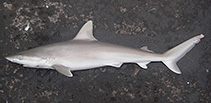
Elasmobranchii (tubarões e raias) (sharks and rays) > Carcharhiniformes (Ground sharks) > Carcharhinidae (Requiem sharks)
Etymology: Carcharhinus:karcharos (Gr.), sharp or jagged; rhinus, an ancient name for sharks, from rhine (Gr.), rasp, both words alluding to a shark's jagged, rasp-like skin (See ETYFish); acronotus:acro-, from akron (Gr.), top, summit or peak; notus, from notos (Gr.), back, allusion not explained, perhaps referring to “raised” (translation) back at first dorsal fin (See ETYFish). More on author: Poey.
Ambiente: milieu / zona climática / intervalo de profundidade / gama de distribuição Ecologia
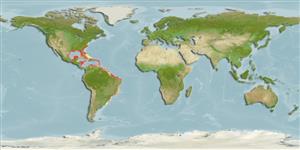
marinhas associadas(os) a recifes; intervalo de profundidade 9 - 64 m (Ref. 50072), usually 9 - ? m (Ref. 55176). Subtropical; 40°N - 37°S, 100°W - 33°W (Ref. 55176)
Western Atlantic: North Carolina, USA to southern Brazil and Uruguay (Ref. 58839), including the Gulf of Mexico and the Caribbean.
Comprimento na primeira maturidade / Tamanho / Peso / Idade
Maturidade: Lm110.7, range 87 - 137 cm Max length : 200 cm TL macho/indeterminado; (Ref. 244); peso máx. Publicado: 18.9 kg (Ref. 40637); Idade máx. registada: 20 anos (Ref. 108669)
Found on continental and insular shelves, mainly over sandy, shell, and coral bottoms. Feeds on small fishes, including pinfish (Sparidae) and porcupine fish. Preyed on by larger sharks. Viviparous (with a yolk-sac placenta), with 3 to 6 young per litter. Performs a 'hunch' display, with back arched, caudal lowered and head raised, as a possible threat display when confronted by divers. Utilized dried salted for human consumption. Minimum depth from Ref. 055176.
Compagno, L.J.V., 1984. FAO Species Catalogue. Vol. 4. Sharks of the world. An annotated and illustrated catalogue of shark species known to date. Part 2 - Carcharhiniformes. FAO Fish. Synop. 125(4/2):251-655. Rome: FAO. (Ref. 244)
Categoria na Lista Vermelha da IUCN (Ref. 130435: Version 2025-2 (Global))
Ciclo de vida Reprodução Maturidade Maturidade/Rel. das guelras Fecundidade Desova Agregações de desova Ovos Desenvolvimento dos ovos Larvas Dinâmica larvar
Fisiologia Composição corporal Nutrientes Consumo de oxigénio Tipo de natação Velocidade de natação Pigmentos visuais Som de peixe Doenças e Parasitas Toxicidade (LC50s)
Temperatura preferida (Ref. 123201): 22.2 - 28, mean 25.5 °C (based on 520 cells).
Índice de diversidade filogenética (Ref. 82804): PD50 = 0.5000 [Uniqueness, from 0.5 = low to 2.0 = high].
Bayesian length-weight: a=0.00525 (0.00244 - 0.01130), b=3.07 (2.90 - 3.24), in cm total length, based on LWR estimates for this Genus-body shape (Ref. 93245).
Nível Trófico (Ref. 69278): 4.4 ±0.5 se; based on diet studies.
Resiliência (Ref. 120179): Baixo, tempo mínimo de duplicação da população 4,5 - 14 anos (K=0.12; tm=3; tmax=15; Fec=4).
Prior r = 0.44, 95% CL = 0.29 - 0.66, Based on 1 full stock assessment.
Vulnerabilidade da pesca (Ref. 59153): High vulnerability (60 of 100). 🛈