



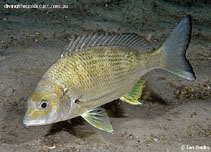
Acanthopagrus australis (Günther, 1859)
Yellowfin bream
Beobachtung melden im Fish Watcher
| Native range | All suitable habitat | Point map | Year 2050 |

|
| This map was computer-generated and has not yet been reviewed. |
| Acanthopagrus australis AquaMaps Data sources: GBIF OBIS |
Klassifizierung / Names Namen | Synonyme | Catalog of Fishes(Gattung, Arten) | ITIS | CoL | WoRMS | Cloffa
> Eupercaria/misc (Various families in series Eupercaria) > Sparidae (Porgies)
Etymology: Acanthopagrus: Greek, akantha = thorn + Greek, pagros, a kind of fish (Ref. 45335).
More on author: Günther.
Etymology: Acanthopagrus: Greek, akantha = thorn + Greek, pagros, a kind of fish (Ref. 45335).
More on author: Günther.
Umwelt: Milieu / Klimazone / Tiefenbereich / Verbreitungsgebiet Ökologie
seewasser; brackwasser demersal; ozeanodrom. Temperate; 19°S - 38°S
Verbreitung Territorien | FAO Gebiete | Ökosysteme | Vorkommen | Punkt Karte | Einführungen | Faunafri
Southwest Pacific: endemic to eastern Australia, from Townsville in Queensland to the Gippsland Lakes in Victoria (Ref. 75154). Occurrence in Japan and Ryukyu Islands (Ref. 559) and Taiwan (Ref. 5193) need verification.
Länge bei der ersten Reifung / Größe / Gewicht / Alter
Geschlechtsreife: Lm ?, range 24 - ? cm
Max length : 66.0 cm SL Männchen/unbestimmt; (Ref. 44894); max. veröff. Gewicht: 4.5 kg (Ref. 6390); max. veröff. Alter: 14 Jahre (Ref. 56606)
Max length : 66.0 cm SL Männchen/unbestimmt; (Ref. 44894); max. veröff. Gewicht: 4.5 kg (Ref. 6390); max. veröff. Alter: 14 Jahre (Ref. 56606)
Inhabitant estuaries, coastal rivers, creeks, lakes and bays, usually in marine or brackish water, but in dry seasons they penetrate the lowermost reaches of fresh water (Ref. 44894). Common in coastal and estuarine rocky habitat. They enter rivers upstream to the limit of brackish waters. They migrate from their feeding to their spawning grounds; they spawn mainly during winter in the vicinity of river entrances; eggs are planktonic and hatch after 2.5 days. A portion of the population changes sex from male to female after spawning. They feed on mollusks, crustaceans, worms, fish and ascidians. It is parasitised by the monogeneans Anoplodiscus australis and A. spari on the fins and body surface (Ref. 124057).
Lebenszyklus und Paarungsverhalten Geschlechtsreife | Fortpflanzung | Ablaichen | Eier | Fruchtbarkeit | Larven
A proportion of the population change sex from male to female after their first spawning season (Ref. 6390). Other fish remain functional males throughout their life and another small proportion develop directly into females at the age of 4 years (Ref. 27246, 28262). Also Ref. 28504.
The eggs and larvae are planktonic (Ref. 30572). After about four weeks the developed fry enter the estuary at night on the full moon and settle in estuarine littoral areas at about 1.4 cm in length (Ref. 30572). The fry rapidly develop into juveniles and grow to about 10 cm after one year (Ref. 30572).
Hauptreferenz
Laden Sie Ihre Referenzen hoch | Referenzen | Koordinator | Partner
Kailola, P.J., M.J. Williams, P.C. Stewart, R.E. Reichelt, A. McNee and C. Grieve, 1993. Australian fisheries resources. Bureau of Resource Sciences, Canberra, Australia. 422 p. (Ref. 6390)
IUCN Rote Liste Status (Ref. 130435: Version 2025-2 (Global))
nicht bedroht (LC) ; Date assessed: 04 December 2009
CITES
Not Evaluated
Bedrohung für Menschen
Harmless
Nutzung durch Menschen
Fischereien: kommerziell; Aquakultur: kommerziell; Sportfisch: ja
FAO - Publication: search | FishSource |
Mehr Information
Trophische Ökologie
Lebensmittel (Beutetiere)
Nahrungszusammensetzung
Nahrungsaufnahme
Lebensmittelrationen
Räuber
Lebensmittel (Beutetiere)
Nahrungszusammensetzung
Nahrungsaufnahme
Lebensmittelrationen
Räuber
Populationsdynamik
Wachstumsparameter
Max. Alter/Größen
Länge-Gewicht-Rel.
Länge-Länge-Verhältnis.
Längenhäufigkeiten
Massenkonvertierung
Rekrutierung
Dichte
Wachstumsparameter
Max. Alter/Größen
Länge-Gewicht-Rel.
Länge-Länge-Verhältnis.
Längenhäufigkeiten
Massenkonvertierung
Rekrutierung
Dichte
Lebenszyklus
Fortpflanzung
Geschlechtsreife
Reifung/Kiemen rel.
Fruchtbarkeit
Ablaichen
Laichaggregationen
Eier
Eientwicklung
Larven
Larven Pop.Dyn.
Fortpflanzung
Geschlechtsreife
Reifung/Kiemen rel.
Fruchtbarkeit
Ablaichen
Laichaggregationen
Eier
Eientwicklung
Larven
Larven Pop.Dyn.
Anatomie
Kiemenoberfläche
Gehirn
Otolith
Kiemenoberfläche
Gehirn
Otolith
Physiologie
Körperliche Zusammensetzung
Nährstoffe
Sauerstoffverbrauch
Schwimmart
Schwimmgeschwindigkeit
Visuelle Pigmente
Fischgeräusche
Krankheiten und Parasiten
Toxizität (LC50s)
Körperliche Zusammensetzung
Nährstoffe
Sauerstoffverbrauch
Schwimmart
Schwimmgeschwindigkeit
Visuelle Pigmente
Fischgeräusche
Krankheiten und Parasiten
Toxizität (LC50s)
Genetik
Genom
Genetik
Heterozygotie
Vererbbarkeit
Genetische Vielfalt
Genom
Genetik
Heterozygotie
Vererbbarkeit
Genetische Vielfalt
Menschenbezogen
Aquakultur-Systeme
Aquakultur Profile
Zuchtlinien
Ciguatera-Fälle
Briefmarken, Münzen, Verschiedenes.
Aquakultur-Systeme
Aquakultur Profile
Zuchtlinien
Ciguatera-Fälle
Briefmarken, Münzen, Verschiedenes.
Tools
E-Book | Feldführer | Bestimmungsschlüssel | Längenhäufigkeits Tool | Lebensdaten Tool | Punkt Karte |
Catch-MSY |
Zusatzinformationen
Download XML
Zusammenfassung | Punktdaten | Namen | Photos
Internet Quellen
AFORO (otoliths) | Aquatic Commons | BHL | Cloffa | Websites from users | FishWatcher Einträge suchen | CISTI | Catalog of Fishes: Gattung, Arten | DiscoverLife | ECOTOX | FAO - Publication: search | Faunafri | Fishipedia | Fishtrace | GloBI | Google Books | Google Scholar | Google | IGFA World Record | Nationale Datenbanken | OneZoom | Open Tree of Life | Otolith Atlas of Taiwan Fishes | PubMed | Reef Life Survey | Socotra Atlas | TreeBase | Tree of Life | Wikipedia: Gehe zu, Suchen | World Records Freshwater Fishing | Zoologischer Rekord
Schätzungen auf der Grundlage von Modellen
Bevorzugte Temperatur (Ref. 123201): 20.2 - 26.1, mean 24.7 °C (based on 68 cells).
Phylogenetischer Diversitätsindex (Ref. 82804): PD50 = 0.5000 [Uniqueness, from 0.5 = low to 2.0 = high].
Bayesian length-weight: a=0.01259 (0.00603 - 0.02627), b=3.03 (2.86 - 3.20), in cm total length, based on LWR estimates for this (Sub)family-body shape (Ref. 93245).
Trophische Ebene (Ref. 69278): 3.1 ±0.40 se; based on food items.
Widerstandsfähigkeit (Ref. 120179): niedrig, Verdopplung der Population dauert 4,5 - 14 Jahre. (tm=3-4; tmax=14; Fec=300,000).
Nährstoffe (Ref. 124155): Calcium = 35.9 [17.6, 68.9] mg/100g; Iron = 0.358 [0.201, 0.691] mg/100g; Protein = 19.4 [18.3, 20.5] %; Omega3 = 0.57 [0.34, 0.97] g/100g; Selenium = 10.5 [5.1, 20.6] μg/100g; VitaminA = 10.2 [3.0, 30.3] μg/100g; Zinc = 0.67 [0.47, 0.95] mg/100g (wet weight);