This website uses cookies to enhance your browsing experience and ensure the functionality of our site. For more detailed information about the types of cookies we use and how we protect your privacy, please visit our Privacy Information page.
×
Cookie Settings
This website uses different types of cookies to enhance your experience. Please select your preferences below:
> Eupercaria/misc (Various families in series Eupercaria) > Priacanthidae (Bigeyes or catalufas)
Etymology: Pristigenys:Greek, pristis = saw + Greek, genys, -yos = face (Ref. 45335). More on author: Cuvier.
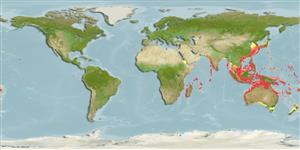
Umwelt: Milieu / Klimazone / Tiefenbereich / Verbreitungsgebiet Ökologie
seewasser riff-verbunden; tiefenbereich 1 - 250 m (Ref. 100719), usually 5 - 30 m (Ref. 94109). Tropical
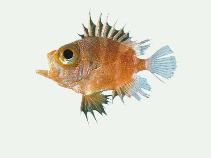
Rückenflossenstacheln (insgesamt) : 10; Rückenflossenweichstrahlen (insgesamt) : 11; Afterflossenstacheln: 3; Afterflossenweichstrahlen: 10; Wirbelzahl: 23. This species is distinguished from its congeners by the following set of characters: D X,11; A III,10; total gill rakers on first arch 27-31, mode 27 (upper limb 7-10, lower 19-22); lateral-line scales 31-39, mode 35; body scales above pectoral fin with about 11-60 spinules on posterior margin, the number increasing with growth; generally rounded caudal fin in young, becoming somewhat double emarginate in adults (noticeable in specimens over 15.0 cm SL); absence of black margins on posterior soft portions of vertical fins; 5 white or pale vertical bands (often indistinct) on body about 1/2-3/5 width of pupil expanded ventrally and dorsally with latter angled posterodorsally, very notable in young, less obvious in adults (Ref. 94109). Body shape (shape guide): short and / or deep; Cross section: compressed.
Associated with rocky habitats and known from 80 to more than 100 m depth but probably also occurring in shallower water, especially as juveniles (Ref.5403). From dive observations, juveniles and young individuals likely occur at 5-30 m depths (Ref. 94109). Eggs are pelagic (0.75 mm), small and spherical.
Iwatsuki, Y., T. Matsuda, W.C. Starnes, T. Nakabo and T. Yoshino, 2012. A valid priacanthid species, Pristigenys refulgens (Valenciennes 1862), and a redescription of P. niphonia (Cuvier in Cuvier & Valenciennes 1829) in the Indo-West Pacific (Perciformes: Priacanthidae). Zootaxa 3206:41-57. (Ref. 94109)
IUCN Rote Liste Status (Ref. 130435: Version 2025-2 (Global))
Bevorzugte Temperatur (Ref. 123201): 20.8 - 28.9, mean 27.6 °C (based on 972 cells).
Phylogenetischer Diversitätsindex (Ref. 82804): PD50 = 0.5312 [Uniqueness, from 0.5 = low to 2.0 = high].
Bayesian length-weight: a=0.02239 (0.00941 - 0.05325), b=2.93 (2.72 - 3.14), in cm total length, based on LWR estimates for this (Sub)family-body shape (Ref. 93245).
Trophische Ebene (Ref. 69278): 3.9 ±0.5 se; based on size and trophs of closest relatives
Widerstandsfähigkeit (Ref. 120179): hoch, Verdopplung der Population dauert weniger als 15 Monate. (Preliminary K or Fecundity.).
Anfälligkeit der Fischerei (Ref. 59153): Low vulnerability (23 of 100). 🛈