



Rostroraja alba (Lacepède, 1803)
White skate
Beobachtung melden im Fish Watcher
| Native range | All suitable habitat | Point map | Year 2050 |

|
| This map was computer-generated and has not yet been reviewed. |
| Rostroraja alba AquaMaps Data sources: GBIF OBIS |
Hochladen Photos und videos
Bilder | Google Bild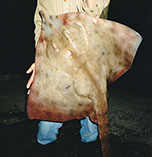 Rostroraja alba
Photo von Østergaard, T.
Bilder | Google Bild
Photo von Østergaard, T.
Klassifizierung / Names Namen | Synonyme | Catalog of Fishes(Gattung, Arten) | ITIS | CoL | WoRMS | Cloffa
Elasmobranchii (Haie und Rochen) (sharks and rays) > Rajiformes (Skates and rays) > Rajidae (Skates)
Etymology: Rostroraja: Latin, rostrum = beak + Latin, raja, -ae = a sting ray (Ref. 45335).
More on author: Lacepède.
Etymology: Rostroraja: Latin, rostrum = beak + Latin, raja, -ae = a sting ray (Ref. 45335).
More on author: Lacepède.
Umwelt: Milieu / Klimazone / Tiefenbereich / Verbreitungsgebiet Ökologie
seewasser demersal; tiefenbereich 30 - 600 m (Ref. 6808), usually 50 - 500 m (Ref. 26999). Subtropical; 56°N - 37°S, 19°W - 23°E
Verbreitung Territorien | FAO Gebiete | Ökosysteme | Vorkommen | Punkt Karte | Einführungen | Faunafri
Eastern Atlantic and southwest Indian Ocean (British Isles to Mozambique) and the Mediterranean Sea.
Größe / Gewicht / Alter
Geschlechtsreife: Lm ? range ? - ? cm
Max length : 230 cm TL Männchen/unbestimmt; (Ref. 11284); 202.0 cm TL (female)
Max length : 230 cm TL Männchen/unbestimmt; (Ref. 11284); 202.0 cm TL (female)
Kurzbeschreibung Bestimmungsschlüssel | Morphologie | Morphometrie
A giant skate with a broad-based, abruptly narrow-tipped snout covered with small, sharp thorns; pectoral disc angular, and no thorns on nape or back, but three rows of large thorns on tail (Ref. 5578). Larger immature and adult individuals grey with numerous small white spots above, underside white with no black pores; hatchlings plain reddish-brown above, often with blue spots, and white below with broad dusky grey margins on disc (Ref. 5578).
Body shape (shape guide): other.
Body shape (shape guide): other.
Inhabit shelf and slope waters (Ref. 4426). Found on sand and rock-sand bottom (Ref. 6808). A bottom-predator of bony fishes, other elasmobranchs, fish offal, crabs, shrimps, mysids, octopi, and cuttlefish (Ref. 5578). Minimum depth reported taken from Ref. 4426. Maximum length for female is 202 cm (Ref. 41333). Oviparous. Distinct pairing with embrace. Young may tend to follow large objects, such as their mother (Ref. 205). Eggs are oblong capsules with stiff pointed horns at the corners deposited in sandy or muddy flats (Ref. 205). Egg capsules are 12.5-18.3 cm long and 10.0-13.9 cm wide (Ref. 41250). About 55-156 eggs are produced per individual annually (Ref. 41250).
Lebenszyklus und Paarungsverhalten Geschlechtsreife | Fortpflanzung | Ablaichen | Eier | Fruchtbarkeit | Larven
Oviparous, paired eggs are laid. Embryos feed solely on yolk (Ref. 50449). Eggs are laid in huge cases and take up to 18 months to hatch (Ref. 5578). Distinct pairing with embrace. Young may tend to follow large objects, such as their mother (Ref. 205).
Hauptreferenz
Laden Sie Ihre Referenzen hoch | Referenzen | Koordinator : McEachran, John | Partner
McEachran, J.D. and K.A. Dunn, 1998. Phylogenetic analysis of skates, a morphologically conservative clade of elasmobranchs (Chondrichthyes: Rajidae). Copeia 1998(2):271-290. (Ref. 27314)
IUCN Rote Liste Status (Ref. 130435: Version 2025-2 (Global))
stark gefährdet (EN) (A2cd); Date assessed: 30 August 2022
CITES
Not Evaluated
Bedrohung für Menschen
Traumatogenic (Ref. 5578)
Nutzung durch Menschen
Fischereien: weniger kommerziell; Sportfisch: ja
FAO - Publication: search | FishSource | Das Meer um uns herum
Mehr Information
Trophische Ökologie
Lebensmittel (Beutetiere)
Nahrungszusammensetzung
Nahrungsaufnahme
Lebensmittelrationen
Räuber
Lebensmittel (Beutetiere)
Nahrungszusammensetzung
Nahrungsaufnahme
Lebensmittelrationen
Räuber
Populationsdynamik
Wachstumsparameter
Max. Alter/Größen
Länge-Gewicht-Rel.
Länge-Länge-Verhältnis.
Längenhäufigkeiten
Massenkonvertierung
Rekrutierung
Dichte
Wachstumsparameter
Max. Alter/Größen
Länge-Gewicht-Rel.
Länge-Länge-Verhältnis.
Längenhäufigkeiten
Massenkonvertierung
Rekrutierung
Dichte
Lebenszyklus
Fortpflanzung
Geschlechtsreife
Reifung/Kiemen rel.
Fruchtbarkeit
Ablaichen
Laichaggregationen
Eier
Eientwicklung
Larven
Larven Pop.Dyn.
Fortpflanzung
Geschlechtsreife
Reifung/Kiemen rel.
Fruchtbarkeit
Ablaichen
Laichaggregationen
Eier
Eientwicklung
Larven
Larven Pop.Dyn.
Anatomie
Kiemenoberfläche
Gehirn
Otolith
Kiemenoberfläche
Gehirn
Otolith
Physiologie
Körperliche Zusammensetzung
Nährstoffe
Sauerstoffverbrauch
Schwimmart
Schwimmgeschwindigkeit
Visuelle Pigmente
Fischgeräusche
Krankheiten und Parasiten
Toxizität (LC50s)
Körperliche Zusammensetzung
Nährstoffe
Sauerstoffverbrauch
Schwimmart
Schwimmgeschwindigkeit
Visuelle Pigmente
Fischgeräusche
Krankheiten und Parasiten
Toxizität (LC50s)
Menschenbezogen
Aquakultur-Systeme
Aquakultur Profile
Zuchtlinien
Ciguatera-Fälle
Briefmarken, Münzen, Verschiedenes.
Aquakultur-Systeme
Aquakultur Profile
Zuchtlinien
Ciguatera-Fälle
Briefmarken, Münzen, Verschiedenes.
Tools
Zusatzinformationen
Download XML
Zusammenfassung | Punktdaten | Namen | Photos
Internet Quellen
AFORO (otoliths) | Aquatic Commons | BHL | Cloffa | Websites from users | FishWatcher Einträge suchen | CISTI | Catalog of Fishes: Gattung, Arten | DiscoverLife | ECOTOX | FAO - Publication: search | Faunafri | Fishipedia | Fishtrace | GloBI | Google Books | Google Scholar | Google | IGFA World Record | Nationale Datenbanken | OneZoom | Open Tree of Life | Otolith Atlas of Taiwan Fishes | PubMed | Reef Life Survey | Socotra Atlas | TreeBase | Tree of Life | Wikipedia: Gehe zu, Suchen | World Records Freshwater Fishing | Zoologischer Rekord
Schätzungen auf der Grundlage von Modellen
Bevorzugte Temperatur (Ref. 123201): 8.8 - 17.5, mean 13.5 °C (based on 474 cells).
Phylogenetischer Diversitätsindex (Ref. 82804): PD50 = 0.5039 [Uniqueness, from 0.5 = low to 2.0 = high].
Bayesian length-weight: a=0.00302 (0.00258 - 0.00354), b=3.23 (3.19 - 3.27), in cm total length, based on LWR estimates for this species (Ref. 93245).
Trophische Ebene (Ref. 69278): 4.4 ±0.83 se; based on food items.
Widerstandsfähigkeit (Ref. 120179): niedrig, Verdopplung der Population dauert 4,5 - 14 Jahre. (Fec=55).
Nährstoffe (Ref. 124155): Calcium = 11.3 [2.5, 57.1] mg/100g; Iron = 0.67 [0.17, 1.98] mg/100g; Protein = 17.9 [15.2, 20.5] %; Omega3 = 0.497 [0.171, 1.832] g/100g; Selenium = 34.5 [10.7, 119.7] μg/100g; VitaminA = 9.38 [3.06, 30.12] μg/100g; Zinc = 0.375 [0.184, 0.690] mg/100g (wet weight);