



Scleropages jardinii (Saville-Kent, 1892)
Australian bonytongue
Carregue seu(sua) Fotos e vídeos
Fotos | Imagem do Google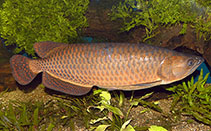 Scleropages jardinii
Foto de Muséum-Aquarium de Nancy/B. Alenda
Fotos | Imagem do Google
Foto de Muséum-Aquarium de Nancy/B. Alenda
Classificação / Nomes Nomes comuns | Sinônimos | Catalog of Fishes(Gênero, Espécies) | ITIS | CoL | WoRMS | Cloffa
> Osteoglossiformes (Bony tongues) > Osteoglossidae (Arowanas)
Etymology: Scleropages: Greek, skleros = hard + Greek, page, -es = knot (Ref. 45335).
Eponymy: Francis Lascelles ‘Frank’ Jardine (1841–1919) was a pastoralist and pioneer associated with the exploration and settlement of the Cape York Peninsula in Queensland, where the Jardine River is named after him. [...] (Ref. 128868), visit book page.
More on author: Saville-Kent.
Etymology: Scleropages: Greek, skleros = hard + Greek, page, -es = knot (Ref. 45335).
Eponymy: Francis Lascelles ‘Frank’ Jardine (1841–1919) was a pastoralist and pioneer associated with the exploration and settlement of the Cape York Peninsula in Queensland, where the Jardine River is named after him. [...] (Ref. 128868), visit book page.
More on author: Saville-Kent.
Meio ambiente: milieu / Zona climática / intervalo de profundidade / faixa de distribuição Ecologia
; Água doce pelágico(a,os,as). Tropical; ? - 15°C (Ref. 44894); 6°S - 14°S
Distribuição Territórios | Áreas da FAO | Ecossistemas | Ocorrências | Mapa de pontos | Introduções | Faunafri
Asia and Oceania: northern Australia and central-southern New Guinea (Ref. 58511).
Comprimento de primeira maturação / Tamanho / Peso / Idade
Maturidade: Lm 45.0 range ? - ? cm
Max length : 100.0 cm SL macho/indeterminado; (Ref. 44894); common length : 55.0 cm SL macho/indeterminado; (Ref. 44894)
Max length : 100.0 cm SL macho/indeterminado; (Ref. 44894); common length : 55.0 cm SL macho/indeterminado; (Ref. 44894)
Descrição suscinta Chaves de identificação | Morfologia | Morfometria
Espinhos dorsais (total) : 0; Raios dorsais (total) : 20 - 24; Espinhos anais: 0; Raios anais : 28 - 32.
Body shape (shape guide): fusiform / normal.
Body shape (shape guide): fusiform / normal.
Adults occur in still waters of streams and swamps where it is usually seen near the surface or close to shore among aquatic vegetation (Ref. 2847, 44894). Solitary, territorial and spawn prior to the wet season when surface water temperatures approach 30°C (Ref. 44894). Young feed primarily on microcrustaceans (Ref. 2847). Primarily a surface feeder, feeding on a variety of terrestrial and aquatic insects, small fishes, frogs, crustaceans, and some plant material (Ref. 44894). Mouthbrooders (Ref. 56180). Maximum weight reported in Ref. 5259 may be 12.27 kg (W. Lau, pers. Comm. 07/05). Important food fish (Ref. 58511) and a valuable aquarium fish (Ref. 83518).
Ciclo de vida ou comportamento de acasalamento Maturidade | Reprodução | Desova | Ovos | Fecundidade | Larvas
Fertilized eggs are carried in the mouth of the female. Eggs hatch in 1-2 weeks. Larvae, with their enlarged yolk sac, are kept in or close to the mouth for another 4 or 5 weeks. Young fish commence feeding, primarily on microcrustaceans, at a size of 2-3 cm, well before the yolk sac is entirely resorbed. Become independent at a length of 3.5-4.0 cm.
Referência principal
Carregar suas referências | Referências | Coordenador | Colaboradores
Allen, G.R., 1991. Field guide to the freshwater fishes of New Guinea. Publication, no. 9. 268 p. Christensen Research Institute, Madang, Papua New Guinea. (Ref. 2847)
Status na Lista Vermelha da UICN (Ref. 130435: Version 2025-2 (Global))
Segura ou pouco preocupante (LC) ; Date assessed: 14 February 2019
CITES
Not Evaluated
Ameaça para os humanos
Harmless
Uso pelos humanos
Pescarias: sem interesse; Aquacultura: espécies comerciais; peixe esportivo: sim; Aquário: Espécies comerciais
FAO - Publication: search | FishSource |
Mais informação
Ecologia Trófica
Itens alimentares (presas)
Composição da dieta
Consumo alimentar
Rações alimentares
Predadores
Itens alimentares (presas)
Composição da dieta
Consumo alimentar
Rações alimentares
Predadores
Dinâmica populacional
Parâmetros de crescimento
Idade máxima / tamanhos
Relação comprimento-peso.
Relação comprimento-comprimento.
Frequências de comprimento
Conversão de massa
Recrutamento
Abundância
Parâmetros de crescimento
Idade máxima / tamanhos
Relação comprimento-peso.
Relação comprimento-comprimento.
Frequências de comprimento
Conversão de massa
Recrutamento
Abundância
Ciclo de vida
Reprodução
Maturidade
Maturidade/Rel. das guelras
Fecundidade
Desova
Agregações de desova
Ovos
Desenvolvimento dos ovos
Larvas
Dinâmica larval
Reprodução
Maturidade
Maturidade/Rel. das guelras
Fecundidade
Desova
Agregações de desova
Ovos
Desenvolvimento dos ovos
Larvas
Dinâmica larval
Fisiologia
Composição corporal
Nutrientes
Consumo de oxigênio
Tipo de natação
Velocidade de natação
Pigmentos visuais
Som de peixe
Doenças e Parasitas
Toxicidade (LC50s)
Composição corporal
Nutrientes
Consumo de oxigênio
Tipo de natação
Velocidade de natação
Pigmentos visuais
Som de peixe
Doenças e Parasitas
Toxicidade (LC50s)
Genética
genoma
Genética
Heterozigosidade
Hereditariedade
Diversidade genética
genoma
Genética
Heterozigosidade
Hereditariedade
Diversidade genética
Relacionado a humanos
Sistemas de aquicultura
Perfis para aquacultura
Estirpes
Casos de Ciguatera
Selos, moedas, diversos.
Sistemas de aquicultura
Perfis para aquacultura
Estirpes
Casos de Ciguatera
Selos, moedas, diversos.
Ferramentas
Questionário orgânico | Livro eletrônico | Guia de campo | Ferramenta auxiliar de frequências de comprimento | Ferramenta sobre a história de vida | Mapa de pontos |
Catch-MSY |
Relatórios especiais
Checar Manutenção em Aquário | Checar Planilhas de Fatos sobre as Espécies | Checar Planilhas de Fatos sobre Aquicultura
Baixar XML
Fontes da internet
AFORO (otoliths) | Banco de dados para Espécies Aliens/Invasivas | Aquatic Commons | BHL | Cloffa | Websites from users | Checar Observador de Peixes (FishWatcher) | CISTI | Catalog of Fishes: Gênero, Espécies | DiscoverLife | ECOTOX | FAO - Publication: search | Faunafri | Fishipedia | Fishtrace | GloBI | Google Books | Google Scholar | Google | IGFA World Record | OneZoom | Open Tree of Life | Otolith Atlas of Taiwan Fishes | Aquários públicos | PubMed | Reef Life Survey | Socotra Atlas | TreeBase | Árvore da vida | Wikipedia: Ir para, procura | World Records Freshwater Fishing | Registro zoológico
Estimativas baseadas em modelos
Índice de diversidade filogenética (Ref. 82804): PD50 = 0.5781 [Uniqueness, from 0.5 = low to 2.0 = high].
Bayesian length-weight: a=0.01122 (0.00514 - 0.02450), b=3.04 (2.87 - 3.21), in cm total length, based on all LWR estimates for this body shape (Ref. 93245).
Nível Trófico (Ref. 69278): 2.8 ±0.1 se; based on diet studies.
Resiliência (Ref. 120179): Baixo, tempo mínimo de duplicação da população 4,5 - 14 anos (tm=4-5; Fec=30-130).