



Hirundichthys affinis (Günther, 1866)
Fourwing flyingfish
Beobachtung melden im Fish Watcher
| Native range | All suitable habitat | Point map | Year 2050 |

|
| This map was computer-generated and has not yet been reviewed. |
| Hirundichthys affinis AquaMaps Data sources: GBIF OBIS |
Hochladen Photos und videos
Bilder | Briefmarken, Münzen, Verschiedenes. | Google Bild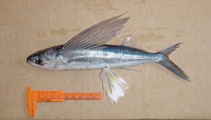 Hirundichthys affinis
Photo von Vaske Jr., T.
Bilder | Briefmarken, Münzen, Verschiedenes. | Google Bild
Photo von Vaske Jr., T.
Klassifizierung / Names Namen | Synonyme | Catalog of Fishes(Gattung, Arten) | ITIS | CoL | WoRMS | Cloffa
> Beloniformes (Needle fishes) > Exocoetidae (Flyingfishes)
Etymology: Hirundichthys: latin, hirundo = swift; 1300 + Greek, ichthys = fish (Ref. 45335).
More on author: Günther.
Etymology: Hirundichthys: latin, hirundo = swift; 1300 + Greek, ichthys = fish (Ref. 45335).
More on author: Günther.
Umwelt: Milieu / Klimazone / Tiefenbereich / Verbreitungsgebiet Ökologie
seewasser pelagic-neritic; ozeanodrom (Ref. 51243); tiefenbereich 0 - 100 m (Ref. 5217). Subtropical; 41°N - 13°S, 98°W - 14°E
Verbreitung Territorien | FAO Gebiete | Ökosysteme | Vorkommen | Punkt Karte | Einführungen | Faunafri
Eastern Atlantic: Guinea to Angola. Western Atlantic: Gulf Stream off Virginia, USA and northern Gulf of Mexico to northern Brazil (Ref. 7251), including the Caribbean Sea (Ref. 3720). Northwest Atlantic: Canada (Ref. 5951).
Länge bei der ersten Reifung / Größe / Gewicht / Alter
Geschlechtsreife: Lm 25.1 range ? - ? cm
Max length : 33.0 cm TL Männchen/unbestimmt; (Ref. 109257); common length : 24.0 cm TL Männchen/unbestimmt; (Ref. 5217); max. veröff. Alter: 1.00 Jahre (Ref. 6503)
Max length : 33.0 cm TL Männchen/unbestimmt; (Ref. 109257); common length : 24.0 cm TL Männchen/unbestimmt; (Ref. 5217); max. veröff. Alter: 1.00 Jahre (Ref. 6503)
Kurzbeschreibung Bestimmungsschlüssel | Morphologie | Morphometrie
Rückenflossenstacheln (insgesamt) : 0; Rückenflossenweichstrahlen (insgesamt) : 11; Afterflossenstacheln: 0; Afterflossenweichstrahlen: 11 - 12. Body elongate, thick, somewhat flattened ventrally; snout shorter than eye, blunt; palatine teeth usually absent; dorsal and anal fins set far back on body, their bases short; dorsal fin low, rays at anterior end the longest; anal fin origin slightly before, or 1 or 2 rays behind dorsal fin origin; pectoral fins strikingly long, 60 to 70 % of SL, only first ray unbranched; pelvic fins large, reaching well beyond anal fin origin; more than 25 scale rows of predorsal scales; dorsally, the color is usually iridescent blue or green in life; dorsal fin colorless or only slightly pigmented; pectoral fins dark, with a pale basal triangle and a narrow white margin (on trailing edge when extended) (Ref. 3720).
Body shape (shape guide): elongated; Cross section: other (see diagnosi.
Body shape (shape guide): elongated; Cross section: other (see diagnosi.
Occurs in surface waters both near and far from the coast (Ref. 5217). Forms schools. Capable of leaping out and gliding for long distances above the water. Seasonal variation in abundance was noted in the eastern Caribbean countries, a phenomenon that may be due to post-spawning mortality (Ref. 6838). The most important commercial fish species of the eastern Caribbean (Ref. 6504). Considered a good food fish; marketed fresh.
Lebenszyklus und Paarungsverhalten Geschlechtsreife | Fortpflanzung | Ablaichen | Eier | Fruchtbarkeit | Larven
Spawns on the water surface and to a depth of 20 m (Ref. 6834). Post-spawning mortality may explain the disappearance of mature cohorts at the close of the spawning season in June (Ref. 6838).
Hauptreferenz
Laden Sie Ihre Referenzen hoch | Referenzen | Koordinator : Parin, Nikolay V. | Partner
Gibbs, R.H. Jr., 1978. Exocoetidae. In W. Fischer (ed.) FAO species identification sheets for fishery purposes. Western Central Atlantic (Fishing Area 31). Vol. 2. pag.var. (Ref. 3720)
IUCN Rote Liste Status (Ref. 130435: Version 2025-2 (Global))
nicht bedroht (LC) ; Date assessed: 29 January 2013
CITES
Not Evaluated
Bedrohung für Menschen
Harmless
Nutzung durch Menschen
Fischereien: kommerziell; Köder: usually
FAO - Publication: search | FIRMS - Stock assessments | FishSource |
Mehr Information
Trophische Ökologie
Lebensmittel (Beutetiere)
Nahrungszusammensetzung
Nahrungsaufnahme
Lebensmittelrationen
Räuber
Lebensmittel (Beutetiere)
Nahrungszusammensetzung
Nahrungsaufnahme
Lebensmittelrationen
Räuber
Populationsdynamik
Wachstumsparameter
Max. Alter/Größen
Länge-Gewicht-Rel.
Länge-Länge-Verhältnis.
Längenhäufigkeiten
Massenkonvertierung
Rekrutierung
Dichte
Wachstumsparameter
Max. Alter/Größen
Länge-Gewicht-Rel.
Länge-Länge-Verhältnis.
Längenhäufigkeiten
Massenkonvertierung
Rekrutierung
Dichte
Lebenszyklus
Fortpflanzung
Geschlechtsreife
Reifung/Kiemen rel.
Fruchtbarkeit
Ablaichen
Laichaggregationen
Eier
Eientwicklung
Larven
Larven Pop.Dyn.
Fortpflanzung
Geschlechtsreife
Reifung/Kiemen rel.
Fruchtbarkeit
Ablaichen
Laichaggregationen
Eier
Eientwicklung
Larven
Larven Pop.Dyn.
Anatomie
Kiemenoberfläche
Gehirn
Otolith
Kiemenoberfläche
Gehirn
Otolith
Physiologie
Körperliche Zusammensetzung
Nährstoffe
Sauerstoffverbrauch
Schwimmart
Schwimmgeschwindigkeit
Visuelle Pigmente
Fischgeräusche
Krankheiten und Parasiten
Toxizität (LC50s)
Körperliche Zusammensetzung
Nährstoffe
Sauerstoffverbrauch
Schwimmart
Schwimmgeschwindigkeit
Visuelle Pigmente
Fischgeräusche
Krankheiten und Parasiten
Toxizität (LC50s)
Genetik
Genom
Genetik
Heterozygotie
Vererbbarkeit
Genetische Vielfalt
Genom
Genetik
Heterozygotie
Vererbbarkeit
Genetische Vielfalt
Menschenbezogen
Aquakultur-Systeme
Aquakultur Profile
Zuchtlinien
Ciguatera-Fälle
Briefmarken, Münzen, Verschiedenes.
Aquakultur-Systeme
Aquakultur Profile
Zuchtlinien
Ciguatera-Fälle
Briefmarken, Münzen, Verschiedenes.
Tools
E-Book | Feldführer | Bestimmungsschlüssel | Längenhäufigkeits Tool | Lebensdaten Tool | Punkt Karte |
Catch-MSY |
Zusatzinformationen
Download XML
Zusammenfassung | Punktdaten | Namen | Photos
Internet Quellen
AFORO (otoliths) | Aquatic Commons | BHL | Cloffa | Websites from users | FishWatcher Einträge suchen | CISTI | Catalog of Fishes: Gattung, Arten | DiscoverLife | ECOTOX | FAO - Publication: search | Faunafri | Fishipedia | Fishtrace | GloBI | Google Books | Google Scholar | Google | IGFA World Record | OneZoom | Open Tree of Life | Otolith Atlas of Taiwan Fishes | PubMed | Reef Life Survey | Socotra Atlas | TreeBase | Tree of Life | Wikipedia: Gehe zu, Suchen | World Records Freshwater Fishing | Zoologischer Rekord
Schätzungen auf der Grundlage von Modellen
Bevorzugte Temperatur (Ref. 123201): 14.3 - 23.6, mean 20 °C (based on 39 cells).
Phylogenetischer Diversitätsindex (Ref. 82804): PD50 = 0.5002 [Uniqueness, from 0.5 = low to 2.0 = high].
Bayesian length-weight: a=0.00813 (0.00422 - 0.01564), b=3.01 (2.83 - 3.19), in cm total length, based on LWR estimates for this species & (Sub)family-body (Ref. 93245).
Trophische Ebene (Ref. 69278): 3.8 ±0.56 se; based on food items.
Generation time: 0.6 ( na - na) years. Estimated as median ln(3)/K based on 1 growth studies.
Widerstandsfähigkeit (Ref. 120179): hoch, Verdopplung der Population dauert weniger als 15 Monate. (tm<1; tmax=1).
Nährstoffe (Ref. 124155): Calcium = 396 [116, 1,186] mg/100g; Iron = 3.76 [1.31, 9.56] mg/100g; Protein = 17.8 [15.4, 20.2] %; Omega3 = 0.379 [0.103, 1.550] g/100g; Selenium = 69.1 [18.9, 235.1] μg/100g; VitaminA = 3.98 [0.62, 29.25] μg/100g; Zinc = 1.31 [0.68, 2.45] mg/100g (wet weight);