



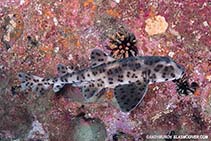
Heterodontus quoyi (Fréminville, 1840)
Galapagos bullhead shark
Lägg till din observation i Fish Watcher
| Native range | All suitable habitat | Point map | Year 2050 |

|
| This map was computer-generated and has not yet been reviewed. |
| Heterodontus quoyi AquaMaps Data sources: GBIF OBIS |
Klassificering / Namn Populärnamn | synonymer | Catalog of Fishes(Släkte, Arter) | ITIS | CoL | WoRMS | Cloffa
Elasmobranchii (hajar och rockor) (sharks and rays) > Heterodontiformes (Bullhead and horn sharks) > Heterodontidae (Bullhead, horn, or Port Jackson sharks)
Etymology: Heterodontus: heteros (Gr.), different; odontos (Gr.), tooth, referring to pointy teeth (for clutching prey) at front of jaws, different than rounded molar-like teeth (for grinding hard-shelled invertebrates) at the back (See ETYFish); quoyi: In honor of naval surgeon and naturalist Jean René Constant Quoy (1790‒1869), for his friendship, his “tireless zeal and extensive knowledge” (translation) of zoology, and for lessons and advice that have guided Fréminville in his study of science (See ETYFish).
Eponymy: Jean René Constant Quoy (1790–1869) was a French naval surgeon and zoologist who named many species, often with Joseph Paul Gaimard (q. [...] (Ref. 128868), visit book page.
Etymology: Heterodontus: heteros (Gr.), different; odontos (Gr.), tooth, referring to pointy teeth (for clutching prey) at front of jaws, different than rounded molar-like teeth (for grinding hard-shelled invertebrates) at the back (See ETYFish); quoyi: In honor of naval surgeon and naturalist Jean René Constant Quoy (1790‒1869), for his friendship, his “tireless zeal and extensive knowledge” (translation) of zoology, and for lessons and advice that have guided Fréminville in his study of science (See ETYFish).
Eponymy: Jean René Constant Quoy (1790–1869) was a French naval surgeon and zoologist who named many species, often with Joseph Paul Gaimard (q. [...] (Ref. 128868), visit book page.
Miljö: miljö / Klimatzon / djupintervall / distributionsområde Ekologi
marina revassocierade; djupintervall 3 - 40 m (Ref. 5227), usually 16 - 30 m (Ref. 54549). Tropical; 0°S - 10°S, 90°W - 71°W
Utbredning Territorier | FAO områden | Ekosystem | Förekomster | Prickkarta | Utplanteringar | Faunafri
Eastern Pacific: Peru (including offshore islands) and the Galapagos Islands. There might be another Heterodontus species from Peru which is Heterodontus peruanus, but these two cannot be separated as of this time for lack of materials examined.
Storlek / Vikt / Ålder
Inhabits sand flat and rocky, boulder strewn reef areas, with sand between outcroppings in inshore continental and insular waters. Rests motionless on the bottom. Is docile, non-aggressive and a poor swimmer (Ref. 5227). Nocturnal (Ref. 43278). Feeds on shellfish, crabs, and small invertebrates (Ref. 28023). Oviparous (Ref. 50449). Size at birth (for a newly hatched male) is 17 cm.
Livscykel och parningsbeteende Könsmognad | Reproduktion | Lek | Ägg | Fekunditet | Larver
Oviparous, paired eggs are laid. Embryos feed solely on yolk (Ref. 50449). Distinct pairing with embrace (Ref. 205).
Huvudreferens
Ladda upp dina referenser | referenser | Koordinator | Medarbetare
Compagno, L.J.V., 1984. FAO Species Catalogue. Vol. 4. Sharks of the world. An annotated and illustrated catalogue of shark species known to date. Part 1 - Hexanchiformes to Lamniformes. FAO Fish. Synop. 125(4/1):1-249. Rome, FAO. (Ref. 247)
Status på IUCN:s rödlista (Ref. 130435: Version 2025-2 (Global))
Least Concern (LC) ; Date assessed: 24 January 2020
CITES
Not Evaluated
Hot mot människor
Traumatogenic
Mänskliga användningsområden
Fiskeri: saknar intresse
FAO - fiskeri: artprofil; Publication: search | FishSource |
Ytterligare information
Populationsdynamik
Tillväxtparametrar
Max. åldrar / storlekar
Längd-vikt rel.
Längd-längd rel.
Längd-frekvenser
Massakonvertering
Rekrytering
Abundans
Tillväxtparametrar
Max. åldrar / storlekar
Längd-vikt rel.
Längd-längd rel.
Längd-frekvenser
Massakonvertering
Rekrytering
Abundans
Livscykel
Reproduktion
Könsmognad
Mognad/Gills rel.
Fekunditet
Lek
Lekande aggregat
Ägg
Utveckling av ägg
Larver
Larvdynamik
Reproduktion
Könsmognad
Mognad/Gills rel.
Fekunditet
Lek
Lekande aggregat
Ägg
Utveckling av ägg
Larver
Larvdynamik
Anatomi
Gälyta
Hjärna
Otolit
Gälyta
Hjärna
Otolit
Fysiologi
Kroppssammansättning
Näringsämnen
Syreförbrukning
Typ av simning
Simhastighet
Visuella pigment
Ljud från fisk
Sjukdomar & Parasiter
Toxicitet (LC50)
Kroppssammansättning
Näringsämnen
Syreförbrukning
Typ av simning
Simhastighet
Visuella pigment
Ljud från fisk
Sjukdomar & Parasiter
Toxicitet (LC50)
Genetik
Genom
Genetik
Heterozygositet
Ärftlighet
Genetisk mångfald
Genom
Genetik
Heterozygositet
Ärftlighet
Genetisk mångfald
Människorelaterad
Vattenbrukssystem
Vattenbruksprofiler
Avelslinjer
Ciguatera-fall
Frimärken, mynt, diverse.
Vattenbrukssystem
Vattenbruksprofiler
Avelslinjer
Ciguatera-fall
Frimärken, mynt, diverse.
Verktyg
E-bok | Fälthandbok | Bestämningsnycklar | Längdfördelnings-verktyg | Livshistorie-verktyg | Prickkarta |
Fångst-MSY |
Särskilda rapporter
Kontrollera för underhåll av akvarium | Kontrollera om det finns faktablad om arter | Kontrollera om det finns faktablad om vattenbruk
Ladda ner XML
Internet-källor
AFORO (otoliths) | Aquatic Commons | BHL | Cloffa | Websites from users | Check FishWatcher | CISTI | Catalog of Fishes: Släkte, Arter | DiscoverLife | ECOTOX | FAO - fiskeri: artprofil; Publication: search | Faunafri | Fishipedia | Fishtrace | GloBI | Google Books | Google Scholar | Google | IGFA World Record | OneZoom | Open Tree of Life | Otolith Atlas of Taiwan Fishes | PubMed | Reef Life Survey | Socotra Atlas | TreeBase | Tree of Life | Wikipedia: Go, sök | World Records Freshwater Fishing | Zoologiskt register
Uppskattningar baserade på modeller
Önskad temperatur (Ref. 123201): 17.7 - 23.2, mean 20.5 °C (based on 16 cells).
Index för fylogenetisk mångfald (Ref. 82804): PD50 = 0.5029 [Uniqueness, from 0.5 = low to 2.0 = high].
Bayesian length-weight: a=0.00380 (0.00163 - 0.00884), b=3.15 (2.95 - 3.35), in cm total length, based on LWR estimates for this (Sub)family-body shape (Ref. 93245).
Trofisk nivå (Ref. 69278): 3.5 ±0.50 se; based on food items.
Resiliens (Ref. 120179): Låg, lägsta populationsfördubblingstid 4,5-14 år (Fec assumed to be <100).
Näringsämnen (Ref. 124155): Calcium = 12.5 [2.4, 47.7] mg/100g; Iron = 0.364 [0.088, 1.020] mg/100g; Protein = 19.2 [17.1, 21.3] %; Omega3 = 0.0756 [, ] g/100g; Selenium = 27.9 [8.7, 80.7] μg/100g; VitaminA = 53.7 [17.4, 155.9] μg/100g; Zinc = 0.969 [0.473, 1.973] mg/100g (wet weight);