



Heterodontus quoyi (Fréminville, 1840)
Galapagos bullhead shark
Adicionar as suas observações no Fish Watcher
| Native range | All suitable habitat | Point map | Year 2050 |

|
| This map was computer-generated and has not yet been reviewed. |
| Heterodontus quoyi AquaMaps Data sources: GBIF OBIS |
Adicionar o seu Fotografias e vídeos
Fotografias | vídeos | Imagem do Google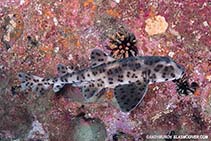 Heterodontus quoyi
Fotografia de Murch, A.
Fotografias | vídeos | Imagem do Google
Fotografia de Murch, A.
Classificação / Nomes Nomes comuns | Sinónimos | Catalog of Fishes(Género, Espécies) | ITIS | CoL | WoRMS | Cloffa
Elasmobranchii (tubarões e raias) (sharks and rays) > Heterodontiformes (Bullhead and horn sharks) > Heterodontidae (Bullhead, horn, or Port Jackson sharks)
Etymology: Heterodontus: heteros (Gr.), different; odontos (Gr.), tooth, referring to pointy teeth (for clutching prey) at front of jaws, different than rounded molar-like teeth (for grinding hard-shelled invertebrates) at the back (See ETYFish); quoyi: In honor of naval surgeon and naturalist Jean René Constant Quoy (1790‒1869), for his friendship, his “tireless zeal and extensive knowledge” (translation) of zoology, and for lessons and advice that have guided Fréminville in his study of science (See ETYFish).
Eponymy: Jean René Constant Quoy (1790–1869) was a French naval surgeon and zoologist who named many species, often with Joseph Paul Gaimard (q. [...] (Ref. 128868), visit book page.
Etymology: Heterodontus: heteros (Gr.), different; odontos (Gr.), tooth, referring to pointy teeth (for clutching prey) at front of jaws, different than rounded molar-like teeth (for grinding hard-shelled invertebrates) at the back (See ETYFish); quoyi: In honor of naval surgeon and naturalist Jean René Constant Quoy (1790‒1869), for his friendship, his “tireless zeal and extensive knowledge” (translation) of zoology, and for lessons and advice that have guided Fréminville in his study of science (See ETYFish).
Eponymy: Jean René Constant Quoy (1790–1869) was a French naval surgeon and zoologist who named many species, often with Joseph Paul Gaimard (q. [...] (Ref. 128868), visit book page.
Ambiente: milieu / zona climática / intervalo de profundidade / gama de distribuição Ecologia
marinhas associadas(os) a recifes; intervalo de profundidade 3 - 40 m (Ref. 5227), usually 16 - 30 m (Ref. 54549). Tropical; 0°S - 10°S, 90°W - 71°W
Distribuição Territórios | Áreas FAO | Ecossistemas | Ocorrências | Mapa dos pontos | Introduções | Faunafri
Eastern Pacific: Peru (including offshore islands) and the Galapagos Islands. There might be another Heterodontus species from Peru which is Heterodontus peruanus, but these two cannot be separated as of this time for lack of materials examined.
Tamanho / Peso / Idade
Inhabits sand flat and rocky, boulder strewn reef areas, with sand between outcroppings in inshore continental and insular waters. Rests motionless on the bottom. Is docile, non-aggressive and a poor swimmer (Ref. 5227). Nocturnal (Ref. 43278). Feeds on shellfish, crabs, and small invertebrates (Ref. 28023). Oviparous (Ref. 50449). Size at birth (for a newly hatched male) is 17 cm.
Ciclo de vida e comportamento de acasalamento Maturidade | Reprodução | Desova | Ovos | Fecundidade | Larvas
Oviparous, paired eggs are laid. Embryos feed solely on yolk (Ref. 50449). Distinct pairing with embrace (Ref. 205).
Referência principal
Carregar as suas referências | Referências | Coordenador | Colaboradores
Compagno, L.J.V., 1984. FAO Species Catalogue. Vol. 4. Sharks of the world. An annotated and illustrated catalogue of shark species known to date. Part 1 - Hexanchiformes to Lamniformes. FAO Fish. Synop. 125(4/1):1-249. Rome, FAO. (Ref. 247)
Categoria na Lista Vermelha da IUCN (Ref. 130435: Version 2025-2 (Global))
Preocupação menor (LC) ; Date assessed: 24 January 2020
CITES
Not Evaluated
Ameaça para o homem
Traumatogenic
Utilização humana
Pescarias: sem interesse
FAO - pescarias: perfil da espécie; Publication: search | FishSource |
Mais informação
Ecologia Trófica
Produtos alimentares (presas)
Composição da dieta
Consumo alimentar
Rações alimentares
Predadores
Produtos alimentares (presas)
Composição da dieta
Consumo alimentar
Rações alimentares
Predadores
Dinâmica das populações
Parâmetros de crescimento
Idades / tamanhos máximos
Comprimento-peso rel.
Comprimento-comprimento rel.
Frequência de comprimento
Conversão de massa
Recrutamento
Abundância
Parâmetros de crescimento
Idades / tamanhos máximos
Comprimento-peso rel.
Comprimento-comprimento rel.
Frequência de comprimento
Conversão de massa
Recrutamento
Abundância
Ciclo de vida
Reprodução
Maturidade
Maturidade/Rel. das guelras
Fecundidade
Desova
Agregações de desova
Ovos
Desenvolvimento dos ovos
Larvas
Dinâmica larvar
Reprodução
Maturidade
Maturidade/Rel. das guelras
Fecundidade
Desova
Agregações de desova
Ovos
Desenvolvimento dos ovos
Larvas
Dinâmica larvar
Anatomia
Área branquial
Cérebro
Otólitos
Área branquial
Cérebro
Otólitos
Fisiologia
Composição corporal
Nutrientes
Consumo de oxigénio
Tipo de natação
Velocidade de natação
Pigmentos visuais
Som de peixe
Doenças e Parasitas
Toxicidade (LC50s)
Composição corporal
Nutrientes
Consumo de oxigénio
Tipo de natação
Velocidade de natação
Pigmentos visuais
Som de peixe
Doenças e Parasitas
Toxicidade (LC50s)
Genética
genoma
Genética
Heterozigotia
Hereditariedade
Diversidade genética
genoma
Genética
Heterozigotia
Hereditariedade
Diversidade genética
Relacionado com o ser humano
Sistemas de aquacultura
Perfis para aquacultura
Estirpes
Casos de Ciguatera
Selos, moedas, diversos.
Sistemas de aquacultura
Perfis para aquacultura
Estirpes
Casos de Ciguatera
Selos, moedas, diversos.
Ferramentas
E-book | Guia de campo | Chaves de identificação | Ferramenta auxiliar de frequências de comprimento | Ferramenta sobre a história de vida | Mapa dos pontos |
Captura-MSY |
Relatórios especiais
Descarregue XML
Fontes da internet
AFORO (otoliths) | Aquatic Commons | BHL | Cloffa | Websites from users | Consultar FishWatcher | CISTI | Catalog of Fishes: Género, Espécies | DiscoverLife | ECOTOX | FAO - pescarias: perfil da espécie; Publication: search | Faunafri | Fishipedia | Fishtrace | GloBI | Google Books | Google Scholar | Google | IGFA World Record | OneZoom | Open Tree of Life | Otolith Atlas of Taiwan Fishes | PubMed | Reef Life Survey | Socotra Atlas | TreeBase | Árvore da vida | Wikipedia: ir para, procurar | World Records Freshwater Fishing | Registo zoológico
Estimativas baseadas em modelos
Temperatura preferida (Ref. 123201): 17.7 - 23.2, mean 20.5 °C (based on 16 cells).
Índice de diversidade filogenética (Ref. 82804): PD50 = 0.5029 [Uniqueness, from 0.5 = low to 2.0 = high].
Bayesian length-weight: a=0.00380 (0.00163 - 0.00884), b=3.15 (2.95 - 3.35), in cm total length, based on LWR estimates for this (Sub)family-body shape (Ref. 93245).
Nível Trófico (Ref. 69278): 3.5 ±0.50 se; based on food items.
Resiliência (Ref. 120179): Baixo, tempo mínimo de duplicação da população 4,5 - 14 anos (Fec assumed to be <100).
Nutrientes (Ref. 124155): Calcium = 12.5 [2.4, 47.7] mg/100g; Iron = 0.364 [0.088, 1.020] mg/100g; Protein = 19.2 [17.1, 21.3] %; Omega3 = 0.0756 [, ] g/100g; Selenium = 27.9 [8.7, 80.7] μg/100g; VitaminA = 53.7 [17.4, 155.9] μg/100g; Zinc = 0.969 [0.473, 1.973] mg/100g (wet weight);