



Epinephelus awoara (Temminck & Schlegel, 1842)
Yellow grouper
Lägg till din observation i Fish Watcher
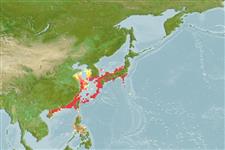
| Native range | All suitable habitat | Point map | Year 2050 |
|
| This map was computer-generated and has not yet been reviewed. |
| Epinephelus awoara AquaMaps Data sources: GBIF OBIS |
Ladda upp din foton och Videor
Bilder | Google image Epinephelus awoara
Bild av Caron Wong@114°E Hong Kong Reef Fish Survey
Bilder | Google image
Bild av Caron Wong@114°E Hong Kong Reef Fish Survey
Klassificering / Namn Populärnamn | synonymer | Catalog of Fishes(Släkte, Arter) | ITIS | CoL | WoRMS | Cloffa
> Perciformes/Serranoidei (Groupers) > Epinephelidae (Groupers)
Etymology: Epinephelus: Greek, epinephelos = cloudy (Ref. 45335).
More on authors: Temminck & Schlegel.
Etymology: Epinephelus: Greek, epinephelos = cloudy (Ref. 45335).
More on authors: Temminck & Schlegel.
Miljö: miljö / Klimatzon / djupintervall / distributionsområde Ekologi
marina revassocierade; djupintervall 10 - 50 m (Ref. 5222). Tropical; 39°N - 12°N, 110°E - 143°E (Ref. 5222)
Utbredning Territorier | FAO områden | Ekosystem | Förekomster | Prickkarta | Utplanteringar | Faunafri
Northwest Pacific: Korea, Japan, Taiwan, China, Viet Nam, and islands in the South China Sea.
Längd vid första mognad / Storlek / Vikt / Ålder
Könsmognad: Lm ?, range 16 - ? cm
Max length : 60.0 cm TL hane/ej könsbestämd; (Ref. 5222); common length : 30.0 cm TL hane/ej könsbestämd; (Ref. 9137)
Max length : 60.0 cm TL hane/ej könsbestämd; (Ref. 5222); common length : 30.0 cm TL hane/ej könsbestämd; (Ref. 9137)
Kort beskrivning Bestämningsnycklar | Morfologi | Morfometri
Taggstrålar i ryggfenan (totalt) : 11; Mjukstrålar i ryggfenan (totalt) : 15 - 16; Taggstrålar i analfenan: 3; Mjukstrålar i analfenan: 8. Distinguished by the following characteristics: head and body pale greyish brown dorsally, usually golden yellow ventrally; 4 broad dark bars on the dorsal part of the body, one on caudal peduncle and another often visible on nape; numerous small yellow spots on head and body; body and median fins with small greyish white spots; soft dorsal and caudal fins and sometimes the anal fin, with prominent yellow margin; dusky yellow paired fins; yellow mustache in the maxillary groove; body depth 2.7-3.3 times in SL; head length 2.3-2.6 times in SL; convex interorbital area; strongly convex dorsal head profile; subangular preopercle, 2-5 strong spines at the angle; upper edge of operculum straight, uppermost spine rudimentary; maxilla reaches about to vertical at rear edge of eye; 2 rows of small, subequal teeth on midlateral part of lower jaw; caudal fin convex; lateral body scales distinctly ctenoid, with auxiliary scales in fish larger than 30 cm SL; pyloric caeca 12, in 3 bundles (Ref. 089707).
Body shape (shape guide): fusiform / normal.
Body shape (shape guide): fusiform / normal.
Occurs in rocky areas as well as on sandy-mud bottoms. Juveniles are common in tide pools. In captivity, the species is aggressive, chasing and biting other species, especially members of its own species. Protogynous hermaphrodite (Ref. 5222). Artificial fertilization of eggs was done and the longest survival time for the larvae was 15 days (Ref. 6780). In Hong Kong live fish markets (Ref. 27253).
Livscykel och parningsbeteende Könsmognad | Reproduktion | Lek | Ägg | Fekunditet | Larver
Huvudreferens
Ladda upp dina referenser | referenser | Koordinator | Medarbetare
Heemstra, P.C. and J.E. Randall, 1993. FAO Species Catalogue. Vol. 16. Groupers of the world (family Serranidae, subfamily Epinephelinae). An annotated and illustrated catalogue of the grouper, rockcod, hind, coral grouper and lyretail species known to date. Rome: FAO. FAO Fish. Synop. 125(16):382 p. (Ref. 5222)
Status på IUCN:s rödlista (Ref. 130435: Version 2025-2 (Global))
Data deficient (DD) ; Date assessed: 20 November 2016
CITES
Not Evaluated
Hot mot människor
Harmless
Mänskliga användningsområden
Fiskeri: kommersiell; Vattenbruk: kommersiell
FAO - Publication: search | FishSource | Havet omkring oss
Ytterligare information
Populationsdynamik
Tillväxtparametrar
Max. åldrar / storlekar
Längd-vikt rel.
Längd-längd rel.
Längd-frekvenser
Massakonvertering
Rekrytering
Abundans
Tillväxtparametrar
Max. åldrar / storlekar
Längd-vikt rel.
Längd-längd rel.
Längd-frekvenser
Massakonvertering
Rekrytering
Abundans
Livscykel
Reproduktion
Könsmognad
Mognad/Gills rel.
Fekunditet
Lek
Lekande aggregat
Ägg
Utveckling av ägg
Larver
Larvdynamik
Reproduktion
Könsmognad
Mognad/Gills rel.
Fekunditet
Lek
Lekande aggregat
Ägg
Utveckling av ägg
Larver
Larvdynamik
Anatomi
Gälyta
Hjärna
Otolit
Gälyta
Hjärna
Otolit
Fysiologi
Kroppssammansättning
Näringsämnen
Syreförbrukning
Typ av simning
Simhastighet
Visuella pigment
Ljud från fisk
Sjukdomar & Parasiter
Toxicitet (LC50)
Kroppssammansättning
Näringsämnen
Syreförbrukning
Typ av simning
Simhastighet
Visuella pigment
Ljud från fisk
Sjukdomar & Parasiter
Toxicitet (LC50)
Människorelaterad
Vattenbrukssystem
Vattenbruksprofiler
Avelslinjer
Ciguatera-fall
Frimärken, mynt, diverse.
Vattenbrukssystem
Vattenbruksprofiler
Avelslinjer
Ciguatera-fall
Frimärken, mynt, diverse.
Verktyg
E-bok | Fälthandbok | Bestämningsnycklar | Längdfördelnings-verktyg | Livshistorie-verktyg | Prickkarta |
Fångst-MSY |
Särskilda rapporter
Kontrollera för underhåll av akvarium | Kontrollera om det finns faktablad om arter | Kontrollera om det finns faktablad om vattenbruk
Ladda ner XML
Internet-källor
AFORO (otoliths) | Aquatic Commons | BHL | Cloffa | Websites from users | Check FishWatcher | CISTI | Catalog of Fishes: Släkte, Arter | DiscoverLife | ECOTOX | FAO - Publication: search | Faunafri | Fishipedia | Fishtrace | GloBI | Google Books | Google Scholar | Google | IGFA World Record | Nationella databaser | OneZoom | Open Tree of Life | Otolith Atlas of Taiwan Fishes | PubMed | Reef Life Survey | Socotra Atlas | TreeBase | Tree of Life | Wikipedia: Go, sök | World Records Freshwater Fishing | Zoologiskt register
Uppskattningar baserade på modeller
Önskad temperatur (Ref. 123201): 16.2 - 25.6, mean 22.5 °C (based on 74 cells).
Index för fylogenetisk mångfald (Ref. 82804): PD50 = 0.5000 [Uniqueness, from 0.5 = low to 2.0 = high].
Bayesian length-weight: a=0.01096 (0.00635 - 0.01893), b=3.04 (2.90 - 3.18), in cm total length, based on LWR estimates for this species & Genus-body shape (Ref. 93245).
Trofisk nivå (Ref. 69278): 3.6 ±0.55 se; based on food items.
Resiliens (Ref. 120179): Hög, lägsta populationsfördubblingstid mindre än 15 månader (Fecundity = 24,329).
Näringsämnen (Ref. 124155): Calcium = 25.4 [12.5, 56.5] mg/100g; Iron = 0.474 [0.258, 0.967] mg/100g; Protein = 18.4 [16.9, 19.8] %; Omega3 = 0.113 [0.070, 0.180] g/100g; Selenium = 34.9 [21.0, 62.3] μg/100g; VitaminA = 167 [47, 594] μg/100g; Zinc = 1.34 [0.94, 1.87] mg/100g (wet weight);