



Hochladen Photos und videos
Bilder | videos | Google Bild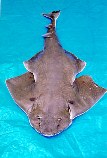 Squatina dumeril
Female Photo von Harris, M.
Bilder | videos | Google Bild
Female Photo von Harris, M.
Klassifizierung / Names Namen | Synonyme | Catalog of Fishes(Gattung, Arten) | ITIS | CoL | WoRMS | Cloffa
Elasmobranchii (Haie und Rochen) (sharks and rays) > Squatiniformes (Angel sharks) > Squatinidae (Angel sharks)
Etymology: Squatina: Latin for skate, which angel sharks superficially resemble, presumably tautonymous with Squalus squatina Linnaeus 1758 (no species mentioned) (See ETYFish); dumeril: In honor of French zoologist André Marie Constant Duméril (1774-1860) “in testimony of [Lesueur’s] remembrance and esteem” (not in honor of Duméril’s equally famous zoologist son Auguste, born in 1812) [presumably a noun in apposition, without the patronymic “i”] (See ETYFish).
Eponymy: Dr André Marie Constant Duméril (1774–1860) was a French zoologist who qualified as a physician (1793). [...] (Ref. 128868), visit book page.
More on author: Lesueur.
Etymology: Squatina: Latin for skate, which angel sharks superficially resemble, presumably tautonymous with Squalus squatina Linnaeus 1758 (no species mentioned) (See ETYFish); dumeril: In honor of French zoologist André Marie Constant Duméril (1774-1860) “in testimony of [Lesueur’s] remembrance and esteem” (not in honor of Duméril’s equally famous zoologist son Auguste, born in 1812) [presumably a noun in apposition, without the patronymic “i”] (See ETYFish).
Eponymy: Dr André Marie Constant Duméril (1774–1860) was a French zoologist who qualified as a physician (1793). [...] (Ref. 128868), visit book page.
More on author: Lesueur.
Umwelt: Milieu / Klimazone / Tiefenbereich / Verbreitungsgebiet Ökologie
seewasser bathydemersal; tiefenbereich 1 - 1375 m (Ref. 26938), usually ? - 128 m (Ref. 55306). Subtropical; 43°N - 9°N, 96°W - 58°W (Ref. 54904)
Verbreitung Territorien | FAO Gebiete | Ökosysteme | Vorkommen | Punkt Karte | Einführungen | Faunafri
Western Atlantic: southern New England, USA to the Gulf of Mexico, Jamaica and Venezuela. Also in Columbia (Ref. 26938).
Länge bei der ersten Reifung / Größe / Gewicht / Alter
Geschlechtsreife: Lm 99.5, range 92 - 107 cm
Max length : 152 cm TL Männchen/unbestimmt; (Ref. 247); common length : 100.0 cm TL Männchen/unbestimmt; (Ref. 6077)
Max length : 152 cm TL Männchen/unbestimmt; (Ref. 247); common length : 100.0 cm TL Männchen/unbestimmt; (Ref. 6077)
Kurzbeschreibung Bestimmungsschlüssel | Morphologie | Morphometrie
A ray-shaped shark. Head narrowing to distinct neck at base of pectoral fins (Ref. 26938).
Body shape (shape guide): other.
Body shape (shape guide): other.
Occurs on the outer continental shelf and the upper slope. Found from shoreline to depths of 1,375 m (Ref. 26938). Benthic burrower; feeds on small bottom fishes, crustaceans and mollusks (Ref. 27549). Ovoviviparous. Will bite when captured and can inflict nasty lacerations with its trap-like jaws and pointed teeth.
Lebenszyklus und Paarungsverhalten Geschlechtsreife | Fortpflanzung | Ablaichen | Eier | Fruchtbarkeit | Larven
Ovoviviparous, embryos feed solely on yolk (Ref. 50449).
Hauptreferenz
Laden Sie Ihre Referenzen hoch | Referenzen | Koordinator : Compagno, Leonard J.V. | Partner
Vaz, D.F.B. and M.R. De Carvalho, 2013. Morphological and taxonomic revision of species of Squatina from the Southwestern Atlantic Ocean (Chondrichthyes: Squatiniformes: Squatinidae). Zootaxa 3695(1):001-081. (Ref. 95520)
IUCN Rote Liste Status (Ref. 130435: Version 2025-2 (Global))
nicht bedroht (LC) ; Date assessed: 23 June 2017
CITES
Not Evaluated
Bedrohung für Menschen
Traumatogenic
Nutzung durch Menschen
Fischereien: weniger kommerziell
FAO - Fischereien: Artbeschreibung; Publication: search | FishSource | Das Meer um uns herum
Mehr Information
Trophische Ökologie
Lebensmittel (Beutetiere)
Nahrungszusammensetzung
Nahrungsaufnahme
Lebensmittelrationen
Räuber
Lebensmittel (Beutetiere)
Nahrungszusammensetzung
Nahrungsaufnahme
Lebensmittelrationen
Räuber
Populationsdynamik
Wachstumsparameter
Max. Alter/Größen
Länge-Gewicht-Rel.
Länge-Länge-Verhältnis.
Längenhäufigkeiten
Massenkonvertierung
Rekrutierung
Dichte
Wachstumsparameter
Max. Alter/Größen
Länge-Gewicht-Rel.
Länge-Länge-Verhältnis.
Längenhäufigkeiten
Massenkonvertierung
Rekrutierung
Dichte
Lebenszyklus
Fortpflanzung
Geschlechtsreife
Reifung/Kiemen rel.
Fruchtbarkeit
Ablaichen
Laichaggregationen
Eier
Eientwicklung
Larven
Larven Pop.Dyn.
Fortpflanzung
Geschlechtsreife
Reifung/Kiemen rel.
Fruchtbarkeit
Ablaichen
Laichaggregationen
Eier
Eientwicklung
Larven
Larven Pop.Dyn.
Anatomie
Kiemenoberfläche
Gehirn
Otolith
Kiemenoberfläche
Gehirn
Otolith
Physiologie
Körperliche Zusammensetzung
Nährstoffe
Sauerstoffverbrauch
Schwimmart
Schwimmgeschwindigkeit
Visuelle Pigmente
Fischgeräusche
Krankheiten und Parasiten
Toxizität (LC50s)
Körperliche Zusammensetzung
Nährstoffe
Sauerstoffverbrauch
Schwimmart
Schwimmgeschwindigkeit
Visuelle Pigmente
Fischgeräusche
Krankheiten und Parasiten
Toxizität (LC50s)
Genetik
Genom
Genetik
Heterozygotie
Vererbbarkeit
Genetische Vielfalt
Genom
Genetik
Heterozygotie
Vererbbarkeit
Genetische Vielfalt
Menschenbezogen
Aquakultur-Systeme
Aquakultur Profile
Zuchtlinien
Ciguatera-Fälle
Briefmarken, Münzen, Verschiedenes.
Aquakultur-Systeme
Aquakultur Profile
Zuchtlinien
Ciguatera-Fälle
Briefmarken, Münzen, Verschiedenes.
Tools
Zusatzinformationen
Download XML
Zusammenfassung | Punktdaten | Namen | Photos
Internet Quellen
AFORO (otoliths) | Aquatic Commons | BHL | Cloffa | Websites from users | FishWatcher Einträge suchen | CISTI | Catalog of Fishes: Gattung, Arten | DiscoverLife | ECOTOX | FAO - Fischereien: Artbeschreibung; Publication: search | Faunafri | Fishipedia | Fishtrace | GloBI | GoMexSI (interaction data) | Google Books | Google Scholar | Google | IGFA World Record | OceanAdapt | OneZoom | Open Tree of Life | Otolith Atlas of Taiwan Fishes | PubMed | Reef Life Survey | Socotra Atlas | TreeBase | Tree of Life | Wikipedia: Gehe zu, Suchen | World Records Freshwater Fishing | Zoobank | Zoologischer Rekord
Schätzungen auf der Grundlage von Modellen
Phylogenetischer Diversitätsindex (Ref. 82804): PD50 = 0.5000 [Uniqueness, from 0.5 = low to 2.0 = high].
Bayesian length-weight: a=0.00676 (0.00402 - 0.01136), b=3.06 (2.91 - 3.21), in cm total length, based on LWR estimates for this species & Genus-body shape (Ref. 93245).
Trophische Ebene (Ref. 69278): 4.5 ±0.6 se; based on diet studies.
Widerstandsfähigkeit (Ref. 120179): niedrig, Verdopplung der Population dauert 4,5 - 14 Jahre. (Fec assumed to be <100).