



Envoyez vos Photos et vidéos
Images | vidéos | Images Google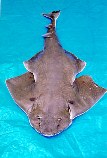 Squatina dumeril
Female Photo de Harris, M.
Images | vidéos | Images Google
Female Photo de Harris, M.
Classification / Noms Noms communs | Synonymes | Catalog of Fishes(Genre, Espèce) | ITIS | CoL | WoRMS | Cloffa
Élasmobranches (requins et raies) (sharks and rays) > Squatiniformes (Angel sharks) > Squatinidae (Angel sharks)
Etymology: Squatina: Latin for skate, which angel sharks superficially resemble, presumably tautonymous with Squalus squatina Linnaeus 1758 (no species mentioned) (See ETYFish); dumeril: In honor of French zoologist André Marie Constant Duméril (1774-1860) “in testimony of [Lesueur’s] remembrance and esteem” (not in honor of Duméril’s equally famous zoologist son Auguste, born in 1812) [presumably a noun in apposition, without the patronymic “i”] (See ETYFish).
Eponymy: Dr André Marie Constant Duméril (1774–1860) was a French zoologist who qualified as a physician (1793). [...] (Ref. 128868), visit book page.
More on author: Lesueur.
Etymology: Squatina: Latin for skate, which angel sharks superficially resemble, presumably tautonymous with Squalus squatina Linnaeus 1758 (no species mentioned) (See ETYFish); dumeril: In honor of French zoologist André Marie Constant Duméril (1774-1860) “in testimony of [Lesueur’s] remembrance and esteem” (not in honor of Duméril’s equally famous zoologist son Auguste, born in 1812) [presumably a noun in apposition, without the patronymic “i”] (See ETYFish).
Eponymy: Dr André Marie Constant Duméril (1774–1860) was a French zoologist who qualified as a physician (1793). [...] (Ref. 128868), visit book page.
More on author: Lesueur.
Environnement : milieu / zone climatique / profondeur / gamme de distribution Écologie
marin bathydémersal; profondeur 1 - 1375 m (Ref. 26938), usually ? - 128 m (Ref. 55306). Subtropical; 43°N - 9°N, 96°W - 58°W (Ref. 54904)
Distribution Territoires | Zones FAO | Écosystèmes | Occurrences | Carte par point | Introductions | Faunafri
Western Atlantic: southern New England, USA to the Gulf of Mexico, Jamaica and Venezuela. Also in Columbia (Ref. 26938).
Longueur à la première maturité / Taille / Poids / Âge
Maturité: Lm 99.5, range 92 - 107 cm
Max length : 152 cm TL mâle / non sexé; (Ref. 247); common length : 100.0 cm TL mâle / non sexé; (Ref. 6077)
Max length : 152 cm TL mâle / non sexé; (Ref. 247); common length : 100.0 cm TL mâle / non sexé; (Ref. 6077)
Description synthétique Clés d'identification | Morphologie | Morphométrie
A ray-shaped shark. Head narrowing to distinct neck at base of pectoral fins (Ref. 26938).
Body shape (shape guide): other.
Body shape (shape guide): other.
Occurs on the outer continental shelf and the upper slope. Found from shoreline to depths of 1,375 m (Ref. 26938). Benthic burrower; feeds on small bottom fishes, crustaceans and mollusks (Ref. 27549). Ovoviviparous. Will bite when captured and can inflict nasty lacerations with its trap-like jaws and pointed teeth.
Cycle de vie et comportement reproducteur Maturité | Reproduction | Frai | Œufs | Fécondité | Larves
Ovoviviparous, embryos feed solely on yolk (Ref. 50449).
Référence principale
Téléchargez vos références | Références | Coordinateur : Compagno, Leonard J.V. | Collaborateurs
Vaz, D.F.B. and M.R. De Carvalho, 2013. Morphological and taxonomic revision of species of Squatina from the Southwestern Atlantic Ocean (Chondrichthyes: Squatiniformes: Squatinidae). Zootaxa 3695(1):001-081. (Ref. 95520)
Statut dans la liste rouge de l'IUCN (Ref. 130435: Version 2025-2 (Global))
Préoccupation mineure (LC) ; Date assessed: 23 June 2017
CITES
Not Evaluated
Menace pour l'homme
Traumatogenic
Utilisations par l'homme
Pêcheries: intérêt commercial mineur
FAO - pêcheries: Résumé espèce; Publication: search | FishSource | Sea Around Us
Plus d'informations
Écologie trophique
Aliments (proies)
Composition du régime alimentaire
Consommation alimentaire
Rations alimentaires
Prédateurs
Aliments (proies)
Composition du régime alimentaire
Consommation alimentaire
Rations alimentaires
Prédateurs
Dynamique des populations
Paramètres de croissance
Âges / tailles maximales
Longueur-poids rel.
Rel. longueur-longueur.
Fréquences de longueurs
Conversion de masse
Recrutement
Abondance
Paramètres de croissance
Âges / tailles maximales
Longueur-poids rel.
Rel. longueur-longueur.
Fréquences de longueurs
Conversion de masse
Recrutement
Abondance
Cycle de vie
Reproduction
Maturité
Maturité/épines rel.
Fécondité
Frai
Agrégats de frai
Œufs
Développement de l'œuf
Larves
Dynamique des populations larvaires
Reproduction
Maturité
Maturité/épines rel.
Fécondité
Frai
Agrégats de frai
Œufs
Développement de l'œuf
Larves
Dynamique des populations larvaires
Anatomie
Surface branchiale
Cerveau
Otolithe
Surface branchiale
Cerveau
Otolithe
Physiologie
Composition corporelle
Nutriments
Consommation d'oxygène
Type de natation
Vitesse de nage
Pigments visuels
Son de poisson
Maladies et parasites
Toxicité (CL50)
Composition corporelle
Nutriments
Consommation d'oxygène
Type de natation
Vitesse de nage
Pigments visuels
Son de poisson
Maladies et parasites
Toxicité (CL50)
Génétique
génôme
Génétique
Hétérozygotie
Héritabilité
Diversité génétique
génôme
Génétique
Hétérozygotie
Héritabilité
Diversité génétique
Liées à l'homme
Systèmes d'aquaculture
Profils d'aquaculture
Souches
Cas de ciguatera
Timbres, pièces de monnaie, divers
Systèmes d'aquaculture
Profils d'aquaculture
Souches
Cas de ciguatera
Timbres, pièces de monnaie, divers
Outils
E-book | Guide de terrain | Générateur de fréquences de longueur | Outil de dynamique de population | Carte par point |
Capture-MSY |
Articles particuliers
Télécharger en XML
Sources Internet
AFORO (otoliths) | Aquatic Commons | BHL | Cloffa | Websites from users | FishWatcher | CISTI | Catalog of Fishes: Genre, Espèce | DiscoverLife | ECOTOX | FAO - pêcheries: Résumé espèce; Publication: search | Faunafri | Fishipedia | Fishtrace | GloBI | GoMexSI (interaction data) | Google Books | Google Scholar | Google | IGFA World Record | OceanAdapt | OneZoom | Open Tree of Life | Otolith Atlas of Taiwan Fishes | PubMed | Reef Life Survey | Socotra Atlas | TreeBase | Arbre de Vie | Wikipedia: aller à, chercher | | Zoobank | Zoological Record
Estimations basées sur des modèles
|
Indice de diversité phylogénétique (Réf. 82804) |
PD50 = 0.5000 [Uniqueness, from 0.5 = low to 2.0 = high]. |
| Bayesian length-weight | a=0.00676 (0.00402 - 0.01136), b=3.06 (2.91 - 3.21), in cm total length, based on LWR estimates for this species & Genus-body shape (Ref. 93245). |
|
Niveau trophique (Réf. 69278) |
4.5 ±0.6 se; based on diet studies. |
|
Résilience (Réf. 120179) |
Faible, temps minimum de doublement de population : 4,5 à 14 années (Fec assumed to be <100). |
|
Vulnérabilité de la pêche (Ref. 59153) |
High to very high vulnerability (75 of 100). 🛈 |
|
Catégorie de prix (Ref. 80766) |
Medium. |