This website uses cookies to enhance your browsing experience and ensure the functionality of our site. For more detailed information about the types of cookies we use and how we protect your privacy, please visit our Privacy Information page.
×
Cookie Settings
This website uses different types of cookies to enhance your experience. Please select your preferences below:
sub class Elasmobranchii (ฉลามและกระเบน) (sharks and rays) > Squatiniformes (Angel sharks) > Squatinidae (Angel sharks)
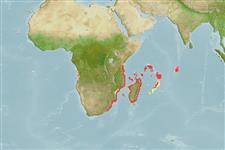
Etymology: Squatina:Latin for skate, which angel sharks superficially resemble, presumably tautonymous with Squalus squatina Linnaeus 1758 (no species mentioned) (See ETYFish); africana:ana- (L.), belonging to: Africa, referring to distribution from South Africa to Mozambique, Tanzania and Madagascar (See ETYFish). More on author: Regan.
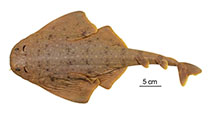
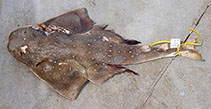
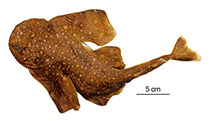
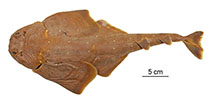
This medium-sized angel shark species (maximum size 122.0 or possibly 130.0 cm TL) posess the following characters: no median row of scute-like denticles on the trunk; anterior nasal flap has two lateral, elongate barbels and a medial rectangular barbel, the ventral margin of medial barbel is slightly fringed, but that of lateral barbels are almost smooth; posterior nasal flap without additional barblet; concave between eyes; pectoral-pelvic space 6.0-10.2% TL; pectoral-fin apex is angular; pelvic-fin free rear tips do not reach level of first dorsal-fin origin; tail moderately long, its length from cloaca 51.2-53.2% TL; pectoral fins are moderately long, length 31.8-35.6% TL; dorsal fins are not lobe-like; first dorsal-fin base is somewhat longer than second dorsal-fin base; caudal fin of adults with angular apices; monospondylous centra 46-49; diplosondylous precaudal centra 58-62; total precaudal centra 104-111; total vertebral centra 134-143; pectoral-fin skeleton is with propterygium articulating with three radials. Colouration: dorsal medium to dark brown, reddish-brown or grayish, with a variable pattern of numerous light and dark reddish spots and blotches, marbled with brownish reticulations and partially forming symmetrical dark bands or saddles (Ref. 128961). Cross section: flattened.
Found on the continental shelf and uppermost slope, from the surf line close inshore to 494 m depth (Ref. 247). Feeds on bony fish, squid and octopus (Ref. 247). Ovoviviparous (Ref. 50449), with about 7 to 11 young in a litter (Ref. 247). Largest juvenile males measured with clearly immature claspers are 45.3 cm TL (ZMH 26100) and 50.3 cm TL (MNHN-IC-1987-1265) while the largest female examined is 94.0 cm TL (SAIAB 187381) and possibly an adult; while small female specimens of 29.3 cm TL (ZMMU P-14844), 30.9 cm TL (ZMH 123064), and 38.5 cm TL (MNHN-IC-1988-0359) mm TL are clearly juvenile (Ref. 128961). Sometimes caught by surf anglers (Ref. 6588).
Weigmann, S., D.F.B. Vaz, K.V. Akhilesh, R.H. Leeney and G.J.P. Naylor, 2023. Revision of the western Indian ocean angel sharks, genus Squatina (Squatiniformes, Squatinidae), with description of a new species and redescription of the African angel shark Squatina africana Regan, 1908. Biology 2023, 12(77):975. (Ref. 128961)
สถานะบัญชีแดงของ IUCN (Ref. 130435: Version 2025-2 (Global))
อุณหภูมิที่ต้องการ (อ้างอิง 123201): 14 - 24.8, mean 18.2 °C (based on 68 cells).
ดัชนีความหลากหลายทางวิวัฒนาการ (อ้างอิง 82804): PD50 = 0.5000 [Uniqueness, from 0.5 = low to 2.0 = high].
Bayesian length-weight: a=0.00479 (0.00260 - 0.00880), b=3.03 (2.86 - 3.20), in cm total length, based on LWR estimates for this species & Genus-body shape (Ref. 93245).
ระดับชั้นอาหาร (อ้างอิง 69278): 4.2 ±0.5 se; based on diet studies.