Valenciennea puellaris, Maiden goby : fisheries, aquarium

Valenciennea puellaris (Tomiyama, 1956)

Maiden goby
Lägg till din observation i Fish Watcher
Native range | All suitable habitat | Point map | Year 2050
This map was computer-generated and has not yet been reviewed.
Valenciennea puellaris   AquaMaps   Data sources: GBIF OBIS
Ladda upp din foton och Videor
Bilder | Videor | Google image

Klassificering / Namn Populärnamn | synonymer | Catalog of Fishes(Släkte, Arter) | ITIS | CoL | WoRMS | Cloffa

> Gobiiformes (Gobies) > Gobiidae (Gobies) > Gobiinae
Etymology: Valenciennea: From Achille Valenciennes 1794-1865; he worked with Duméril, Cuvier and Lacepède since 1815; malacologist, author of a "Histoire naturelle des poissons" (Ref. 45335).
Eponymy: Achille Valenciennes (1794–1865) was a French zoologist; primarily an ichthyologist and conchologist. [...] (Ref. 128868), visit book page.

Miljö: miljö / Klimatzon / djupintervall / distributionsområde Ekologi

marina revassocierade; ej vandrande (Ref. 52884); djupintervall 2 - 84 m (Ref. 86942), usually 10 - 30 m (Ref. 8527). Tropical; 22°C - 26°C (Ref. 27115); 32°N - 24°S

Utbredning Territorier | FAO områden | Ekosystem | Förekomster | Prickkarta | Utplanteringar | Faunafri

Indo-Pacific: Red Sea to Samoa, north to southern Japan, south to the Great Barrier Reef and New Caledonia.

Storlek / Vikt / Ålder

Könsmognad: Lm ?  range ? - ? cm
Max length : 20.0 cm SL hane/ej könsbestämd; (Ref. 48637)

Kort beskrivning Bestämningsnycklar | Morfologi | Morfometri

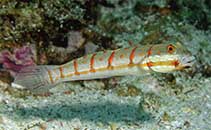
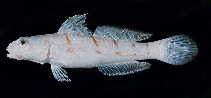
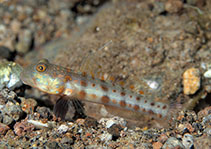
Taggstrålar i ryggfenan (totalt) : 7; Mjukstrålar i ryggfenan (totalt) : 11 - 12; Taggstrålar i analfenan: 1; Mjukstrålar i analfenan: 11 - 12. Characterized by pale grey body color for Pacific fish with row of large orange spots on side, a series of dash-like markings below, smaller orange spots on back and blue to whitish streaks or spots on head; Indian Ocean fish with pale blue-grey body color with orange stripe across lower head, cheeks with blue markings and orange bars on side connected to pale orange stripe on lower half; third dorsal spine, longest, filamentous in juveniles under 40 mm SL; rounded caudal fin, 3.0-4.2 in SL; longitudinal scale series 79-91; ctenoid body scales, becoming cycloid anteriorly before first dorsal fin, on lower side, and midline of abdomen; head or midline of nape without scales; side of nape with scales extending forward to above middle of operculum; scaleless pectoral fin base; partly to fully scaled prepelvic area; depth of body 4.8-6.0 in SL (Ref. 90102).
Body shape (shape guide): fusiform / normal.

Biologi     Ordlista (t.ex. epibenthic)

Adults inhabit sandy areas of clear lagoon and seaward reefs (Ref. 9710, 48637). They occur in pairs and use burrows as refuge. Monogamous (Ref. 52884). The burrow is shallow, only a few cm, and made under large pieces of rubble. May be found on dark volcanic sand such as those in the Philippines, Indonesia, and the northern Mariana Is. Also Ref. 58652.

Livscykel och parningsbeteende Könsmognad | Reproduktion | Lek | Ägg | Fekunditet | Larver

Monogamous mating is observed as both obligate and social (Ref. 52884).

Huvudreferens Ladda upp dina referenser | referenser | Koordinator | Medarbetare

Hoese, D.F. and H.K. Larson, 1994. Revision of the Indo-Pacific gobiid fish genus Valenciennea, with descriptions of seven new species. Indo-Pac. Fish. (23):71 p. (Ref. 8527)

Status på IUCN:s rödlista (Ref. 130435: Version 2025-2 (Global))

  Least Concern (LC) ; Date assessed: 11 March 2015

CITES

Not Evaluated

CMS (Ref. 116361)

Not Evaluated

Hot mot människor

  Harmless


Mänskliga användningsområden

Fiskeri: kommersiell; Akvarium: Kommersiell
FAO - Publication: search | FishSource |

Ytterligare information

Trofisk ekologi
Livsmedelsartiklar (preys)
Födosammansättning
Födointag
Matransoner
Predatorer
Ekologi
Ekologi
Populationsdynamik
Tillväxtparametrar
Max. åldrar / storlekar
Längd-vikt rel.
Längd-längd rel.
Längd-frekvenser
Massakonvertering
Rekrytering
Abundans
Livscykel
Reproduktion
Könsmognad
Mognad/Gills rel.
Fekunditet
Lek
Lekande aggregat
Ägg
Utveckling av ägg
Larver
Larvdynamik
Utbredning
Territorier
FAO områden
Ekosystem
Förekomster
Utplanteringar
BRUVS - Videor
Anatomi
Gälyta
Hjärna
Otolit
Fysiologi
Kroppssammansättning
Näringsämnen
Syreförbrukning
Typ av simning
Simhastighet
Visuella pigment
Ljud från fisk
Sjukdomar & Parasiter
Toxicitet (LC50)
Genetik
Genom
Genetik
Heterozygositet
Ärftlighet
Genetisk mångfald
Människorelaterad
Vattenbrukssystem
Vattenbruksprofiler
Avelslinjer
Ciguatera-fall
Frimärken, mynt, diverse.
Uppsökande verksamhet
Medarbetare
referenser
referenser

Verktyg

Särskilda rapporter

Ladda ner XML

Internet-källor

AFORO (otoliths) | Aquatic Commons | BHL | Cloffa | Websites from users | Check FishWatcher | CISTI | Catalog of Fishes: Släkte, Arter | DiscoverLife | ECOTOX | FAO - Publication: search | Faunafri | Fishipedia | Fishtrace | GloBI | Google Books | Google Scholar | Google | IGFA World Record | Nationella databaser | OneZoom | Open Tree of Life | Otolith Atlas of Taiwan Fishes | Offentliga akvarier | PubMed | Reef Life Survey | Socotra Atlas | TreeBase | Tree of Life | Wikipedia: Go, sök | World Records Freshwater Fishing | Zoologiskt register

Uppskattningar baserade på modeller

Önskad temperatur (Ref. 123201): 25.5 - 29, mean 28 °C (based on 842 cells).
Index för fylogenetisk mångfald (Ref. 82804):  PD50 = 0.5000   [Uniqueness, from 0.5 = low to 2.0 = high].
Bayesian length-weight: a=0.01023 (0.00477 - 0.02194), b=3.01 (2.83 - 3.19), in cm total length, based on LWR estimates for this (Sub)family-body shape (Ref. 93245).
Trofisk nivå (Ref. 69278):  3.2   ±0.3 se; based on size and trophs of closest relatives
Resiliens (Ref. 120179):  Mellan, lägsta populationsfördubblingstid 1,4-4,4 år (Preliminary K or Fecundity.).
Sårbarhet i fisket (Ref. 59153):  Low vulnerability (14 of 100). 🛈
Priskategori (Ref. 80766):   Very high.
Näringsämnen (Ref. 124155):  Calcium = 67.3 [37.5, 120.7] mg/100g; Iron = 0.642 [0.338, 1.122] mg/100g; Protein = 18.4 [16.4, 20.1] %; Omega3 = 0.145 [0.070, 0.232] g/100g; Selenium = 30.2 [18.0, 54.9] μg/100g; VitaminA = 107 [30, 312] μg/100g; Zinc = 1.57 [1.09, 2.26] mg/100g (wet weight);