Valenciennea puellaris, Maiden goby : fisheries, aquarium

Valenciennea puellaris (Tomiyama, 1956)

Maiden goby
Ajouter votre observation dans Fish Watcher
Native range | All suitable habitat | Point map | Year 2050
This map was computer-generated and has not yet been reviewed.
Valenciennea puellaris   AquaMaps   Data sources: GBIF OBIS
Envoyez vos Photos et vidéos
Images | vidéos | Images Google

Classification / Noms Noms communs | Synonymes | Catalog of Fishes(Genre, Espèce) | ITIS | CoL | WoRMS | Cloffa

> Gobiiformes (Gobies) > Gobiidae (Gobies) > Gobiinae
Etymology: Valenciennea: From Achille Valenciennes 1794-1865; he worked with Duméril, Cuvier and Lacepède since 1815; malacologist, author of a "Histoire naturelle des poissons" (Ref. 45335).
Eponymy: Achille Valenciennes (1794–1865) was a French zoologist; primarily an ichthyologist and conchologist. [...] (Ref. 128868), visit book page.

Environnement : milieu / zone climatique / profondeur / gamme de distribution Écologie

marin récifal; non migrateur (Ref. 52884); profondeur 2 - 84 m (Ref. 86942), usually 10 - 30 m (Ref. 8527). Tropical; 22°C - 26°C (Ref. 27115); 32°N - 24°S

Distribution Territoires | Zones FAO | Écosystèmes | Occurrences | Carte par point | Introductions | Faunafri

Indo-Pacific: Red Sea to Samoa, north to southern Japan, south to the Great Barrier Reef and New Caledonia.

Taille / Poids / Âge

Maturité: Lm ?  range ? - ? cm
Max length : 20.0 cm SL mâle / non sexé; (Ref. 48637)

Description synthétique Clés d'identification | Morphologie | Morphométrie

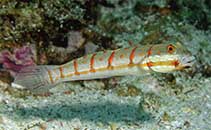
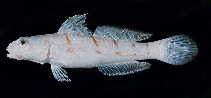
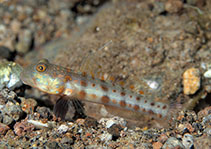
Épines dorsales (Total) : 7; Rayons mous dorsaux (Total) : 11 - 12; Épines anales: 1; Rayons mous anaux: 11 - 12. Characterized by pale grey body color for Pacific fish with row of large orange spots on side, a series of dash-like markings below, smaller orange spots on back and blue to whitish streaks or spots on head; Indian Ocean fish with pale blue-grey body color with orange stripe across lower head, cheeks with blue markings and orange bars on side connected to pale orange stripe on lower half; third dorsal spine, longest, filamentous in juveniles under 40 mm SL; rounded caudal fin, 3.0-4.2 in SL; longitudinal scale series 79-91; ctenoid body scales, becoming cycloid anteriorly before first dorsal fin, on lower side, and midline of abdomen; head or midline of nape without scales; side of nape with scales extending forward to above middle of operculum; scaleless pectoral fin base; partly to fully scaled prepelvic area; depth of body 4.8-6.0 in SL (Ref. 90102).
Body shape (shape guide): fusiform / normal.

Biologie     Glossaire (ex. epibenthic)

Adults inhabit sandy areas of clear lagoon and seaward reefs (Ref. 9710, 48637). They occur in pairs and use burrows as refuge. Monogamous (Ref. 52884). The burrow is shallow, only a few cm, and made under large pieces of rubble. May be found on dark volcanic sand such as those in the Philippines, Indonesia, and the northern Mariana Is. Also Ref. 58652.

Cycle de vie et comportement reproducteur Maturité | Reproduction | Frai | Œufs | Fécondité | Larves

Monogamous mating is observed as both obligate and social (Ref. 52884).

Référence principale Téléchargez vos références | Références | Coordinateur | Collaborateurs

Hoese, D.F. and H.K. Larson, 1994. Revision of the Indo-Pacific gobiid fish genus Valenciennea, with descriptions of seven new species. Indo-Pac. Fish. (23):71 p. (Ref. 8527)

Statut dans la liste rouge de l'IUCN (Ref. 130435: Version 2025-2 (Global))

  Préoccupation mineure (LC) ; Date assessed: 11 March 2015

CITES

Not Evaluated

CMS (Ref. 116361)

Not Evaluated

Menace pour l'homme

  Harmless


Utilisations par l'homme

Pêcheries: commercial; Aquarium: Commercial
FAO - Publication: search | FishSource |

Plus d'informations

Écologie trophique
Aliments (proies)
Composition du régime alimentaire
Consommation alimentaire
Rations alimentaires
Prédateurs
Écologie
Écologie
Dynamique des populations
Paramètres de croissance
Âges / tailles maximales
Longueur-poids rel.
Rel. longueur-longueur.
Fréquences de longueurs
Conversion de masse
Recrutement
Abondance
Cycle de vie
Reproduction
Maturité
Maturité/épines rel.
Fécondité
Frai
Agrégats de frai
Œufs
Développement de l'œuf
Larves
Dynamique des populations larvaires
Distribution
Territoires
Zones FAO
Écosystèmes
Occurrences
Introductions
BRUVS - Vidéos
Anatomie
Surface branchiale
Cerveau
Otolithe
Physiologie
Composition corporelle
Nutriments
Consommation d'oxygène
Type de natation
Vitesse de nage
Pigments visuels
Son de poisson
Maladies et parasites
Toxicité (CL50)
Génétique
génôme
Génétique
Hétérozygotie
Héritabilité
Diversité génétique
Liées à l'homme
Systèmes d'aquaculture
Profils d'aquaculture
Souches
Cas de ciguatera
Timbres, pièces de monnaie, divers
Sensibilisation
Collaborateurs
Références
Références

Outils

Articles particuliers

Télécharger en XML

Sources Internet

AFORO (otoliths) | Aquatic Commons | BHL | Cloffa | Websites from users | FishWatcher | CISTI | Catalog of Fishes: Genre, Espèce | DiscoverLife | ECOTOX | FAO - Publication: search | Faunafri | Fishipedia | Fishtrace | GloBI | Google Books | Google Scholar | Google | IGFA World Record | Bases de données nationales | OneZoom | Open Tree of Life | Otolith Atlas of Taiwan Fishes | Aquariums publics | PubMed | Reef Life Survey | Socotra Atlas | TreeBase | Arbre de Vie | Wikipedia: aller à, chercher | World Records Freshwater Fishing | Zoological Record

Estimations basées sur des modèles

Température préférée (Réf. 123201): 25.5 - 29, mean 28 °C (based on 842 cells).
Indice de diversité phylogénétique (Réf. 82804):  PD50 = 0.5000   [Uniqueness, from 0.5 = low to 2.0 = high].
Bayesian length-weight: a=0.01023 (0.00477 - 0.02194), b=3.01 (2.83 - 3.19), in cm total length, based on LWR estimates for this (Sub)family-body shape (Ref. 93245).
Niveau trophique (Réf. 69278):  3.2   ±0.3 se; based on size and trophs of closest relatives
Résilience (Réf. 120179):  Milieu, temps minimum de doublement de population : 1,4 à 4,4 années (Preliminary K or Fecundity.).
Vulnérabilité de la pêche (Ref. 59153):  Low vulnerability (14 of 100). 🛈
Catégorie de prix (Ref. 80766):   Very high.
Nutriments (Ref. 124155):  Calcium = 67.3 [37.5, 120.7] mg/100g; Iron = 0.642 [0.338, 1.122] mg/100g; Protein = 18.4 [16.4, 20.1] %; Omega3 = 0.145 [0.070, 0.232] g/100g; Selenium = 30.2 [18.0, 54.9] μg/100g; VitaminA = 107 [30, 312] μg/100g; Zinc = 1.57 [1.09, 2.26] mg/100g (wet weight);