This website uses cookies to enhance your browsing experience and ensure the functionality of our site. For more detailed information about the types of cookies we use and how we protect your privacy, please visit our Privacy Information page.
×
Cookie Settings
This website uses different types of cookies to enhance your experience. Please select your preferences below:
Elasmobranchii (Haie und Rochen) (sharks and rays) > Squaliformes (Sleeper and dogfish sharks) > Squalidae (Dogfish sharks)
Etymology: Squalus:Genus name from Latin 'squalus' meaning shark (Ref. 6885, 27436). Eponymy: Dr Kakichi Mitsukuri (1857–1909) was a Japanese zoologist who first went to the USA (1873) and achieved doctorates from Yale (1879) and from Johns Hopkins University (1883). [...] (Ref. 128868), visit book page. More on authors: Jordan & Snyder.
Umwelt: Milieu / Klimazone / Tiefenbereich / Verbreitungsgebiet Ökologie
seewasser benthopelagisch; tiefenbereich 29 - 600 m (Ref. 58302), usually 48 - 533 m (Ref. 57911). Deep-water; 8°C - 17°C (Ref. 57911); 45°N - 55°S, 97°W - 164°W (Ref. 54897)
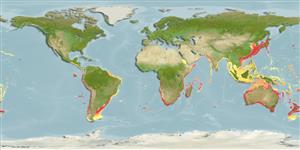
Circumglobal in temperate and subtropical waters: Widely distributed in most oceans but possibly consisting of a species complex (Ref. 6871, 31367). Western Indian Ocean: Walters Shoal (MNHN 1991-0406) (Ref. 33390); Eastern Indian Ocean: southern Australia (Ref. 6871); West Pacific: Seamounts in the North Pacific, Japan, Korea, China (and presumably Taiwan and Viet Nam); Southwest Pacific: possibly in New Zealand; Southeast Pacific: Desventuradas Is. and Juan Fernández Is. Southwest Atlantic: Uruguay to Argentina (Ref. 58839). Records of Squalus blainvillei or Squalus fernandinus from the western Indian Ocean, New Caledonia and Chile are based in part on this species. Elsewhere, dogfishes very similar to Squalus mitsukurii are not conspecific with Squalus blainvillei.
Länge bei der ersten Reifung / Größe / Gewicht / Alter
Geschlechtsreife: Lm77.8, range 68 - ? cm Max length : 89.8 cm TL Männchen/unbestimmt; (Ref. 55642); 94.3 cm TL (female); common length : 76.0 cm TL Männchen/unbestimmt; (Ref. 31367); common length :82 cm TL (female)
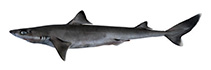
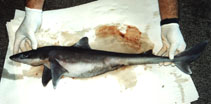
Rückenflossenstacheln (insgesamt) : 2; Afterflossenstacheln: 0. A large dogfish with a long, angular snout and a small mouth slightly more than half the snout length; body without spots; 1st dorsal fin spine over pectoral fins (Ref. 5578). Pearl-grey above, white below; fins with white edges, sides rarely with white spots (Ref. 5578). Body shape (shape guide): elongated.
Found on the continental and insular shelves and upper slopes (Ref. 247, 75154). Perhaps ranging from 4-740 m (Ref. 58302). Feeds on bony fishes including hake, snoek, conger eels and lantern fishes (Ref. 36731), cephalopods, and crustaceans (Ref. 5213). Ovoviviparous (Ref. 205), with about 4 to 9 pups in a litter (Ref. 247).
Ovoviviparous. Probably has 4 to 9 young per litter, most births in autumn, off the east coast of South Africa. There might be a gestation period of up to two years, and sexual segregation of females in the southern part of its range. Size at birth about 22 to 26 cm.
Compagno, L.J.V., 1984. FAO Species Catalogue. Vol. 4. Sharks of the world. An annotated and illustrated catalogue of shark species known to date. Part 1 - Hexanchiformes to Lamniformes. FAO Fish. Synop. 125(4/1):1-249. Rome, FAO. (Ref. 247)
IUCN Rote Liste Status (Ref. 130435: Version 2025-2 (Global))
Bevorzugte Temperatur (Ref. 123201): 6.4 - 21.9, mean 14.1 °C (based on 1219 cells).
Phylogenetischer Diversitätsindex (Ref. 82804): PD50 = 0.5000 [Uniqueness, from 0.5 = low to 2.0 = high].
Bayesian length-weight: a=0.00288 (0.00170 - 0.00489), b=3.08 (2.93 - 3.23), in cm total length, based on LWR estimates for this species & Genus-body shape (Ref. 93245).
Trophische Ebene (Ref. 69278): 4.4 ±0.3 se; based on diet studies.
Widerstandsfähigkeit (Ref. 120179): sehr niedrig, Verdopplung der Population dauert mehr als 14 Jahre. (Fec=4).
Anfälligkeit der Fischerei (Ref. 59153): High vulnerability (58 of 100). 🛈