



Cordylancistrus tayrona Provenzano, Milani & Ardila Rodríguez, 2017
Envoyez vos Photos et vidéos
Images Google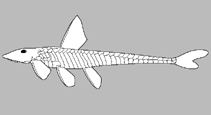 No image available for this species;
drawing shows typical species in Loricariidae.
Images Google
drawing shows typical species in Loricariidae.
Classification / Noms Noms communs | Synonymes | Catalog of Fishes(Genre, Espèce) | ITIS | CoL | WoRMS | Cloffa
> Siluriformes (Catfishes) > Loricariidae (Armored catfishes) > Hypostominae
Etymology: Cordylancistrus: Greek, kordyle, -es = young tunna + Greek, agkistron = hook (Ref. 45335); tayrona: Named after the Tayrona culture or Tayrona nation, an indigenous group that occupied the area of the Sierra Nevada de Santa Marta, and more broadly the area of northeastern Colombia, paying homage to these brave and clever people and to their descendants who today live restricted in the Sierra Nevada de Santa Marta; noun in apposition.
Etymology: Cordylancistrus: Greek, kordyle, -es = young tunna + Greek, agkistron = hook (Ref. 45335); tayrona: Named after the Tayrona culture or Tayrona nation, an indigenous group that occupied the area of the Sierra Nevada de Santa Marta, and more broadly the area of northeastern Colombia, paying homage to these brave and clever people and to their descendants who today live restricted in the Sierra Nevada de Santa Marta; noun in apposition.
Environnement : milieu / zone climatique / profondeur / gamme de distribution Écologie
; eau douce démersal. Tropical
Distribution Territoires | Zones FAO | Écosystèmes | Occurrences | Carte par point | Introductions | Faunafri
South America: Colombia.
Taille / Poids / Âge
Description synthétique Clés d'identification | Morphologie | Morphométrie
Rayons mous dorsaux (Total) : 8 - 9; Rayons mous anaux: 3. lThis species is distinguished from its congeners by the presence of a unique fleshy black or dark brown keel or excrescence over the posterior tip of supraoccipital; with a strip of very small plates (granules) and odontodes along the snout border; with an elongated movable cheek odontodes, that reach the pectoral-fin origin: presence of adipose and anal fins; pectoral-fin spine almost reaching or surpassing half pelvic-fin spine length when adpressed (Ref. 117343).
Body shape (shape guide): elongated.
Body shape (shape guide): elongated.
Specimens were collected in piedmont rivers associated with humid tropical areas of the Sierra Nevada de Santa Marta. These rivers have transparent waters, strong to moderate current and with temperatures ranging from 18-24°C. The substrate include rocks, small stones and sand, and where aquatic vegetation is scarce or absent, because forest canopy shades most of the river course (Ref. 117343).
Cycle de vie et comportement reproducteur Maturité | Reproduction | Frai | Œufs | Fécondité | Larves
Référence principale
Téléchargez vos références | Références | Coordinateur : Fisch-Muller, Sonia | Collaborateurs
Provenzano, F.R. and F.A. Villa-Navarro, 2017. A new species of the catfish genus Cordylancistrus (Siluriformes, Loricariidae) from the Magdalena River, Tolima, Colombia. Zootaxa 4294(5):522-530. (Ref. 117343)
CITES
Not Evaluated
Menace pour l'homme
Harmless
Utilisations par l'homme
Pêcheries: sans intérêt
FAO - Publication: search | FishSource |
Plus d'informations
Écologie trophique
Aliments (proies)
Composition du régime alimentaire
Consommation alimentaire
Rations alimentaires
Prédateurs
Aliments (proies)
Composition du régime alimentaire
Consommation alimentaire
Rations alimentaires
Prédateurs
Écologie
Écologie
Écologie
Dynamique des populations
Paramètres de croissance
Âges / tailles maximales
Longueur-poids rel.
Rel. longueur-longueur.
Fréquences de longueurs
Conversion de masse
Recrutement
Abondance
Paramètres de croissance
Âges / tailles maximales
Longueur-poids rel.
Rel. longueur-longueur.
Fréquences de longueurs
Conversion de masse
Recrutement
Abondance
Cycle de vie
Reproduction
Maturité
Maturité/épines rel.
Fécondité
Frai
Agrégats de frai
Œufs
Développement de l'œuf
Larves
Dynamique des populations larvaires
Reproduction
Maturité
Maturité/épines rel.
Fécondité
Frai
Agrégats de frai
Œufs
Développement de l'œuf
Larves
Dynamique des populations larvaires
Anatomie
Surface branchiale
Cerveau
Otolithe
Surface branchiale
Cerveau
Otolithe
Physiologie
Composition corporelle
Nutriments
Consommation d'oxygène
Type de natation
Vitesse de nage
Pigments visuels
Son de poisson
Maladies et parasites
Toxicité (CL50)
Composition corporelle
Nutriments
Consommation d'oxygène
Type de natation
Vitesse de nage
Pigments visuels
Son de poisson
Maladies et parasites
Toxicité (CL50)
Génétique
génôme
Génétique
Hétérozygotie
Héritabilité
Diversité génétique
génôme
Génétique
Hétérozygotie
Héritabilité
Diversité génétique
Liées à l'homme
Systèmes d'aquaculture
Profils d'aquaculture
Souches
Cas de ciguatera
Timbres, pièces de monnaie, divers
Systèmes d'aquaculture
Profils d'aquaculture
Souches
Cas de ciguatera
Timbres, pièces de monnaie, divers
Outils
E-book | Guide de terrain | Générateur de fréquences de longueur | Outil de dynamique de population | Carte par point |
Capture-MSY |
Articles particuliers
Télécharger en XML
Sources Internet
AFORO (otoliths) | Aquatic Commons | BHL | Cloffa | Websites from users | FishWatcher | CISTI | Catalog of Fishes: Genre, Espèce | DiscoverLife | ECOTOX | FAO - Publication: search | Faunafri | Fishipedia | Fishtrace | GloBI | Google Books | Google Scholar | Google | IGFA World Record | OneZoom | Open Tree of Life | Otolith Atlas of Taiwan Fishes | PubMed | Reef Life Survey | Socotra Atlas | TreeBase | Arbre de Vie | Wikipedia: aller à, chercher | World Records Freshwater Fishing | Zoobank | Zoological Record
Estimations basées sur des modèles
Indice de diversité phylogénétique (Réf. 82804): PD50 = 0.5156 [Uniqueness, from 0.5 = low to 2.0 = high].
Bayesian length-weight: a=0.01549 (0.00726 - 0.03306), b=2.96 (2.79 - 3.13), in cm total length, based on LWR estimates for this (Sub)family-body shape (Ref. 93245).
Résilience (Réf. 120179): Haut, temps minimum de doublement de population inférieur à 15 mois (Preliminary K or Fecundity.).