



Neomerinthe parallelaspina Matsumoto & Motomura, 2024
Parallel-spine scorpionfish
Envoyez vos Photos et vidéos
Images Google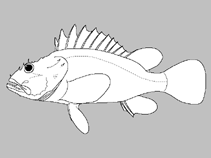 No image available for this species;
drawing shows typical species in Scorpaenidae.
Images Google
drawing shows typical species in Scorpaenidae.
Classification / Noms Noms communs | Synonymes | Catalog of Fishes(Genre, Espèce) | ITIS | CoL | WoRMS | Cloffa
> Perciformes/Scorpaenoidei (Scorpionfishes) > Scorpaenidae (Scorpionfishes or rockfishes) > Scorpaeninae
Etymology: Neomerinthe: Greek, neos = new + Greek, merinthos, -ou = thread (Ref. 45335); parallelaspina: Name 'parallelaspina' from Latin words 'parallela' and 'spina', meaning 'parallel' and 'spine', referring to the orientation of the 3rd and 4th preopercular spines.
Etymology: Neomerinthe: Greek, neos = new + Greek, merinthos, -ou = thread (Ref. 45335); parallelaspina: Name 'parallelaspina' from Latin words 'parallela' and 'spina', meaning 'parallel' and 'spine', referring to the orientation of the 3rd and 4th preopercular spines.
Environnement : milieu / zone climatique / profondeur / gamme de distribution Écologie
marin démersal; profondeur 126 - 207 m (Ref. 133153). Tropical
Distribution Territoires | Zones FAO | Écosystèmes | Occurrences | Carte par point | Introductions | Faunafri
Eastern Indian Ocean: Australia.
Taille / Poids / Âge
Description synthétique Clés d'identification | Morphologie | Morphométrie
Épines dorsales (Total) : 12; Rayons mous dorsaux (Total) : 9. This species is distinguished by the following set of characters: D 9; pectoral-fin rays 19-21 (usually 20); scale rows in longitudinal series 40-45 (43); pored lateral-line scales 23-25 (24); scale rows above lateral line 4-6 (5), below lateral line 9-11 (10), between 6th dorsal-fin spine base and lateral line 5 or 6 (5), and between last dorsal-fin spine base and lateral line 4-6 (5); upper gill rakers 4-6 (5), lower gill rakers 10-15 (12) [7-10 (9) and 2-6 (3) on ceratohyal and hypobranchial, respectively], total gill rakers 15-20 (18); absence of longitudinal ridge on lateral surface of maxilla; presence of lateral lacrimal spine; 3 suborbital spines; presence of 2nd preopercular spine; 4th preopercular spine large, directed parallel to 3rd preopercular spine; absence of upper posttemporal spine; minute slit behind last gill arch; many small cycloid scales on base of pectoral fin and ventral surface of body from isthmus to beyond pelvic fin; posterior margin of soft-rayed portion of dorsal-fin rounded; fin membrane between last dorsal-fin soft ray and caudal peduncle absent; body depth 29.5-36.4 (32.9) % SL; 2nd dorsal-fin ray length 18.0-21.3 (19.8) % SL; 3rd dorsal-fin ray length 17.7-22.4 (20.1) % SL; 4th dorsal-fin ray length 18.3-22.6 (20.0) % SL; 5th dorsal-fin ray length 16.8-21.7 (19.6) % SL; 3rd preopercular spine length 2.3-6.1 (4.2) % HL; 4th preopercular spine length 1.4-4.7 (2.8) % HL; pale yellowish body and pectoral fins, with indistinct blotches above lateral line when preserved (Ref. 133153).
Cross section: compressed.
Cross section: compressed.
Cycle de vie et comportement reproducteur Maturité | Reproduction | Frai | Œufs | Fécondité | Larves
Référence principale
Téléchargez vos références | Références | Coordinateur | Collaborateurs
Matsumoto, T. and H. Motomura, 2024. Two new species of the scorpionfish genus Neomerinthe Fowler 1935 (Teleostei: Scorpaenidae) from northwestern Australia. Ichthyological Research 72(1):1-16. (Ref. 133153)
CITES
Not Evaluated
Menace pour l'homme
Harmless
Utilisations par l'homme
Pêcheries: sans intérêt
FAO - Publication: search | FishSource |
Plus d'informations
Écologie trophique
Aliments (proies)
Composition du régime alimentaire
Consommation alimentaire
Rations alimentaires
Prédateurs
Aliments (proies)
Composition du régime alimentaire
Consommation alimentaire
Rations alimentaires
Prédateurs
Écologie
Écologie
Écologie
Dynamique des populations
Paramètres de croissance
Âges / tailles maximales
Longueur-poids rel.
Rel. longueur-longueur.
Fréquences de longueurs
Conversion de masse
Recrutement
Abondance
Paramètres de croissance
Âges / tailles maximales
Longueur-poids rel.
Rel. longueur-longueur.
Fréquences de longueurs
Conversion de masse
Recrutement
Abondance
Cycle de vie
Reproduction
Maturité
Maturité/épines rel.
Fécondité
Frai
Agrégats de frai
Œufs
Développement de l'œuf
Larves
Dynamique des populations larvaires
Reproduction
Maturité
Maturité/épines rel.
Fécondité
Frai
Agrégats de frai
Œufs
Développement de l'œuf
Larves
Dynamique des populations larvaires
Anatomie
Surface branchiale
Cerveau
Otolithe
Surface branchiale
Cerveau
Otolithe
Physiologie
Composition corporelle
Nutriments
Consommation d'oxygène
Type de natation
Vitesse de nage
Pigments visuels
Son de poisson
Maladies et parasites
Toxicité (CL50)
Composition corporelle
Nutriments
Consommation d'oxygène
Type de natation
Vitesse de nage
Pigments visuels
Son de poisson
Maladies et parasites
Toxicité (CL50)
Génétique
génôme
Génétique
Hétérozygotie
Héritabilité
Diversité génétique
génôme
Génétique
Hétérozygotie
Héritabilité
Diversité génétique
Liées à l'homme
Systèmes d'aquaculture
Profils d'aquaculture
Souches
Cas de ciguatera
Timbres, pièces de monnaie, divers
Systèmes d'aquaculture
Profils d'aquaculture
Souches
Cas de ciguatera
Timbres, pièces de monnaie, divers
Outils
E-book | Guide de terrain | Générateur de fréquences de longueur | Outil de dynamique de population | Carte par point |
Capture-MSY |
Articles particuliers
Télécharger en XML
Sources Internet
AFORO (otoliths) | Aquatic Commons | BHL | Cloffa | Websites from users | FishWatcher | CISTI | Catalog of Fishes: Genre, Espèce | DiscoverLife | ECOTOX | FAO - Publication: search | Faunafri | Fishipedia | Fishtrace | GloBI | Google Books | Google Scholar | Google | IGFA World Record | OneZoom | Open Tree of Life | Otolith Atlas of Taiwan Fishes | PubMed | Reef Life Survey | Socotra Atlas | TreeBase | Arbre de Vie | Wikipedia: aller à, chercher | World Records Freshwater Fishing | Zoobank | Zoological Record
Estimations basées sur des modèles
Indice de diversité phylogénétique (Réf. 82804): PD50 = 0.5000 [Uniqueness, from 0.5 = low to 2.0 = high].
Bayesian length-weight: a=0.01288 (0.00626 - 0.02652), b=3.02 (2.85 - 3.19), in cm total length, based on LWR estimates for this (Sub)family-body shape (Ref. 93245).
Niveau trophique (Réf. 69278): 3.6 ±0.6 se; based on size and trophs of closest relatives
Résilience (Réf. 120179): Haut, temps minimum de doublement de population inférieur à 15 mois (Preliminary K or Fecundity.).