



Neomerinthe parallelaspina Matsumoto & Motomura, 2024
Parallel-spine scorpionfish
Uploaden van uw Foto's en video's
Google afbeelding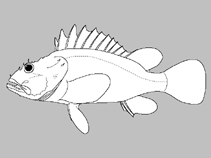 No image available for this species;
drawing shows typical species in Scorpaenidae.
Google afbeelding
drawing shows typical species in Scorpaenidae.
Classificatie / Namen Lokale namen | Synoniemen | Catalog of Fishes(Genus, Soort(en)) | ITIS | CoL | WoRMS | Cloffa
> Perciformes/Scorpaenoidei (Scorpionfishes) > Scorpaenidae (Scorpionfishes or rockfishes) > Scorpaeninae
Etymology: Neomerinthe: Greek, neos = new + Greek, merinthos, -ou = thread (Ref. 45335); parallelaspina: Name 'parallelaspina' from Latin words 'parallela' and 'spina', meaning 'parallel' and 'spine', referring to the orientation of the 3rd and 4th preopercular spines.
Etymology: Neomerinthe: Greek, neos = new + Greek, merinthos, -ou = thread (Ref. 45335); parallelaspina: Name 'parallelaspina' from Latin words 'parallela' and 'spina', meaning 'parallel' and 'spine', referring to the orientation of the 3rd and 4th preopercular spines.
Milieu: milieu / Klimaatzone / Diepte / verspreidingsgebied Ecologie
marien demersaal; diepte 126 - 207 m (Ref. 133153). Tropical
Verspreiding Gebieden | FAO regio's | Ecosystemen | Voorkomen | Verspreidingskaart | Introducties | Faunafri
Eastern Indian Ocean: Australia.
Grootte / Gewicht / Leeftijd
Korte beschrijving Determinatiesleutels | Morfologie | Morfometrie
Dorsale stekels (totaal) : 12; Dorsale zachte stralen (totaal) : 9. This species is distinguished by the following set of characters: D 9; pectoral-fin rays 19-21 (usually 20); scale rows in longitudinal series 40-45 (43); pored lateral-line scales 23-25 (24); scale rows above lateral line 4-6 (5), below lateral line 9-11 (10), between 6th dorsal-fin spine base and lateral line 5 or 6 (5), and between last dorsal-fin spine base and lateral line 4-6 (5); upper gill rakers 4-6 (5), lower gill rakers 10-15 (12) [7-10 (9) and 2-6 (3) on ceratohyal and hypobranchial, respectively], total gill rakers 15-20 (18); absence of longitudinal ridge on lateral surface of maxilla; presence of lateral lacrimal spine; 3 suborbital spines; presence of 2nd preopercular spine; 4th preopercular spine large, directed parallel to 3rd preopercular spine; absence of upper posttemporal spine; minute slit behind last gill arch; many small cycloid scales on base of pectoral fin and ventral surface of body from isthmus to beyond pelvic fin; posterior margin of soft-rayed portion of dorsal-fin rounded; fin membrane between last dorsal-fin soft ray and caudal peduncle absent; body depth 29.5-36.4 (32.9) % SL; 2nd dorsal-fin ray length 18.0-21.3 (19.8) % SL; 3rd dorsal-fin ray length 17.7-22.4 (20.1) % SL; 4th dorsal-fin ray length 18.3-22.6 (20.0) % SL; 5th dorsal-fin ray length 16.8-21.7 (19.6) % SL; 3rd preopercular spine length 2.3-6.1 (4.2) % HL; 4th preopercular spine length 1.4-4.7 (2.8) % HL; pale yellowish body and pectoral fins, with indistinct blotches above lateral line when preserved (Ref. 133153).
Cross section: compressed.
Cross section: compressed.
Levenscyclus en paargedrag Maturiteit | Voortplanting | Paaien | Eieren | Fecunditeit | Larven
Hoofdreferentie
Upload uw referenties | Referenties | Coördinator | Medewerkers
Matsumoto, T. and H. Motomura, 2024. Two new species of the scorpionfish genus Neomerinthe Fowler 1935 (Teleostei: Scorpaenidae) from northwestern Australia. Ichthyological Research 72(1):1-16. (Ref. 133153)
CITES
Not Evaluated
Gevaar voor de mens
Harmless
Gebruik door de mens
Visserij: van geen belang
FAO - Publication: search | FishSource |
Meer informatie
Trofische ecologie
Voedsel (prooien)
Dieetsamenstelling
Voedselconsumptie
Voedselrantsoenen
Predatoren
Voedsel (prooien)
Dieetsamenstelling
Voedselconsumptie
Voedselrantsoenen
Predatoren
Ecologie
Ecologie
Ecologie
Populatiedynamica
Groeiparameters
Max. leeftijden / maten
Lengte-gewicht rel.
Lengte-lengte rel.
Lengtefrequenties
Massaconversie
Rekrutering
Abundantie
Groeiparameters
Max. leeftijden / maten
Lengte-gewicht rel.
Lengte-lengte rel.
Lengtefrequenties
Massaconversie
Rekrutering
Abundantie
Levenscyclus
Voortplanting
Maturiteit
Rijpheid/kieuwen rel.
Fecunditeit
Paaien
Paaibestanden
Eieren
Ontwikkeling van de eieren
Larven
Larvale populatiedynamiek
Voortplanting
Maturiteit
Rijpheid/kieuwen rel.
Fecunditeit
Paaien
Paaibestanden
Eieren
Ontwikkeling van de eieren
Larven
Larvale populatiedynamiek
Anatomie
Kieuwoppervlak
Hersenen
Otoliet
Kieuwoppervlak
Hersenen
Otoliet
Fysiologie
Lichaamssamenstelling
Voedingsstoffen
Zuurstofverbruik
Type zwemmen
Zwemsnelheid
Visuele pigmenten
Vis geluid
Ziekten en parasieten
Toxiciteit (LC50)
Lichaamssamenstelling
Voedingsstoffen
Zuurstofverbruik
Type zwemmen
Zwemsnelheid
Visuele pigmenten
Vis geluid
Ziekten en parasieten
Toxiciteit (LC50)
Genetica
genoom
Genetica
Heterozygositeit
Erfelijkheid
Genetische diversiteit
genoom
Genetica
Heterozygositeit
Erfelijkheid
Genetische diversiteit
Menselijk gerelateerd
Aquacultuursystemen
Aquacultuurprofielen
Kweeklijnen
Ciguatera gevallen
Postzegels, munten, diversen.
Aquacultuursystemen
Aquacultuurprofielen
Kweeklijnen
Ciguatera gevallen
Postzegels, munten, diversen.
Tools
Speciale rapporten
Bekijk gegevens voor het houden in een aquarium | Bekijk Fact Sheets voor de soort | Bekijk Aquacultuur Fact Sheets
Download XML
Internetbronnen
AFORO (otoliths) | Aquatic Commons | BHL | Cloffa | Websites from users | Bekijk FishWatcher | CISTI | Catalog of Fishes: Genus, Soort(en) | DiscoverLife | ECOTOX | FAO - Publication: search | Faunafri | Fishipedia | Fishtrace | GloBI | Google Books | Google Scholar | Google | IGFA World Record | OneZoom | Open Tree of Life | Otolith Atlas of Taiwan Fishes | PubMed | Reef Life Survey | Socotra Atlas | TreeBase | Tree of Life | Wikipedia: ga naar, zoek | | Zoobank | Zoological Record
Schattingen op basis van modellen
|
Fylogenetische diversiteitsindex (Ref. 82804) |
PD50 = 0.5000 [Uniqueness, from 0.5 = low to 2.0 = high]. |
| Bayesian length-weight | a=0.01288 (0.00623 - 0.02664), b=3.02 (2.85 - 3.19), in cm total length, based on LWR estimates for this (Sub)family-body shape (Ref. 93245). |
|
Trofisch niveau (Ref. 69278) |
3.6 ±0.6 se; based on size and trophs of closest relatives |
|
Weerstandsvermogen (Ref. 120179) |
Hoog, minimale populatieverdubbelingstijd minder dan 15 maanden (Preliminary K or Fecundity.). |
|
Kwetsbaarheid van de visserij (Ref. 59153) |
Low to moderate vulnerability (28 of 100). 🛈 |