



Heteroclinus colemani Hoese, Hay & Dibattista, 2024
Coleman’s weedfish
Hochladen Photos und videos
Google Bild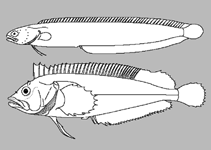 No image available for this species;
drawing shows typical species in Clinidae.
Google Bild
drawing shows typical species in Clinidae.
Klassifizierung / Names Namen | Synonyme | Catalog of Fishes(Gattung, Arten) | ITIS | CoL | WoRMS | Cloffa
> Blenniiformes (Blennies) > Clinidae (Clinids)
Etymology: Heteroclinus: Greek, heteros = other + Greek, klinein, kline = sloping and bed, due to the four apophyses of sphenoid bone (Ref. 45335); colemani: 'colemani', i.e. named for Neville Coleman (Ref. 132458).
Etymology: Heteroclinus: Greek, heteros = other + Greek, klinein, kline = sloping and bed, due to the four apophyses of sphenoid bone (Ref. 45335); colemani: 'colemani', i.e. named for Neville Coleman (Ref. 132458).
Umwelt: Milieu / Klimazone / Tiefenbereich / Verbreitungsgebiet Ökologie
seewasser benthopelagisch; tiefenbereich 0 - 15 m (Ref. 132458). Subtropical
Verbreitung Territorien | FAO Gebiete | Ökosysteme | Vorkommen | Punkt Karte | Einführungen | Faunafri
Indo-West Pacific: Australia
Größe / Gewicht / Alter
Geschlechtsreife: Lm ? range ? - ? cm
Max length : 4.7 cm SL (female)
Max length : 4.7 cm SL (female)
Kurzbeschreibung Bestimmungsschlüssel | Morphologie | Morphometrie
Rückenflossenstacheln (insgesamt) : 27 - 28; Rückenflossenweichstrahlen (insgesamt) : 3; Afterflossenstacheln: 2; Afterflossenweichstrahlen: 18 - 19. This specis is distinguished by the following characters: D III, XXIV-XXV, 3; A II,18-19; pectoral rays 13, uppermost ray very short and easily missed; gill rakers on outer face of first arch 3 + 7-8 = 10-11; circumorbital head pores uniserial (13-17 pores); orbital tentacle is elongated with a rounded lobe, expanding slightly distally; nasal tentacle simple, round, its flap length about equal to tubular base length; middle gill rakers and uppermost rakers on the outer face of first arch not branched dorsally; first dorsal fin elevated in both sexes (second dorsal spine 11.6-16.7% SL, not showing significant change with size), fin originating over posterior end of eye to about middle of preoperculum; third dorsal spine in front of a vertical from pelvic origin; last dorsal ray is connected by membrane to posterior part of caudal peduncle; body deep with proportion increasing with increasing size (depth at anal origin 25.9-30.6% SL in 3.67-5.0 cm SL and 30.3-34.6% SL in specimens 5.1-8.3 cm SL). Colouration: body usually red to reddish orange in life; 6-7 dark saddles along dorsolateral surface of the trunk and tail extending onto dorsal fin, with 6-8 clear windows between spines, no spines in windows; windows sometimes incomplete, with pigment above and or below clear parts of windows; three silver to white bars with brown margins radiating from the eye, the first across snout and middle of upper jaw, the second extending ventrally to end of mouth, the third extending posteriorly from mid posterior edge of eye (Ref. 132458).
Cross section: compressed.
Cross section: compressed.
Depth and maximum size based on original description.
Lebenszyklus und Paarungsverhalten Geschlechtsreife | Fortpflanzung | Ablaichen | Eier | Fruchtbarkeit | Larven
Hauptreferenz
Laden Sie Ihre Referenzen hoch | Referenzen | Koordinator : Williams, Jeffrey T. | Partner
Hoese, D.F., A. Hay and J.D. Dibattista, 2024. A review of the Heteroclinus heptaeolus complex (Pisces: Blennioidei: Clinidae), with three new species and discussion of use of proportions in taxonomic studies. Zootaxa 5432(3):301-348. (Ref. 132458)
CITES
Not Evaluated
Bedrohung für Menschen
Harmless
Nutzung durch Menschen
Fischereien: nicht kommerziell
FAO - Publication: search | FishSource |
Mehr Information
Trophische Ökologie
Lebensmittel (Beutetiere)
Nahrungszusammensetzung
Nahrungsaufnahme
Lebensmittelrationen
Räuber
Lebensmittel (Beutetiere)
Nahrungszusammensetzung
Nahrungsaufnahme
Lebensmittelrationen
Räuber
Populationsdynamik
Wachstumsparameter
Max. Alter/Größen
Länge-Gewicht-Rel.
Länge-Länge-Verhältnis.
Längenhäufigkeiten
Massenkonvertierung
Rekrutierung
Dichte
Wachstumsparameter
Max. Alter/Größen
Länge-Gewicht-Rel.
Länge-Länge-Verhältnis.
Längenhäufigkeiten
Massenkonvertierung
Rekrutierung
Dichte
Lebenszyklus
Fortpflanzung
Geschlechtsreife
Reifung/Kiemen rel.
Fruchtbarkeit
Ablaichen
Laichaggregationen
Eier
Eientwicklung
Larven
Larven Pop.Dyn.
Fortpflanzung
Geschlechtsreife
Reifung/Kiemen rel.
Fruchtbarkeit
Ablaichen
Laichaggregationen
Eier
Eientwicklung
Larven
Larven Pop.Dyn.
Anatomie
Kiemenoberfläche
Gehirn
Otolith
Kiemenoberfläche
Gehirn
Otolith
Physiologie
Körperliche Zusammensetzung
Nährstoffe
Sauerstoffverbrauch
Schwimmart
Schwimmgeschwindigkeit
Visuelle Pigmente
Fischgeräusche
Krankheiten und Parasiten
Toxizität (LC50s)
Körperliche Zusammensetzung
Nährstoffe
Sauerstoffverbrauch
Schwimmart
Schwimmgeschwindigkeit
Visuelle Pigmente
Fischgeräusche
Krankheiten und Parasiten
Toxizität (LC50s)
Genetik
Genom
Genetik
Heterozygotie
Vererbbarkeit
Genetische Vielfalt
Genom
Genetik
Heterozygotie
Vererbbarkeit
Genetische Vielfalt
Menschenbezogen
Aquakultur-Systeme
Aquakultur Profile
Zuchtlinien
Ciguatera-Fälle
Briefmarken, Münzen, Verschiedenes.
Aquakultur-Systeme
Aquakultur Profile
Zuchtlinien
Ciguatera-Fälle
Briefmarken, Münzen, Verschiedenes.
Tools
Zusatzinformationen
Download XML
Zusammenfassung | Punktdaten | Namen | Photos
Internet Quellen
AFORO (otoliths) | Aquatic Commons | BHL | Cloffa | Websites from users | FishWatcher Einträge suchen | CISTI | Catalog of Fishes: Gattung, Arten | DiscoverLife | ECOTOX | FAO - Publication: search | Faunafri | Fishipedia | Fishtrace | GloBI | Google Books | Google Scholar | Google | IGFA World Record | OneZoom | Open Tree of Life | Otolith Atlas of Taiwan Fishes | PubMed | Reef Life Survey | Socotra Atlas | TreeBase | Tree of Life | Wikipedia: Gehe zu, Suchen | World Records Freshwater Fishing | Zoobank | Zoologischer Rekord
Schätzungen auf der Grundlage von Modellen
Phylogenetischer Diversitätsindex (Ref. 82804): PD50 = 0.5000 [Uniqueness, from 0.5 = low to 2.0 = high].
Bayesian length-weight: a=0.00501 (0.00221 - 0.01134), b=3.06 (2.86 - 3.26), in cm total length, based on LWR estimates for this (Sub)family-body shape (Ref. 93245).
Trophische Ebene (Ref. 69278): 3.3 ±0.5 se; based on size and trophs of closest relatives
Widerstandsfähigkeit (Ref. 120179): hoch, Verdopplung der Population dauert weniger als 15 Monate. (Preliminary K or Fecundity.).