



Serrasalmus magallanesi Gallo-Cardozo, Maldonado, Careaga & Carvajal-Vallejos, 2024
Sube tu fotos y Vídeos
Google image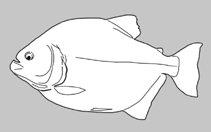 No image available for this species;
drawing shows typical species in Serrasalmidae.
Google image
drawing shows typical species in Serrasalmidae.
Clasificación / Nombres Nombres comunes | Sinónimos | Catalog of Fishes(Género, Especie) | ITIS | CoL | WoRMS | Cloffa
> Characiformes (Characins) > Serrasalmidae (Piranhas and pacus) > Serrasalminae
Etymology: Serrasalmus: Latin, serran, serranus, saw and a fish of genus Serranus + Latin, salmo = salmon (Ref. 45335); magallanesi: Named in honor and memoriam of Frank Magallanes, in recognition of his permanent collaboration with ichthyologists and Serrasalmus fans, mainly through his website OPEFE (https://www.opefe.com).
Etymology: Serrasalmus: Latin, serran, serranus, saw and a fish of genus Serranus + Latin, salmo = salmon (Ref. 45335); magallanesi: Named in honor and memoriam of Frank Magallanes, in recognition of his permanent collaboration with ichthyologists and Serrasalmus fans, mainly through his website OPEFE (https://www.opefe.com).
Entorno: milieu / zona climática / rango de profundidad / gama de distribución Ecología
; agua dulce bentopelágico. Tropical
Distribución Territorios | Áreas FAO | Ecosistemas | Ocurrencias, apariciones | Mapa de puntos | Introducciones | Faunafri
South America: Amazon basin, Bolivia.
Tamaño / Peso / Edad
Descripción breve Claves de identificación | Morfología | Morfometría
This species is distinguished from its congeners by the following characters: differs from S. hollandi by the absence of humeral spot (vs. dark humeral spot); snout oblique (vs. blunt), pored lateral-line scales 75-78 (vs. 83–88), last post-ventral serrae to first anal-fin ray distance 5-7% of HL (vs. 12-20% of HL), second supraneural length 23-31 of HL (vs. 34-42% of HL), supraoccipital to pre-dorsal spine distance 26-28% of SL (vs. 20-22% of SL), lower edge of the operculum yellow or orange (vs. lower edge of the operculum red), pre-dorsal zone silver (vs. darkish predorsal zone), ventral zone silver (vs. reddish ventral zone); differs from S. compressus by having dark basal portion of caudal-fin (vs. dark well-defined vertical terminal band), anal-fin red with dark distal edge (vs. darkish anal-fin) in life, dorsal-fin origin to anal-fin origin distance 49-59% of SL (vs. 61-66%), body depth 50-60% of SL (vs. 64-68%), longitudinal scale rows from the lateral-line to dorsal-fin origin 30-33 (vs. 34-37), cleithrum to eighth pre-pelvic serrae distance 22-25% of HL (vs. 30-37%), second supraneural length 23-31% of HL (vs. 35-42%), supraoccipital to last vertebra of the Weberian apparatus distance 39-42% of HL (vs. 43-49% of HL), high tip of the premaxilla to supraoccipital distance 30-31% of SL (vs. 43-49%), body depth XR 52-54% of SL (vs. 59-64%), low tip of the premaxilla (LTP) to supraoccipital distance 37-39% of SL (vs. 40-43%), second dorsal height 16-17% of SL (vs. 20-21%), premaxilla height 20-22% of HL (vs. 17-19%); differs from S. odyssei by having a dark basal portion of caudal-fin (vs. dark edge in caudal-fin with translucent sub-terminal portion), total pored lateral-line scales 75-78 (vs. 80-86), last post-ventral serrae to first anal-fin ray distance 5-7% of HL (vs. 11-16% of HL), fourth supraneural length 29-30% of HL (vs. 33-35%), body depth radiography 52-54% of SL (vs. 45-49%), LTP to supraoccipital distance 37-39% of SL (vs. 33-36%), supraoccipital to pre-dorsal spine distance 26-28% of SL (vs. 22-24%); differs from S. rhombeus by the dark basal portion of caudal-fin (vs. dark well-defined vertical terminal band), anal-fin red with dark distal edge (vs. anal-fin with dark vertical terminal band) when alive, total pored lateral line scales 75-78 (vs. 84-90), last post-ventral serrae to first anal-fin ray distance 5-7% of HL (vs. 14-15%), low tip of the premaxilla to supraoccipital distance 37-39% of SL (vs. 32-36%), distance of supraoccipital to pre-dorsal spine 26-28 of SL (vs. 20-24% of SL); differs from S. spilopleura by the round or oval spots on the dorsal flanks of equal or smaller diameter than the pupil, not large (vs. no spots on flanks), dark basal portion of caudal-fin (vs. dark caudal with diffuse edge), inter-orbital distance 30-46% of HL (vs. 50-54%), total pored lateral-line scales 75-78 (vs. 80-86), last post-ventral serrae to first anal-fin ray distance 5-7% of HL (vs. 9-16%), second supraneural length 23-31% of HL (vs. 43-44%); differs from S. maculatus by having a silver colored body (vs. yellowish) when alive, anal-fin red with dark distal edge (vs. yellowish), dark basal portion of caudal-fin (vs. caudal-fin with dark sub-terminal vertical band and a translucent vertical terminal band), total pored lateral-line scales 75-78 (vs. 80-86); differs from S. elongatus by having round to oval spots on the dorsal flanks of equal or smaller diameter than the pupil, not large (vs. small spots on the flanks forming vertical zigzag lines on flanks), anal-fin red with dark distal edge (vs. darkish anal-fin), post-occipital distance 34-39% of SL (vs. 29-33%), base of dorsal-fin 18-22% of SL (vs. 15-17%), anal-fin base 33-41% of SL (vs. 26-31%), pectoral-fin to dorsal-fin distance 46-56% of SL (vs. 36-42%), ventral-fin to dorsal-fin distance 44-65% of SL (vs. 34-41%), dorsal-fin origin to anal-fin origin distance 49-59% of SL (vs. 37-44%), end of dorsal-fin to anal-fin origin distance 40-49% of SL (vs. 28-35%), body depth 50-60% of SL (vs. 36-42%), total pored lateral-line scales 75-78 (vs. 86-100); differs from S. marginatus by having dark basal portion of caudal-fin (vs. dark basal part of caudal-fin with a dark thin vertical terminal band, but in some cases, it can have a faint vertical terminal band), lower edge of the operculum yellow or orange (vs. silver) in life, anal-fin red with dark distal edge (vs. yellowish), last post-ventral serrae to pre-anal spine distance 9-14% of HL (vs. 4-8%), fourth supraneural length 29-30% of HL (vs. 31-42%) (Ref. 132507).
Cross section: compressed.
Cross section: compressed.
Inhabits streams and lagoons of fluvial (meandric) and of tectonic origin in white and clear water systems that run through the lowlands of the Bolivian Amazon basin, upper Madeira River system (Ref. 132507).
Ciclo vital y comportamiento de apareamiento Madurez | Reproducción | Puesta | Huevos | Fecundidad | Larva
Referencia principal
Suba sus referencias | Referencias | Coordinador | Colaboradores
Gallo-Cardozo, F., M. Maldonado, M. Careaga and F. M. Carvajal-Vallejos, 2024. A new species of piranha (Serrasalmus, Serrasalmidae) from the upper Madeira River system, Amazon basin, Bolivia. J. Ichthyol. 64(3):386-409. (Ref. 132507)
CITES
Not Evaluated
Amenaza para el ser humano
Harmless
Usos humanos
FAO - Publication: search | FishSource |
Más información
Ecología Trófica
Alimentos (presas)
Composición de la dieta
consumo de alimento
Raciones de comida
Despredadores
Alimentos (presas)
Composición de la dieta
consumo de alimento
Raciones de comida
Despredadores
Ecología
Ecología
Ecología
Dinámica de la población
Coeficiente del crecimiento para
Edades / tallas máximas
Longitud-peso rel.
Longitud-longitud rel.
Longitud-frecuencias
Conversión de masas
Reclutamiento
Abundancia
Coeficiente del crecimiento para
Edades / tallas máximas
Longitud-peso rel.
Longitud-longitud rel.
Longitud-frecuencias
Conversión de masas
Reclutamiento
Abundancia
Ciclo de vida
Reproducción
Madurez
Madurez/Gills rel.
Fecundidad
Puesta
Agregaciones de desove
Huevos
Desarrollo de los huevos
Larva
Dinámica larvaria
Reproducción
Madurez
Madurez/Gills rel.
Fecundidad
Puesta
Agregaciones de desove
Huevos
Desarrollo de los huevos
Larva
Dinámica larvaria
Distribución
Territorios
Áreas FAO
Ecosistemas
Ocurrencias, apariciones
Introducciones
BRUVS - Vídeos
Territorios
Áreas FAO
Ecosistemas
Ocurrencias, apariciones
Introducciones
BRUVS - Vídeos
Anatomía
Superficie branquial
Cerebro
Otolito
Superficie branquial
Cerebro
Otolito
Fisiología
Composición corporal
Nutrientes
Consumo del oxígeno
Tipo de natación
Velocidad de natación
Pigmentos visuales
Sonido de peces
Enfermedades y parásitos
Toxicidad (CL50)
Composición corporal
Nutrientes
Consumo del oxígeno
Tipo de natación
Velocidad de natación
Pigmentos visuales
Sonido de peces
Enfermedades y parásitos
Toxicidad (CL50)
Genética
Genoma
Genética
Heterocigosidad
heritabilidad
Diversidad genética
Genoma
Genética
Heterocigosidad
heritabilidad
Diversidad genética
Relacionados con el ser humano
Sistemas de acuicultura
Perfiles de acuicultura
Razas
Ciguatera cases
Sellos, monedas, varios
Sistemas de acuicultura
Perfiles de acuicultura
Razas
Ciguatera cases
Sellos, monedas, varios
Herramientas
Libro electrónico | Guía de campo | Asistente para frecuencias de tallas | Herramienta de ciclo de vida | Mapa de puntos |
Catch-MSY |
Informes especiales
Comprobar el mantenimiento del acuario | Buscar fichas sobre especies | Consulte las hojas informativas sobre acuicultura
Descargar XML
Fuentes de Internet
AFORO (otoliths) | Aquatic Commons | BHL | Cloffa | Websites from users | Check FishWatcher | CISTI | Catalog of Fishes: Género, Especie | DiscoverLife | ECOTOX | FAO - Publication: search | Faunafri | Fishipedia | Fishtrace | GloBI | Google Books | Google Scholar | Google | IGFA World Record | OneZoom | Open Tree of Life | Otolith Atlas of Taiwan Fishes | PubMed | Reef Life Survey | Socotra Atlas | TreeBase | Árbol de la vida | Wikipedia: Go, búsqueda | World Records Freshwater Fishing | Zoobank | Expediente Zoológico
Estimaciones basadas en modelos
Índice de diversidad filogenética (Referencia 82804): PD50 = 0.5000 [Uniqueness, from 0.5 = low to 2.0 = high].
Bayesian length-weight: a=0.01380 (0.00641 - 0.02973), b=3.16 (2.99 - 3.33), in cm total length, based on LWR estimates for this Genus-body shape (Ref. 93245).
Nivel trófico (Referencia 69278): 3.5 ±0.6 se; based on size and trophs of closest relatives
Resiliencia (Referencia 120179): Alto, población duplicada en un tiempo mínimo inferior a 15 meses (Preliminary K or Fecundity.).