



Serrasalmus magallanesi Gallo-Cardozo, Maldonado, Careaga & Carvajal-Vallejos, 2024
Uploaden van uw Foto's en video's
Google afbeelding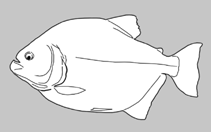 No image available for this species;
drawing shows typical species in Serrasalmidae.
Google afbeelding
drawing shows typical species in Serrasalmidae.
Classificatie / Namen Lokale namen | Synoniemen | Catalog of Fishes(Genus, Soort(en)) | ITIS | CoL | WoRMS | Cloffa
> Characiformes (Characins) > Serrasalmidae (Piranhas and pacus) > Serrasalminae
Etymology: Serrasalmus: Latin, serran, serranus, saw and a fish of genus Serranus + Latin, salmo = salmon (Ref. 45335); magallanesi: Named in honor and memoriam of Frank Magallanes, in recognition of his permanent collaboration with ichthyologists and Serrasalmus fans, mainly through his website OPEFE (https://www.opefe.com).
Etymology: Serrasalmus: Latin, serran, serranus, saw and a fish of genus Serranus + Latin, salmo = salmon (Ref. 45335); magallanesi: Named in honor and memoriam of Frank Magallanes, in recognition of his permanent collaboration with ichthyologists and Serrasalmus fans, mainly through his website OPEFE (https://www.opefe.com).
Milieu: milieu / Klimaatzone / Diepte / verspreidingsgebied Ecologie
; zoet water benthopelagisch. Tropical
Verspreiding Gebieden | FAO regio's | Ecosystemen | Voorkomen | Verspreidingskaart | Introducties | Faunafri
South America: Amazon basin, Bolivia.
Grootte / Gewicht / Leeftijd
Maturiteit: Lm ? range ? - ? cm
Max length : 15.7 cm SL mannelijk / geslacht onbekend; (Ref. 132507)
Max length : 15.7 cm SL mannelijk / geslacht onbekend; (Ref. 132507)
Korte beschrijving Determinatiesleutels | Morfologie | Morfometrie
This species is distinguished from its congeners by the following characters: differs from S. hollandi by the absence of humeral spot (vs. dark humeral spot); snout oblique (vs. blunt), pored lateral-line scales 75-78 (vs. 83–88), last post-ventral serrae to first anal-fin ray distance 5-7% of HL (vs. 12-20% of HL), second supraneural length 23-31 of HL (vs. 34-42% of HL), supraoccipital to pre-dorsal spine distance 26-28% of SL (vs. 20-22% of SL), lower edge of the operculum yellow or orange (vs. lower edge of the operculum red), pre-dorsal zone silver (vs. darkish predorsal zone), ventral zone silver (vs. reddish ventral zone); differs from S. compressus by having dark basal portion of caudal-fin (vs. dark well-defined vertical terminal band), anal-fin red with dark distal edge (vs. darkish anal-fin) in life, dorsal-fin origin to anal-fin origin distance 49-59% of SL (vs. 61-66%), body depth 50-60% of SL (vs. 64-68%), longitudinal scale rows from the lateral-line to dorsal-fin origin 30-33 (vs. 34-37), cleithrum to eighth pre-pelvic serrae distance 22-25% of HL (vs. 30-37%), second supraneural length 23-31% of HL (vs. 35-42%), supraoccipital to last vertebra of the Weberian apparatus distance 39-42% of HL (vs. 43-49% of HL), high tip of the premaxilla to supraoccipital distance 30-31% of SL (vs. 43-49%), body depth XR 52-54% of SL (vs. 59-64%), low tip of the premaxilla (LTP) to supraoccipital distance 37-39% of SL (vs. 40-43%), second dorsal height 16-17% of SL (vs. 20-21%), premaxilla height 20-22% of HL (vs. 17-19%); differs from S. odyssei by having a dark basal portion of caudal-fin (vs. dark edge in caudal-fin with translucent sub-terminal portion), total pored lateral-line scales 75-78 (vs. 80-86), last post-ventral serrae to first anal-fin ray distance 5-7% of HL (vs. 11-16% of HL), fourth supraneural length 29-30% of HL (vs. 33-35%), body depth radiography 52-54% of SL (vs. 45-49%), LTP to supraoccipital distance 37-39% of SL (vs. 33-36%), supraoccipital to pre-dorsal spine distance 26-28% of SL (vs. 22-24%); differs from S. rhombeus by the dark basal portion of caudal-fin (vs. dark well-defined vertical terminal band), anal-fin red with dark distal edge (vs. anal-fin with dark vertical terminal band) when alive, total pored lateral line scales 75-78 (vs. 84-90), last post-ventral serrae to first anal-fin ray distance 5-7% of HL (vs. 14-15%), low tip of the premaxilla to supraoccipital distance 37-39% of SL (vs. 32-36%), distance of supraoccipital to pre-dorsal spine 26-28 of SL (vs. 20-24% of SL); differs from S. spilopleura by the round or oval spots on the dorsal flanks of equal or smaller diameter than the pupil, not large (vs. no spots on flanks), dark basal portion of caudal-fin (vs. dark caudal with diffuse edge), inter-orbital distance 30-46% of HL (vs. 50-54%), total pored lateral-line scales 75-78 (vs. 80-86), last post-ventral serrae to first anal-fin ray distance 5-7% of HL (vs. 9-16%), second supraneural length 23-31% of HL (vs. 43-44%); differs from S. maculatus by having a silver colored body (vs. yellowish) when alive, anal-fin red with dark distal edge (vs. yellowish), dark basal portion of caudal-fin (vs. caudal-fin with dark sub-terminal vertical band and a translucent vertical terminal band), total pored lateral-line scales 75-78 (vs. 80-86); differs from S. elongatus by having round to oval spots on the dorsal flanks of equal or smaller diameter than the pupil, not large (vs. small spots on the flanks forming vertical zigzag lines on flanks), anal-fin red with dark distal edge (vs. darkish anal-fin), post-occipital distance 34-39% of SL (vs. 29-33%), base of dorsal-fin 18-22% of SL (vs. 15-17%), anal-fin base 33-41% of SL (vs. 26-31%), pectoral-fin to dorsal-fin distance 46-56% of SL (vs. 36-42%), ventral-fin to dorsal-fin distance 44-65% of SL (vs. 34-41%), dorsal-fin origin to anal-fin origin distance 49-59% of SL (vs. 37-44%), end of dorsal-fin to anal-fin origin distance 40-49% of SL (vs. 28-35%), body depth 50-60% of SL (vs. 36-42%), total pored lateral-line scales 75-78 (vs. 86-100); differs from S. marginatus by having dark basal portion of caudal-fin (vs. dark basal part of caudal-fin with a dark thin vertical terminal band, but in some cases, it can have a faint vertical terminal band), lower edge of the operculum yellow or orange (vs. silver) in life, anal-fin red with dark distal edge (vs. yellowish), last post-ventral serrae to pre-anal spine distance 9-14% of HL (vs. 4-8%), fourth supraneural length 29-30% of HL (vs. 31-42%) (Ref. 132507).
Cross section: compressed.
Cross section: compressed.
Inhabits streams and lagoons of fluvial (meandric) and of tectonic origin in white and clear water systems that run through the lowlands of the Bolivian Amazon basin, upper Madeira River system (Ref. 132507).
Levenscyclus en paargedrag Maturiteit | Voortplanting | Paaien | Eieren | Fecunditeit | Larven
Hoofdreferentie
Upload uw referenties | Referenties | Coördinator | Medewerkers
Gallo-Cardozo, F., M. Maldonado, M. Careaga and F. M. Carvajal-Vallejos, 2024. A new species of piranha (Serrasalmus, Serrasalmidae) from the upper Madeira River system, Amazon basin, Bolivia. J. Ichthyol. 64(3):386-409. (Ref. 132507)
CITES
Not Evaluated
Gevaar voor de mens
Harmless
Gebruik door de mens
FAO - Publication: search | FishSource |
Meer informatie
Trofische ecologie
Voedsel (prooien)
Dieetsamenstelling
Voedselconsumptie
Voedselrantsoenen
Predatoren
Voedsel (prooien)
Dieetsamenstelling
Voedselconsumptie
Voedselrantsoenen
Predatoren
Ecologie
Ecologie
Ecologie
Populatiedynamica
Groeiparameters
Max. leeftijden / maten
Lengte-gewicht rel.
Lengte-lengte rel.
Lengtefrequenties
Massaconversie
Rekrutering
Abundantie
Groeiparameters
Max. leeftijden / maten
Lengte-gewicht rel.
Lengte-lengte rel.
Lengtefrequenties
Massaconversie
Rekrutering
Abundantie
Levenscyclus
Voortplanting
Maturiteit
Rijpheid/kieuwen rel.
Fecunditeit
Paaien
Paaibestanden
Eieren
Ontwikkeling van de eieren
Larven
Larvale populatiedynamiek
Voortplanting
Maturiteit
Rijpheid/kieuwen rel.
Fecunditeit
Paaien
Paaibestanden
Eieren
Ontwikkeling van de eieren
Larven
Larvale populatiedynamiek
Anatomie
Kieuwoppervlak
Hersenen
Otoliet
Kieuwoppervlak
Hersenen
Otoliet
Fysiologie
Lichaamssamenstelling
Voedingsstoffen
Zuurstofverbruik
Type zwemmen
Zwemsnelheid
Visuele pigmenten
Vis geluid
Ziekten en parasieten
Toxiciteit (LC50)
Lichaamssamenstelling
Voedingsstoffen
Zuurstofverbruik
Type zwemmen
Zwemsnelheid
Visuele pigmenten
Vis geluid
Ziekten en parasieten
Toxiciteit (LC50)
Genetica
genoom
Genetica
Heterozygositeit
Erfelijkheid
Genetische diversiteit
genoom
Genetica
Heterozygositeit
Erfelijkheid
Genetische diversiteit
Menselijk gerelateerd
Aquacultuursystemen
Aquacultuurprofielen
Kweeklijnen
Ciguatera gevallen
Postzegels, munten, diversen.
Aquacultuursystemen
Aquacultuurprofielen
Kweeklijnen
Ciguatera gevallen
Postzegels, munten, diversen.
Tools
Speciale rapporten
Bekijk gegevens voor het houden in een aquarium | Bekijk Fact Sheets voor de soort | Bekijk Aquacultuur Fact Sheets
Download XML
Internetbronnen
AFORO (otoliths) | Aquatic Commons | BHL | Cloffa | Websites from users | Bekijk FishWatcher | CISTI | Catalog of Fishes: Genus, Soort(en) | DiscoverLife | ECOTOX | FAO - Publication: search | Faunafri | Fishipedia | Fishtrace | GloBI | Google Books | Google Scholar | Google | IGFA World Record | OneZoom | Open Tree of Life | Otolith Atlas of Taiwan Fishes | PubMed | Reef Life Survey | Socotra Atlas | TreeBase | Tree of Life | Wikipedia: ga naar, zoek | World Records Freshwater Fishing | Zoobank | Zoological Record
Schattingen op basis van modellen
Fylogenetische diversiteitsindex (Ref. 82804): PD50 = 0.5000 [Uniqueness, from 0.5 = low to 2.0 = high].
Bayesian length-weight: a=0.01380 (0.00641 - 0.02973), b=3.16 (2.99 - 3.33), in cm total length, based on LWR estimates for this Genus-body shape (Ref. 93245).
Trofisch niveau (Ref. 69278): 3.5 ±0.6 se; based on size and trophs of closest relatives
Weerstandsvermogen (Ref. 120179): Hoog, minimale populatieverdubbelingstijd minder dan 15 maanden (Preliminary K or Fecundity.).