This website uses cookies to enhance your browsing experience and ensure the functionality of our site. For more detailed information about the types of cookies we use and how we protect your privacy, please visit our Privacy Information page.
×
Cookie Settings
This website uses different types of cookies to enhance your experience. Please select your preferences below:
> Gobiiformes (Gobies) > Gobiidae (Gobies) > Sicydiinae
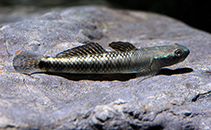
Etymology: Stiphodon:Greek, stiphos, -eos, -oys = mass + Greek, odous = teeth (Ref. 45335); chlorestes:Name from Latin 'chlorestes', a genus of hummingbirds, referring to this species often quickly flapping its pectoral fins in the mid-layer of water, like a hovering hummingbird. Also, the males have a metallic turquoise head and chartreuse body sides, similar to the plumage of the hummingbird Chlorestes cyanus; moun in apposition.
Ambiente: milieu / zona climática / intervalo de profundidade / gama de distribuição Ecologia
marinhas; Água doce; estuarina demersal; anfídromo. Tropical
Maturidade: Lm? range ? - ? cm Max length : 4.0 cm SL macho/indeterminado; (Ref. 131349); 3.8 cm SL (female)
Descrição breve Chaves de identificação | Morfologia | Morfometria
Espinhos dorsais (total) : 7; Raios dorsais moles (total) : 9 - 10; Espinhos anais: 1; Raios anais moles: 10 - 11. This species of the S. elegans group, is distinguished by the following: larger body size
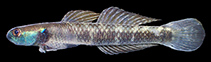
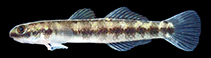
(maximum size > 4 cm (vs. the S. sapphirinus group) and pectoral-fin rays 15 (vs. 13-14); differs from other species of the S. elegans group by having wider interorbital width, males with occipital region almost naked, 7-8 oval bands or a black longitudinal band on lower body, with dorsal, anal, and caudal fins brown with white spots in males, a short red or orange line on posterior upper edge of caudal fin, pectoral fins with 3-8 rows of black and white spots in males and with one to two rows in females (Ref. 131349). Cross section: oval.
This species prefers deep and fast-flowing water and cohabits with other Stiphodon species. The new species was found together with three other sicydiine species, including S. atropurpureus, S. percnopterygionus, and Sicyopterus longifilis; other common species are A. ocellaris and an unidentified species of Rhinogobius (Ref. 131349).
Ciclo de vida e comportamento de acasalamento Maturidade | Reprodução | Desova | Ovos | Fecundidade | Larvas
Jhuang, W.-C., A.C. Dimaquibo and T.-Y. Liao, 2024. Stiphodon chlorestes, a new species of sicydiine goby (Teleostei: Gobioidei) from Taiwan and Luzon. J. Fish Biol. 2024:1-16. (Ref. 131349)
Categoria na Lista Vermelha da IUCN (Ref. 130435: Version 2025-2 (Global))
Ecologia Trófica Produtos alimentares (presas) Composição da dieta Consumo alimentar Rações alimentares Predadores
Ecologia Ecologia
Dinâmica das populações Parâmetros de crescimento Idades / tamanhos máximos Comprimento-peso rel. Comprimento-comprimento rel. Frequência de comprimento Conversão de massa Recrutamento Abundância
Ciclo de vida Reprodução Maturidade Maturidade/Rel. das guelras Fecundidade Desova Agregações de desova Ovos Desenvolvimento dos ovos Larvas Dinâmica larvar
Distribuição Territórios Áreas FAO Ecossistemas Ocorrências Introduções BRUVS - Vídeos
Anatomia Área branquial Cérebro Otólitos
Fisiologia Composição corporal Nutrientes Consumo de oxigénio Tipo de natação Velocidade de natação Pigmentos visuais Som de peixe Doenças e Parasitas Toxicidade (LC50s)
Índice de diversidade filogenética (Ref. 82804): PD50 = 0.5000 [Uniqueness, from 0.5 = low to 2.0 = high].
Bayesian length-weight: a=0.00389 (0.00180 - 0.00842), b=3.12 (2.94 - 3.30), in cm total length, based on all LWR estimates for this body shape (Ref. 93245).
Resiliência (Ref. 120179): Elevada, tempo mínimo de duplicação da população menor que 15 meses (Preliminary K or Fecundity.).
Vulnerabilidade da pesca (Ref. 59153): Low vulnerability (10 of 100). 🛈