



Hochladen Photos und videos
Bilder | Google Bild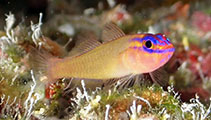 Trimma cavicapum
Photo von Mason-Parker, C.
Bilder | Google Bild
Photo von Mason-Parker, C.
Klassifizierung / Names Namen | Synonyme | Catalog of Fishes(Gattung, Arten) | ITIS | CoL | WoRMS | Cloffa
> Gobiiformes (Gobies) > Gobiidae (Gobies) > Gobiinae
Etymology: Trimma: Greek, trimma, -atos = something crushed (Ref. 45335); cavicapum: Name from Latin 'cavicapum' is proposed as an arbitrary combination of letters derived from blue ('caerulus'), stripe ('virgatus') and head ('caput'), pronounced as ‘cavi’ + ‘cap’ + ‘um’); noun in apposition.
Etymology: Trimma: Greek, trimma, -atos = something crushed (Ref. 45335); cavicapum: Name from Latin 'cavicapum' is proposed as an arbitrary combination of letters derived from blue ('caerulus'), stripe ('virgatus') and head ('caput'), pronounced as ‘cavi’ + ‘cap’ + ‘um’); noun in apposition.
Umwelt: Milieu / Klimazone / Tiefenbereich / Verbreitungsgebiet Ökologie
seewasser riff-verbunden; tiefenbereich 22 - 28 m (Ref. 131294). Deep-water
Verbreitung Territorien | FAO Gebiete | Ökosysteme | Vorkommen | Punkt Karte | Einführungen | Faunafri
Seychelles.
Größe / Gewicht / Alter
Geschlechtsreife: Lm ? range ? - ? cm
Max length : 2.1 cm SL (female)
Max length : 2.1 cm SL (female)
Kurzbeschreibung Bestimmungsschlüssel | Morphologie | Morphometrie
Rückenflossenstacheln (insgesamt) : 7; Rückenflossenweichstrahlen (insgesamt) : 10 - 11; Afterflossenstacheln: 1; Afterflossenweichstrahlen: 10. This species is distinguished by the following characters: predorsal midline no scales; fifth pelvic-fin ray unbranched; cheek with 6 papillae in row c; at least some inner pectoral-fin rays are branched; second spine of first dorsal fin extending posteriorly only to interspace between two fins; an interorbital trench that fades out between fifth and sixth papillae of row p. Colouration: no red bars across body; when alive, head with three blue stripes, one dorsal midline, second from top of orbit to near upper lip, and third across dorsal margin of preoperculum, lower part of iris, and across lips meeting counterpart at ventral midline, the intervening area on head red dorsally grading to yellow and light purplish ventrally, and body with many melanophores on a dirty yellow background; when preserved, blue lines on head are black (Ref. 131294).
Cross section: oval.
Cross section: oval.
Occurs in pairs or small groups. Sightings of this species suggest that it inhabits crevices (containing a mix of red coralline algae, Halimeda sp., Tubastrea coccinea, sponges and ascidians) and caves in steep sloping reefs deeper than 18-20 m. It has only been seen in such steep-sloping, coral-rich habitats on outer reefs facing open ocean. It was not observed during exploration of similar depth ranges around the same atolls in areas with different bathymetry and substrate type (very little coral, dominated by rock and algae, with gradual slopes). (Ref. 131294).
Lebenszyklus und Paarungsverhalten Geschlechtsreife | Fortpflanzung | Ablaichen | Eier | Fruchtbarkeit | Larven
Hauptreferenz
Laden Sie Ihre Referenzen hoch | Referenzen | Koordinator | Partner
Winterbottom, R., E. Brighton and C. Mason-Parker, 2024. A new species of Trimma (Teleostei: Gobiidae) from the Seychelles, Indian Ocean. J. Ocean Sci. Found. 41:37-45. (Ref. 131294)
CITES
Not Evaluated
Bedrohung für Menschen
Harmless
Nutzung durch Menschen
Fischereien: nicht kommerziell
FAO - Publication: search | FishSource |
Mehr Information
Trophische Ökologie
Lebensmittel (Beutetiere)
Nahrungszusammensetzung
Nahrungsaufnahme
Lebensmittelrationen
Räuber
Lebensmittel (Beutetiere)
Nahrungszusammensetzung
Nahrungsaufnahme
Lebensmittelrationen
Räuber
Ökologie
Ökologie
Ökologie
Populationsdynamik
Wachstumsparameter
Max. Alter/Größen
Länge-Gewicht-Rel.
Länge-Länge-Verhältnis.
Längenhäufigkeiten
Massenkonvertierung
Rekrutierung
Dichte
Wachstumsparameter
Max. Alter/Größen
Länge-Gewicht-Rel.
Länge-Länge-Verhältnis.
Längenhäufigkeiten
Massenkonvertierung
Rekrutierung
Dichte
Lebenszyklus
Fortpflanzung
Geschlechtsreife
Reifung/Kiemen rel.
Fruchtbarkeit
Ablaichen
Laichaggregationen
Eier
Eientwicklung
Larven
Larven Pop.Dyn.
Fortpflanzung
Geschlechtsreife
Reifung/Kiemen rel.
Fruchtbarkeit
Ablaichen
Laichaggregationen
Eier
Eientwicklung
Larven
Larven Pop.Dyn.
Anatomie
Kiemenoberfläche
Gehirn
Otolith
Kiemenoberfläche
Gehirn
Otolith
Physiologie
Körperliche Zusammensetzung
Nährstoffe
Sauerstoffverbrauch
Schwimmart
Schwimmgeschwindigkeit
Visuelle Pigmente
Fischgeräusche
Krankheiten und Parasiten
Toxizität (LC50s)
Körperliche Zusammensetzung
Nährstoffe
Sauerstoffverbrauch
Schwimmart
Schwimmgeschwindigkeit
Visuelle Pigmente
Fischgeräusche
Krankheiten und Parasiten
Toxizität (LC50s)
Genetik
Genom
Genetik
Heterozygotie
Vererbbarkeit
Genetische Vielfalt
Genom
Genetik
Heterozygotie
Vererbbarkeit
Genetische Vielfalt
Menschenbezogen
Aquakultur-Systeme
Aquakultur Profile
Zuchtlinien
Ciguatera-Fälle
Briefmarken, Münzen, Verschiedenes.
Aquakultur-Systeme
Aquakultur Profile
Zuchtlinien
Ciguatera-Fälle
Briefmarken, Münzen, Verschiedenes.
Tools
Zusatzinformationen
Download XML
Zusammenfassung | Punktdaten | Namen | Photos
Internet Quellen
AFORO (otoliths) | Aquatic Commons | BHL | Cloffa | Websites from users | FishWatcher Einträge suchen | CISTI | Catalog of Fishes: Gattung, Arten | DiscoverLife | ECOTOX | FAO - Publication: search | Faunafri | Fishipedia | Fishtrace | GloBI | Google Books | Google Scholar | Google | IGFA World Record | OneZoom | Open Tree of Life | Otolith Atlas of Taiwan Fishes | PubMed | Reef Life Survey | Socotra Atlas | TreeBase | Tree of Life | Wikipedia: Gehe zu, Suchen | World Records Freshwater Fishing | Zoobank | Zoologischer Rekord
Schätzungen auf der Grundlage von Modellen
Phylogenetischer Diversitätsindex (Ref. 82804): PD50 = 0.5000 [Uniqueness, from 0.5 = low to 2.0 = high].
Bayesian length-weight: a=0.01023 (0.00477 - 0.02194), b=3.01 (2.83 - 3.19), in cm total length, based on LWR estimates for this (Sub)family-body shape (Ref. 93245).
Widerstandsfähigkeit (Ref. 120179): hoch, Verdopplung der Population dauert weniger als 15 Monate. (Preliminary K or Fecundity.).