



Sphoeroides camila Carvalho-Filho, Rotundo, Pitassy & Sazima, 2023
Southern bandtail puffer
Tải lên của bạn hình ảnh Và Video
Google image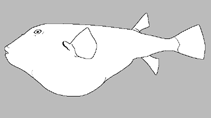 No image available for this species;
drawing shows typical species in Tetraodontidae.
Google image
drawing shows typical species in Tetraodontidae.
Phân loại / Tên Tên thường gặp | Các synonym ( Các tên trùng) | Catalog of Fishes(Giống, Các loài) | ITIS | CoL | WoRMS | Cloffa
> Tetraodontiformes (Puffers and filefishes) > Tetraodontidae (Puffers) > Tetraodontinae
Etymology: Sphoeroides: Greek, sphaira = ball + Greek, suffix, oides = similar to (Ref. 45335); camila: Named for Camila Carvalho, one of the daughters of the first author of the new species; noun in apposition.
Etymology: Sphoeroides: Greek, sphaira = ball + Greek, suffix, oides = similar to (Ref. 45335); camila: Named for Camila Carvalho, one of the daughters of the first author of the new species; noun in apposition.
Môi trường: môi trường / vùng khí hậu / Mức độ sâu / phạm vi phân phối Sinh thái học
biển cùng sống ở rạn san hô. Tropical
Sự phân bố Lãnh thổ | Các khu vực của FAO | Các hệ sinh thái | Những lần xuất hiện | Bản đồ điểm | Những chỉ dẫn | Faunafri
Southwestern Atlantic: Brazil, vagrants may occur in the Southern Caribbean.
Bộ gần gũi / Khối lượng (Trọng lượng) / Tuổi
Chín muồi sinh dục: Lm ? range ? - ? cm
Max length : 14.0 cm SL con đực/không giới tính; (Ref. 131040); common length : 10.0 cm TL con đực/không giới tính; (Ref. 131040)
Max length : 14.0 cm SL con đực/không giới tính; (Ref. 131040); common length : 10.0 cm TL con đực/không giới tính; (Ref. 131040)
Mô tả ngắn gọn Khóa để định loại | Hình thái học | Sinh trắc học
Các vây lưng mềm (tổng cộng) : 7 - 8; Tia mềm vây hậu môn: 6 - 8. This species is distinguished from its congeners by the following characters: D 7-8 (rarely 6); A 6-8, rarely 5 (unbranched rays 0-2, branched rays 4-6); pectoral-fin rays 13-14 (rarely 11, 12, 15, or 16), not including a rudimentary one on upper fin sheath; dorsal-fin rays 7–8 (rarely 6); dorsum with two pale lappets before opercle, none black; lappets on left sagittal section of body 24-34; lappets on head before opercle 1-8; adults no prickles on dorsum or sides of body (rarely a small patch after interorbital space), prickles occasionally present in juveniles from interorbital to middle back; very distinct row of black spots on ventrolateral body from chin to end of caudal-fin peduncle, the mid-ones vertically oblong, those on extremities rounded and considerably smaller; absence of black rounded spots above ventrolateral row; caudal fin with a dark bar at base and a very wide yellow-greenish bar posteriorly (Ref. 131040).
Cross section: angular.
Cross section: angular.
This species is common in shallow, clear reef waters, up to 20 m deep along the Brazilian coast, and occasionally to 70 m depth; usually observed alone, in pairs or small groups, and often several individuals are found in a small area, hovering over the substrate. It rarely occurs in
seagrass beds. It is a generalist zoobenthivore, but frequently consumes zooplankton and drift material in the water column or at water surface. Diet is composed of crustaceans, molluscs, worms, echinoderms, and zooplankton larvae. Several individuals of this species were attracted to mussels opened by a diver, which indicates opportunistic foraging, a feature observed for several other pufferfish specie. An individual was observed following a hunting gold spotted eel Myrichthys ocellatus Lesueur, 1825 and snatching two small crabs flushed by the eel, which again demonstrates its opportunistic foraging. This species is diurnal, spending the night in reef crevices or partially buried on the adjacent sand/gravel bottom, with the eyes and upper dorsum exposed (Ref. 131040).
Vòng đời và hành vi giao phối Chín muồi sinh dục | Sự tái sinh sản | Đẻ trứng | Các trứng | Sự sinh sản | Ấu trùng
Tài liệu tham khảo chính
Tải lên tài liệu tham khảo của bạn | Các tài liệu tham khảo | Người điều phối : Matsuura, Keiichi | Người cộng tác
Araujo, G.S., Y.R Kurtz, I. Sazima, P.H. Carvalho, S.R. Floeter, A. Vilasboa, M.M. Rotundo, C.E.L. Ferreira, J.P. Barreiros, D.E. Pitassy and A. Carvalho-Filho, 2023. Evolutionary history, biogeography, and a new species of Sphoeroides a(Tetraodontiformes: Tetraodontidae): how the major biogeographic barriers of the Atlantic Ocean shaped the evolution of a pufferfish genus. Zool. J. of the Linnean Soc. 199(4):978-993. (Ref. 131040)
CITES
Not Evaluated
Mối đe dọa đối với con người
Harmless
Sử dụng của con người
FAO - Publication: search | FishSource |
Thêm thông tin
Sinh thái dinh dưỡng
Thức ăn (con mồi)
Thành phần thức ăn
Thành phần thức ăn
Khẩu phần ăn
Các động vật ăn mồi
Thức ăn (con mồi)
Thành phần thức ăn
Thành phần thức ăn
Khẩu phần ăn
Các động vật ăn mồi
Sinh thái học
Sinh thái học
Sinh thái học
Biến động dân số
Các thông số tăng trưởng
Độ tuổi / kích thước tối đa
Chiều dài-trọng lượng tương đối
Chiều dài-chiều dài tương đối.
Chiều dài-tần số
Chuyển đổi khối lượng
Bổ xung
Sự phong phú
Các thông số tăng trưởng
Độ tuổi / kích thước tối đa
Chiều dài-trọng lượng tương đối
Chiều dài-chiều dài tương đối.
Chiều dài-tần số
Chuyển đổi khối lượng
Bổ xung
Sự phong phú
Vòng đời
Sự tái sinh sản
Chín muồi sinh dục
Độ trưởng thành/Mang liên quan
Sự sinh sản
Đẻ trứng
Tập hợp sinh sản
Các trứng
Sự phát triển của trứng
Ấu trùng
Sự biến động ấu trùng
Sự tái sinh sản
Chín muồi sinh dục
Độ trưởng thành/Mang liên quan
Sự sinh sản
Đẻ trứng
Tập hợp sinh sản
Các trứng
Sự phát triển của trứng
Ấu trùng
Sự biến động ấu trùng
Sự phân bố
Lãnh thổ
Các khu vực của FAO
Các hệ sinh thái
Những lần xuất hiện
Những chỉ dẫn
BRUVS - Video
Lãnh thổ
Các khu vực của FAO
Các hệ sinh thái
Những lần xuất hiện
Những chỉ dẫn
BRUVS - Video
Giải phẫu
Vùng mang
Não
sỏi tai
Vùng mang
Não
sỏi tai
Sinh lý học
Thành phần cơ thể
Chất dinh dưỡng
Thành phần ô-xy
Kiểu bơi
Tốc độ bơi
Sắc tố thị giác
Tiếng cá
Bệnh tật & Ký sinh trùng
Độc tính (LC50)
Thành phần cơ thể
Chất dinh dưỡng
Thành phần ô-xy
Kiểu bơi
Tốc độ bơi
Sắc tố thị giác
Tiếng cá
Bệnh tật & Ký sinh trùng
Độc tính (LC50)
Di truyền
Bộ gen
Di truyền
Sự dị hợp tử
Di sản
Đa dạng di truyền
Bộ gen
Di truyền
Sự dị hợp tử
Di sản
Đa dạng di truyền
Liên quan đến con người
Hệ thống nuôi trồng thủy sản
Các tổng quan nuôi trồng thủy sản
Các giống
Các trường hợp ngộ độc Ciguatera
Tem, tiền xu, v.v.
Hệ thống nuôi trồng thủy sản
Các tổng quan nuôi trồng thủy sản
Các giống
Các trường hợp ngộ độc Ciguatera
Tem, tiền xu, v.v.
Các công cụ
Sách điện tử | Hướng dẫn hiện trường | Tần suất chiều dài Wizard | Công cụ của vòng đời | Bản đồ điểm |
Bắt-MSY |
Báo cáo đặc biệt
Kiểm tra bảo trì bể cá | Kiểm tra các tờ thông tin về loài | Kiểm tra các tờ thông tin về nuôi trồng thủy sản
Tải xuống XML
Các nguồn internet
AFORO (otoliths) | Aquatic Commons | BHL | Cloffa | Websites from users | Check FishWatcher | CISTI | Catalog of Fishes: Giống, Các loài | DiscoverLife | ECOTOX | FAO - Publication: search | Faunafri | Fishipedia | Fishtrace | GloBI | Google Books | Google Scholar | Google | IGFA World Record | OneZoom | Open Tree of Life | Otolith Atlas of Taiwan Fishes | PubMed | Reef Life Survey | Socotra Atlas | TreeBase | Cây Đời sống | Wikipedia: Go, tìm | World Records Freshwater Fishing | Zoobank | Tạp chí Zoological Record
Ước tính dựa trên mô hình
Chỉ số đa dạng phát sinh loài (Tài liệu tham khảo 82804): PD50 = 0.5000 [Uniqueness, from 0.5 = low to 2.0 = high].
Bayesian length-weight: a=0.01660 (0.00743 - 0.03706), b=2.92 (2.74 - 3.10), in cm total length, based on LWR estimates for this (Sub)family-body shape (Ref. 93245).
Mức dinh dưỡng (Tài liệu tham khảo 69278): 3.4 ±0.4 se; based on size and trophs of closest relatives
Thích nghi nhanh (Tài liệu tham khảo 120179): Chiêù cao, thời gian nhân đôi của chủng quần tối thiểu là dưới 15 tháng (Preliminary K or Fecundity.).