



Sphoeroides camila Carvalho-Filho, Rotundo, Pitassy & Sazima, 2023
Southern bandtail puffer
Hochladen Photos und videos
Google Bild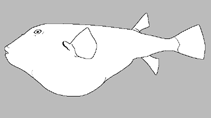 No image available for this species;
drawing shows typical species in Tetraodontidae.
Google Bild
drawing shows typical species in Tetraodontidae.
Klassifizierung / Names Namen | Synonyme | Catalog of Fishes(Gattung, Arten) | ITIS | CoL | WoRMS | Cloffa
> Tetraodontiformes (Puffers and filefishes) > Tetraodontidae (Puffers) > Tetraodontinae
Etymology: Sphoeroides: Greek, sphaira = ball + Greek, suffix, oides = similar to (Ref. 45335); camila: Named for Camila Carvalho, one of the daughters of the first author of the new species; noun in apposition.
Etymology: Sphoeroides: Greek, sphaira = ball + Greek, suffix, oides = similar to (Ref. 45335); camila: Named for Camila Carvalho, one of the daughters of the first author of the new species; noun in apposition.
Umwelt: Milieu / Klimazone / Tiefenbereich / Verbreitungsgebiet Ökologie
seewasser riff-verbunden. Tropical
Verbreitung Territorien | FAO Gebiete | Ökosysteme | Vorkommen | Punkt Karte | Einführungen | Faunafri
Southwestern Atlantic: Brazil, vagrants may occur in the Southern Caribbean.
Größe / Gewicht / Alter
Geschlechtsreife: Lm ? range ? - ? cm
Max length : 14.0 cm SL Männchen/unbestimmt; (Ref. 131040); common length : 10.0 cm TL Männchen/unbestimmt; (Ref. 131040)
Max length : 14.0 cm SL Männchen/unbestimmt; (Ref. 131040); common length : 10.0 cm TL Männchen/unbestimmt; (Ref. 131040)
Kurzbeschreibung Bestimmungsschlüssel | Morphologie | Morphometrie
Rückenflossenweichstrahlen (insgesamt) : 7 - 8; Afterflossenweichstrahlen: 6 - 8. This species is distinguished from its congeners by the following characters: D 7-8 (rarely 6); A 6-8, rarely 5 (unbranched rays 0-2, branched rays 4-6); pectoral-fin rays 13-14 (rarely 11, 12, 15, or 16), not including a rudimentary one on upper fin sheath; dorsal-fin rays 7–8 (rarely 6); dorsum with two pale lappets before opercle, none black; lappets on left sagittal section of body 24-34; lappets on head before opercle 1-8; adults no prickles on dorsum or sides of body (rarely a small patch after interorbital space), prickles occasionally present in juveniles from interorbital to middle back; very distinct row of black spots on ventrolateral body from chin to end of caudal-fin peduncle, the mid-ones vertically oblong, those on extremities rounded and considerably smaller; absence of black rounded spots above ventrolateral row; caudal fin with a dark bar at base and a very wide yellow-greenish bar posteriorly (Ref. 131040).
Cross section: angular.
Cross section: angular.
This species is common in shallow, clear reef waters, up to 20 m deep along the Brazilian coast, and occasionally to 70 m depth; usually observed alone, in pairs or small groups, and often several individuals are found in a small area, hovering over the substrate. It rarely occurs in
seagrass beds. It is a generalist zoobenthivore, but frequently consumes zooplankton and drift material in the water column or at water surface. Diet is composed of crustaceans, molluscs, worms, echinoderms, and zooplankton larvae. Several individuals of this species were attracted to mussels opened by a diver, which indicates opportunistic foraging, a feature observed for several other pufferfish specie. An individual was observed following a hunting gold spotted eel Myrichthys ocellatus Lesueur, 1825 and snatching two small crabs flushed by the eel, which again demonstrates its opportunistic foraging. This species is diurnal, spending the night in reef crevices or partially buried on the adjacent sand/gravel bottom, with the eyes and upper dorsum exposed (Ref. 131040).
Lebenszyklus und Paarungsverhalten Geschlechtsreife | Fortpflanzung | Ablaichen | Eier | Fruchtbarkeit | Larven
Hauptreferenz
Laden Sie Ihre Referenzen hoch | Referenzen | Koordinator : Matsuura, Keiichi | Partner
Araujo, G.S., Y.R Kurtz, I. Sazima, P.H. Carvalho, S.R. Floeter, A. Vilasboa, M.M. Rotundo, C.E.L. Ferreira, J.P. Barreiros, D.E. Pitassy and A. Carvalho-Filho, 2023. Evolutionary history, biogeography, and a new species of Sphoeroides a(Tetraodontiformes: Tetraodontidae): how the major biogeographic barriers of the Atlantic Ocean shaped the evolution of a pufferfish genus. Zool. J. of the Linnean Soc. 199(4):978-993. (Ref. 131040)
CITES
Not Evaluated
Bedrohung für Menschen
Harmless
Nutzung durch Menschen
FAO - Publication: search | FishSource |
Mehr Information
Trophische Ökologie
Lebensmittel (Beutetiere)
Nahrungszusammensetzung
Nahrungsaufnahme
Lebensmittelrationen
Räuber
Lebensmittel (Beutetiere)
Nahrungszusammensetzung
Nahrungsaufnahme
Lebensmittelrationen
Räuber
Ökologie
Ökologie
Ökologie
Populationsdynamik
Wachstumsparameter
Max. Alter/Größen
Länge-Gewicht-Rel.
Länge-Länge-Verhältnis.
Längenhäufigkeiten
Massenkonvertierung
Rekrutierung
Dichte
Wachstumsparameter
Max. Alter/Größen
Länge-Gewicht-Rel.
Länge-Länge-Verhältnis.
Längenhäufigkeiten
Massenkonvertierung
Rekrutierung
Dichte
Lebenszyklus
Fortpflanzung
Geschlechtsreife
Reifung/Kiemen rel.
Fruchtbarkeit
Ablaichen
Laichaggregationen
Eier
Eientwicklung
Larven
Larven Pop.Dyn.
Fortpflanzung
Geschlechtsreife
Reifung/Kiemen rel.
Fruchtbarkeit
Ablaichen
Laichaggregationen
Eier
Eientwicklung
Larven
Larven Pop.Dyn.
Anatomie
Kiemenoberfläche
Gehirn
Otolith
Kiemenoberfläche
Gehirn
Otolith
Physiologie
Körperliche Zusammensetzung
Nährstoffe
Sauerstoffverbrauch
Schwimmart
Schwimmgeschwindigkeit
Visuelle Pigmente
Fischgeräusche
Krankheiten und Parasiten
Toxizität (LC50s)
Körperliche Zusammensetzung
Nährstoffe
Sauerstoffverbrauch
Schwimmart
Schwimmgeschwindigkeit
Visuelle Pigmente
Fischgeräusche
Krankheiten und Parasiten
Toxizität (LC50s)
Genetik
Genom
Genetik
Heterozygotie
Vererbbarkeit
Genetische Vielfalt
Genom
Genetik
Heterozygotie
Vererbbarkeit
Genetische Vielfalt
Menschenbezogen
Aquakultur-Systeme
Aquakultur Profile
Zuchtlinien
Ciguatera-Fälle
Briefmarken, Münzen, Verschiedenes.
Aquakultur-Systeme
Aquakultur Profile
Zuchtlinien
Ciguatera-Fälle
Briefmarken, Münzen, Verschiedenes.
Tools
Zusatzinformationen
Download XML
Zusammenfassung | Punktdaten | Namen | Photos
Internet Quellen
AFORO (otoliths) | Aquatic Commons | BHL | Cloffa | Websites from users | FishWatcher Einträge suchen | CISTI | Catalog of Fishes: Gattung, Arten | DiscoverLife | ECOTOX | FAO - Publication: search | Faunafri | Fishipedia | Fishtrace | GloBI | Google Books | Google Scholar | Google | IGFA World Record | OneZoom | Open Tree of Life | Otolith Atlas of Taiwan Fishes | PubMed | Reef Life Survey | Socotra Atlas | TreeBase | Tree of Life | Wikipedia: Gehe zu, Suchen | World Records Freshwater Fishing | Zoobank | Zoologischer Rekord
Schätzungen auf der Grundlage von Modellen
Phylogenetischer Diversitätsindex (Ref. 82804): PD50 = 0.5000 [Uniqueness, from 0.5 = low to 2.0 = high].
Bayesian length-weight: a=0.01660 (0.00743 - 0.03706), b=2.92 (2.74 - 3.10), in cm total length, based on LWR estimates for this (Sub)family-body shape (Ref. 93245).
Trophische Ebene (Ref. 69278): 3.4 ±0.4 se; based on size and trophs of closest relatives
Widerstandsfähigkeit (Ref. 120179): hoch, Verdopplung der Population dauert weniger als 15 Monate. (Preliminary K or Fecundity.).