



Upeneus brevignathus Uiblein & Bailly, 2024
Shortjaw goatfish
Envoyez vos Photos et vidéos
Images | Images Google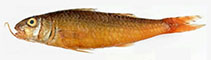 Upeneus brevignathus
Photo de NHM - NMW
Images | Images Google
Photo de NHM - NMW
Classification / Noms Noms communs | Synonymes | Catalog of Fishes(Genre, Espèce) | ITIS | CoL | WoRMS | Cloffa
> Mulliformes (Goatfishes) > Mullidae (Goatfishes)
Etymology: Upeneus: Greek, ypene, -es = upper lip (Ref. 45335); brevignathus: Name refers to the jaw length being rather short in this species compared to others such as the relatively similar U. pori.
Etymology: Upeneus: Greek, ypene, -es = upper lip (Ref. 45335); brevignathus: Name refers to the jaw length being rather short in this species compared to others such as the relatively similar U. pori.
Taxonomic Remarks
FishBase common name changed from Shortjaw goatfish to Shortjaw goatfish (Uiblein et al., 2024: Ref. 130857).
Environnement : milieu / zone climatique / profondeur / gamme de distribution Écologie
marin démersal. Tropical
Distribution Territoires | Zones FAO | Écosystèmes | Occurrences | Carte par point | Introductions | Faunafri
Western Indian Ocean: Yemen.
Taille / Poids / Âge
Description synthétique Clés d'identification | Morphologie | Morphométrie
Dorsal fins VII + 9; pectoral fins 14-15; gill rakers 7-8 + 21-22 = 28-30; lateral-line scales 29-30; body moderately elongate; measurements as % SL: body depth at first dorsal-fin origin 23-24; body depth at anal-fin origin 20-22; cau- dal-peduncle depth 9.5-9.7; caudal-peduncle width 4.0-4.1; maximum head depth 17; head depth through eye 14; head length 27; snout length 10; orbit length 6.3; upper-jaw length 9.3-9.5; barbel length 18; caudal-fin length 28; anal-fin
height 16-17; pelvic-fin length 20; pectoral-fin length 19-20; pectoral-fin width 4.4-4.5; first dorsal-fin height 18-19; dor- sal-fin spines proportionally decreasing in height; second dorsal-fin height 16; caudal fin of preserved fish with at least 9 total oblique bars, upper caudal-fin lobe with 5 dark-grey bars of about pupil width, the four most proximal bars vari- ably curved, no bar on lobe tip; lower caudal-fin lobe with at least 4 dark-grey bars of pupil width or wider, three bars from ventral margin to about mid-lobe, one at lobe tip; dor- sal fins with three grey stripes; barbels pale; body and head from snout tip dark brown-grey dorsally, pale brown ven- trally from eye level; head with a vertically oriented silvery band behind eye that widens below eye and gill cover sil- very or pale-beige silvery; no indication of mid-lateral body stripe; paired and anal fins pale-brown, partly hyaline
The habitat is most probably shallow bottom of the upper shelf reached by traditional artisanal (Ref. 130857).
Cycle de vie et comportement reproducteur Maturité | Reproduction | Frai | Œufs | Fécondité | Larves
Référence principale
Téléchargez vos références | Références | Coordinateur : Randall, John E. | Collaborateurs
Uiblein, F., J.T. Williams, N. Bailly, T.A. Hoang and P.T. Rajan, 2024. Four new goatfishes (Upeneus, Mullidae, Mulliformes) from the Asian Indo-Pacific with a list of valid goatfish species and remarks on goatfish diversity. Cybium 48(2):135-160. (Ref. 130857)
CITES
Not Evaluated
Menace pour l'homme
Harmless
Utilisations par l'homme
FAO - Publication: search | FishSource |
Plus d'informations
Écologie trophique
Aliments (proies)
Composition du régime alimentaire
Consommation alimentaire
Rations alimentaires
Prédateurs
Aliments (proies)
Composition du régime alimentaire
Consommation alimentaire
Rations alimentaires
Prédateurs
Écologie
Écologie
Écologie
Dynamique des populations
Paramètres de croissance
Âges / tailles maximales
Longueur-poids rel.
Rel. longueur-longueur.
Fréquences de longueurs
Conversion de masse
Recrutement
Abondance
Paramètres de croissance
Âges / tailles maximales
Longueur-poids rel.
Rel. longueur-longueur.
Fréquences de longueurs
Conversion de masse
Recrutement
Abondance
Cycle de vie
Reproduction
Maturité
Maturité/épines rel.
Fécondité
Frai
Agrégats de frai
Œufs
Développement de l'œuf
Larves
Dynamique des populations larvaires
Reproduction
Maturité
Maturité/épines rel.
Fécondité
Frai
Agrégats de frai
Œufs
Développement de l'œuf
Larves
Dynamique des populations larvaires
Anatomie
Surface branchiale
Cerveau
Otolithe
Surface branchiale
Cerveau
Otolithe
Physiologie
Composition corporelle
Nutriments
Consommation d'oxygène
Type de natation
Vitesse de nage
Pigments visuels
Son de poisson
Maladies et parasites
Toxicité (CL50)
Composition corporelle
Nutriments
Consommation d'oxygène
Type de natation
Vitesse de nage
Pigments visuels
Son de poisson
Maladies et parasites
Toxicité (CL50)
Génétique
génôme
Génétique
Hétérozygotie
Héritabilité
Diversité génétique
génôme
Génétique
Hétérozygotie
Héritabilité
Diversité génétique
Liées à l'homme
Systèmes d'aquaculture
Profils d'aquaculture
Souches
Cas de ciguatera
Timbres, pièces de monnaie, divers
Systèmes d'aquaculture
Profils d'aquaculture
Souches
Cas de ciguatera
Timbres, pièces de monnaie, divers
Outils
E-book | Guide de terrain | Générateur de fréquences de longueur | Outil de dynamique de population | Carte par point |
Capture-MSY |
Articles particuliers
Télécharger en XML
Sources Internet
AFORO (otoliths) | Aquatic Commons | BHL | Cloffa | Websites from users | FishWatcher | CISTI | Catalog of Fishes: Genre, Espèce | DiscoverLife | ECOTOX | FAO - Publication: search | Faunafri | Fishipedia | Fishtrace | GloBI | Google Books | Google Scholar | Google | IGFA World Record | OneZoom | Open Tree of Life | Otolith Atlas of Taiwan Fishes | PubMed | Reef Life Survey | Socotra Atlas | TreeBase | Arbre de Vie | Wikipedia: aller à, chercher | World Records Freshwater Fishing | Zoobank | Zoological Record
Estimations basées sur des modèles
Indice de diversité phylogénétique (Réf. 82804): PD50 = 0.5000 [Uniqueness, from 0.5 = low to 2.0 = high].
Bayesian length-weight: a=0.00933 (0.00439 - 0.01983), b=3.09 (2.92 - 3.26), in cm total length, based on LWR estimates for this Genus-body shape (Ref. 93245).
Niveau trophique (Réf. 69278): 3.4 ±0.4 se; based on size and trophs of closest relatives
Résilience (Réf. 120179): Haut, temps minimum de doublement de population inférieur à 15 mois (Preliminary K or Fecundity.).