



Upload your photos and videos
Google image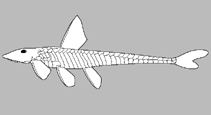 No image available for this species;
drawing shows typical species in Loricariidae.
Google image
drawing shows typical species in Loricariidae.
Classification / Names Common names | Synonyms | Catalog of Fishes(genus, species) | ITIS | CoL | WoRMS | Cloffa
Teleostei (teleosts) > Siluriformes (Catfishes) > Loricariidae (Armored catfishes) > Hypostominae
Etymology: Ancistrus: Greek, agkistron = hook (Ref. 45335); yanesha: Named for the Yanesha or Amuesha indigenous community that occupies territories between the Palcazú, Cacazu, and Pachitea river basins in the Huánuco, Pasco, and Junín departments in Peru. Yanesha literally translates as 'we the people' and the community is known for their strength, resilience, and resistance in the face of various challenges throughout Peru's history; noun in apposition.
Etymology: Ancistrus: Greek, agkistron = hook (Ref. 45335); yanesha: Named for the Yanesha or Amuesha indigenous community that occupies territories between the Palcazú, Cacazu, and Pachitea river basins in the Huánuco, Pasco, and Junín departments in Peru. Yanesha literally translates as 'we the people' and the community is known for their strength, resilience, and resistance in the face of various challenges throughout Peru's history; noun in apposition.
Environment: milieu / climate zone / depth range / distribution range Ecology
Freshwater; demersal; depth range 0 - 1 m (Ref. 130912). Tropical
Distribution Territories | FAO areas | Ecosystems | Occurrences | Point map | Introductions | Faunafri
South America: Peru.
Size / Weight / Age
Short description Identification keys | Morphology | Morphometrics
This species is distinguished from all its congeners, except A. centrolepis, A. claro, A. luzia by having a color pattern of black vermiculated lines covering the head and two to four black parallel, lateral body stripes from head to caudal fin (vs. body uniformly colored or with dark or light spots or blotches over head and body); differs from A. centrolepis, A. claro, A. luzia by dark body stripes never forming dots or vermiculations (vs. dark spots in A. centrolepis, dark vermiculations in A. claro and A. luzia), from A. centrolepis by lateral plates lacking rows of enlarged odontodes (vs. lateral plates having enlarged odontodes in one to three crest-like rows), from A. claro by having deeper caudal peduncle 11.9%-13.4% (vs. 8%-10.7% SL), and from A. luzia by having longer
dentary tooth cups 17.5%-22.2% (vs. 8.8%-18% HL). Regarding species described from the Ucayali River basin in Peru, A. yanesha differs from A. bufonius and A. occloi by the adpressed pectoral spine surpassing pelvic-fin unbranched ray insertion in specimens larger than 3.0 cm SL, reaching half-length of pelvic-fin unbranched ray in larger specimens (vs. pectoral spine not reaching or at most touching pelvic-fin unbranched ray insertion in larger specimens), by the lower lip never reaching anterior margin of pectoral girdle (vs. reaching or almost reaching its anterior margin), by having one preadipose plate (vs. keel formed by three or more preadipose plates), and from A. tamboensis by having longer premaxillary 17.6-20.7 (vs. 11.3-17.0) and dentary tooth cup length 17.5-22.2 (vs. 9.7-16.9) (Ref. 130912).
This species was collected during the dry season in medium to large streams (20-25 m wide, 0.5-1.0 m deep) in the Palcazu River basin. It's habitats had clear, slow-flowing water and substrates of sand, gravel, boulders, leaf litter, and occasionally submerged wood. Other species collected in the same habitat were Attonitus irisae, Bryconamericus pachacuti, Creagrutus change, Knodus pasco, Odontostilbe sp., Characidium sp., Hoplias malabaricus, Crenicichla sp., Tahuantinsuyoa chipi, Astroblepus sp., Rhamdia sp., Chaetostoma lineopunctatum, Farlowella sp., Hypostomus sp, Rineloricaria lanceolata, and Sturisoma sp. (Ref. 130912).
Life cycle and mating behavior Maturity | Reproduction | Spawning | Eggs | Fecundity | Larvae
Main reference
Upload your references | References | Coordinator : Fisch-Muller, Sonia | Collaborators
Neuhaus, E.B., V. Meza-Vargas, J.R. Herrer and N.K. Lujan, 2023. A new distinctively striped species of bushynose catfish (Siluriformes: Loricariidae: Ancistrus) from the Pachitea River drainage, Pasco, Peru. J. Fish Biol. 104(4):969-978. (Ref. 130912)
CITES
Not Evaluated
Threat to humans
Harmless
Human uses
FAO - Publication: search | FishSource |
More information
Trophic ecology
Food items (preys)
Diet composition
Food consumption
Food rations
Predators
Food items (preys)
Diet composition
Food consumption
Food rations
Predators
Ecology
Ecology
Ecology
Population dynamics
Growth parameters
Max. ages / sizes
Length-weight rel.
Length-length rel.
Length-frequencies
Mass conversion
Recruitment
Abundance
Growth parameters
Max. ages / sizes
Length-weight rel.
Length-length rel.
Length-frequencies
Mass conversion
Recruitment
Abundance
Life cycle
Reproduction
Maturity
Maturity/Gills rel.
Fecundity
Spawning
Spawning aggregations
Eggs
Egg development
Larvae
Larval dynamics
Reproduction
Maturity
Maturity/Gills rel.
Fecundity
Spawning
Spawning aggregations
Eggs
Egg development
Larvae
Larval dynamics
Anatomy
Gill area
Brain
Otolith
Gill area
Brain
Otolith
Physiology
Body composition
Nutrients
Oxygen consumption
Swimming type
Swimming speed
Visual pigments
Fish sound
Diseases & Parasites
Toxicity (LC50s)
Body composition
Nutrients
Oxygen consumption
Swimming type
Swimming speed
Visual pigments
Fish sound
Diseases & Parasites
Toxicity (LC50s)
Genetics
Genome
Genetics
Heterozygosity
Heritability
Genetic Diversity
Genome
Genetics
Heterozygosity
Heritability
Genetic Diversity
Human related
Aquaculture systems
Aquaculture profiles
Strains
Ciguatera cases
Stamps, coins, misc.
Aquaculture systems
Aquaculture profiles
Strains
Ciguatera cases
Stamps, coins, misc.
Tools
Special reports
Download XML
Internet sources
AFORO (otoliths) | Aquatic Commons | BHL | Cloffa | Websites from users | Check FishWatcher | CISTI | Catalog of Fishes: genus, species | DiscoverLife | ECOTOX | FAO - Publication: search | Faunafri | Fishipedia | Fishtrace | GloBI | Google Books | Google Scholar | Google | IGFA World Record | OneZoom | Open Tree of Life | Otolith Atlas of Taiwan Fishes | PubMed | Reef Life Survey | Socotra Atlas | TreeBase | Tree of Life | Wikipedia: Go, Search | | Zoobank | Zoological Record
Estimates based on models
|
Phylogenetic diversity index (Ref. 82804) |
PD50 = 0.5000 [Uniqueness, from 0.5 = low to 2.0 = high]. |
| Bayesian length-weight | a=0.01479 (0.00627 - 0.03487), b=2.98 (2.80 - 3.16), in cm total length, based on LWR estimates for this Genus-body shape (Ref. 93245). |
| 0 | |
|
Resilience (Ref. 120179) |
Medium, minimum population doubling time 1.4 - 4.4 years (Preliminary K or Fecundity.). |
|
Fishing Vulnerability (Ref. 59153) |
Low to moderate vulnerability (34 of 100). 🛈 |