



Chiloglanis carnatus Mutizwa, Bragança & Chakona, 2024
Uploaden van uw Foto's en video's
Google afbeelding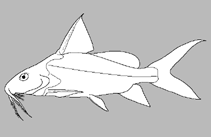 No image available for this species;
drawing shows typical species in Mochokidae.
Google afbeelding
drawing shows typical species in Mochokidae.
Classificatie / Namen Lokale namen | Synoniemen | Catalog of Fishes(Genus, Soort(en)) | ITIS | CoL | WoRMS | Cloffa
> Siluriformes (Catfishes) > Mochokidae (Squeakers or upside-down catfishes) > Chiloglanidinae
Etymology: Chiloglanis: Greek, cheilos = lip + Greek, glanis = a fish that can eat the bait without touching the hook; a cat fish (Ref. 45335); carnatus: Name means fleshy, referring to the dermal tissue covering the base of the dorsal fin of some of the larger specimens and the general robust body structure of this species compared to its regional congeners.
Etymology: Chiloglanis: Greek, cheilos = lip + Greek, glanis = a fish that can eat the bait without touching the hook; a cat fish (Ref. 45335); carnatus: Name means fleshy, referring to the dermal tissue covering the base of the dorsal fin of some of the larger specimens and the general robust body structure of this species compared to its regional congeners.
Milieu: milieu / Klimaatzone / Diepte / verspreidingsgebied Ecologie
; zoet water benthopelagisch. Tropical
Verspreiding Gebieden | FAO regio's | Ecosystemen | Voorkomen | Verspreidingskaart | Introducties | Faunafri
Africa: Zimbabwe.
Grootte / Gewicht / Leeftijd
Maturiteit: Lm ? range ? - ? cm
Max length : 6.2 cm TL mannelijk / geslacht onbekend; (Ref. 130906); 5.6 cm TL (female)
Max length : 6.2 cm TL mannelijk / geslacht onbekend; (Ref. 130906); 5.6 cm TL (female)
Korte beschrijving Determinatiesleutels | Morfologie | Morfometrie
Dorsale zachte stralen (totaal) : 5 - 7; Anale zachte stralen: 12 - 13. This species is distinguished from its congeners in southern Africa (i.e. anoterus, bifurcus, emarginatus, fasciatus, paratus, pretoriae, swierstrai) by the dorsal fin that has a basal portion covered by a fleshy skin, a character which is absent in the other species; with ten closely packed mandibular teeth; a deeply forked caudal fin, with an upper lobe that is shorter than the lower lobe; oral disc with a well-developed mid-ventral cleft; a smooth skin with a few tubercles occasionally found on the head; a dorsal spine with crenate anterior and posterior margins (Ref. 130906).
Cross section: angular.
Cross section: angular.
TThe species was collected from Mukwadzi River, a perennial river that originates from wetlands (dambos) on the eastern side of the Great Dyke. This river flows in a north-western direction cutting through the Great Dyke before it joins the Manyame River. The substratum at the sites was composed of bedrock, cobbles and gravel, and the riparian vegetation was mainly Syzygium Gaertner, 1788 and Phragmites Adanson, 1763. It co-occurred with native fish species that include Labeo cylindricus Peters, 1852, Opsaridium zambezense (Peters, 1852), Enteromius trimaculatus (Peters, 1852), Tilapia sparrmanii Smith, 1840, Clarias gariepinus (Burchell, 1822), and Labeobarbus marequensis (Smith, 1841) as well as the non-native species Serranochromis jallae (Boulenger, 1896) and Micropterus salmoides (Lacepède, 1802) (Ref. 130906).
Levenscyclus en paargedrag Maturiteit | Voortplanting | Paaien | Eieren | Fecunditeit | Larven
Hoofdreferentie
Upload uw referenties | Referenties | Coördinator | Medewerkers
Mutizwa, T.I., W.T. Kadye, P.H.N. Bragança, T. Bere and A. Chakona, 2024. Hidden in the riffles: a new suckermouth catfish (Mochokidae,Chiloglanis) from the middle Zambezi River system, Zimbabwe. ZooKeys 1197:57-91. (Ref. 130906)
CITES
Not Evaluated
Gevaar voor de mens
Harmless
Gebruik door de mens
Visserij: van geen belang
FAO - Publication: search | FishSource |
Meer informatie
Trofische ecologie
Voedsel (prooien)
Dieetsamenstelling
Voedselconsumptie
Voedselrantsoenen
Predatoren
Voedsel (prooien)
Dieetsamenstelling
Voedselconsumptie
Voedselrantsoenen
Predatoren
Ecologie
Ecologie
Ecologie
Populatiedynamica
Groeiparameters
Max. leeftijden / maten
Lengte-gewicht rel.
Lengte-lengte rel.
Lengtefrequenties
Massaconversie
Rekrutering
Abundantie
Groeiparameters
Max. leeftijden / maten
Lengte-gewicht rel.
Lengte-lengte rel.
Lengtefrequenties
Massaconversie
Rekrutering
Abundantie
Levenscyclus
Voortplanting
Maturiteit
Rijpheid/kieuwen rel.
Fecunditeit
Paaien
Paaibestanden
Eieren
Ontwikkeling van de eieren
Larven
Larvale populatiedynamiek
Voortplanting
Maturiteit
Rijpheid/kieuwen rel.
Fecunditeit
Paaien
Paaibestanden
Eieren
Ontwikkeling van de eieren
Larven
Larvale populatiedynamiek
Anatomie
Kieuwoppervlak
Hersenen
Otoliet
Kieuwoppervlak
Hersenen
Otoliet
Fysiologie
Lichaamssamenstelling
Voedingsstoffen
Zuurstofverbruik
Type zwemmen
Zwemsnelheid
Visuele pigmenten
Vis geluid
Ziekten en parasieten
Toxiciteit (LC50)
Lichaamssamenstelling
Voedingsstoffen
Zuurstofverbruik
Type zwemmen
Zwemsnelheid
Visuele pigmenten
Vis geluid
Ziekten en parasieten
Toxiciteit (LC50)
Genetica
genoom
Genetica
Heterozygositeit
Erfelijkheid
Genetische diversiteit
genoom
Genetica
Heterozygositeit
Erfelijkheid
Genetische diversiteit
Menselijk gerelateerd
Aquacultuursystemen
Aquacultuurprofielen
Kweeklijnen
Ciguatera gevallen
Postzegels, munten, diversen.
Aquacultuursystemen
Aquacultuurprofielen
Kweeklijnen
Ciguatera gevallen
Postzegels, munten, diversen.
Tools
Speciale rapporten
Bekijk gegevens voor het houden in een aquarium | Bekijk Fact Sheets voor de soort | Bekijk Aquacultuur Fact Sheets
Download XML
Internetbronnen
AFORO (otoliths) | Aquatic Commons | BHL | Cloffa | Websites from users | Bekijk FishWatcher | CISTI | Catalog of Fishes: Genus, Soort(en) | DiscoverLife | ECOTOX | FAO - Publication: search | Faunafri | Fishipedia | Fishtrace | GloBI | Google Books | Google Scholar | Google | IGFA World Record | OneZoom | Open Tree of Life | Otolith Atlas of Taiwan Fishes | PubMed | Reef Life Survey | Socotra Atlas | TreeBase | Tree of Life | Wikipedia: ga naar, zoek | World Records Freshwater Fishing | Zoobank | Zoological Record
Schattingen op basis van modellen
Fylogenetische diversiteitsindex (Ref. 82804): PD50 = 0.5000 [Uniqueness, from 0.5 = low to 2.0 = high].
Bayesian length-weight: a=0.00389 (0.00180 - 0.00842), b=3.12 (2.94 - 3.30), in cm total length, based on all LWR estimates for this body shape (Ref. 93245).
Trofisch niveau (Ref. 69278): 3.2 ±0.4 se; based on size and trophs of closest relatives
Weerstandsvermogen (Ref. 120179): Hoog, minimale populatieverdubbelingstijd minder dan 15 maanden (Preliminary K or Fecundity.).