



Curculionichthys monolechis Moaris, Gamarra & Reis, 2024
Hochladen Photos und videos
Google Bild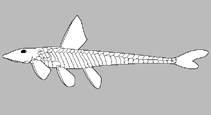 No image available for this species;
drawing shows typical species in Loricariidae.
Google Bild
drawing shows typical species in Loricariidae.
Klassifizierung / Names Namen | Synonyme | Catalog of Fishes(Gattung, Arten) | ITIS | CoL | WoRMS | Cloffa
> Siluriformes (Catfishes) > Loricariidae (Armored catfishes) > Hypoptopomatinae
Etymology: Curculionichthys: Derived from the from the Latin 'curculionem' (elongated snout) and from the Greek 'ichthys' (fishes), in reference to the relatively elongated snouts of the fish species included in this genus; monolechis: Name from the Greek word 'monos' meaning one or single, and 'lekos' for plate, referring to the single rostral plate; noun in apposition.
Etymology: Curculionichthys: Derived from the from the Latin 'curculionem' (elongated snout) and from the Greek 'ichthys' (fishes), in reference to the relatively elongated snouts of the fish species included in this genus; monolechis: Name from the Greek word 'monos' meaning one or single, and 'lekos' for plate, referring to the single rostral plate; noun in apposition.
Umwelt: Milieu / Klimazone / Tiefenbereich / Verbreitungsgebiet Ökologie
; süßwasser demersal. Tropical
Verbreitung Territorien | FAO Gebiete | Ökosysteme | Vorkommen | Punkt Karte | Einführungen | Faunafri
South America: Suriname and French Guiana.
Größe / Gewicht / Alter
Kurzbeschreibung Bestimmungsschlüssel | Morphologie | Morphometrie
Wirbelzahl: 29. This species is distinguished from its congeners by having the following characters: rostral plate single (vs. paired, but variably single in insperatus, luteofrenatus, oliveirai, karipuna); differs from its congeners (except luteofrenatus, piracanjuba, scaius) by having more numerous premaxillary teeth, 20-28 (vs. 6-19) and (except with luteofrenatus, scaius)
with more numerous dentary teeth, 19-25 (vs. 4-18); differs from luteofrenatus, coxipone by having fewer plates in median lateral series, 22-24 (vs. 25-27), from oliveirai, paresi by having more numerous lateral abdominal plates, 6-8 (vs. 4-5 and 4-6, respectively); further differs from insperatus, sabaji, sagarana by having a single series of large median ventral plates (vs. usually three or more regular series of median ventral plates, or small plates irregularly distributed); differs from piracanjuba, scaius by having a longer caudal penduncle, 27.0-31.6% SL (vs. 20.6-25.0 and 25.4-26.8% SL, respectively) and from luteofrenatus, oliveirai by having narrower cleithral width, 22.3-23.7% SL (vs. 23.-25.2 and 23.8-26.8% SL, respectively); further diagnosed from the geographically closer species C. karipuna, by having a shorter head, 29.2-35% SL (vs. 36.4-44.1% HL), larger suborbital depth, 23.0-26.1% HL (vs. 13.3-22.9% HL), total vertebrae 29 (vs. 27-28), more numerous premaxillary teeth 20-28 (vs. 11-17), and at least 5% genetic distance in gene coI (Ref. 130866).
This species was collected in rivers and small- to medium-sized rainforest creeks in areas of rocky rapids and sandbanks. The extinction risk of this species is estimated to be low despite incomplete knowledge of its populational trends and geographic distribution. The species is known from at least 16 localities in the Saramacca River of Suriname and the Marowijne
(¼Maroni) in Suriname and French Guiana, with an estimated Extension of Occurrence (EOO) of 56,513 km2, based on the minimum convex polygon around known localities. It seems to be abundant and despite logging and gold mining being widespread in the area, no specific threats were identified in the region, which is largely forested. Thus, for these reasons, this species is tentatively categorized as Least Concern (LC) according to the IUCN categories and criteria
(IUCN Standards and Petitions Subcommittee, 2019) (Ref. 130866).
Lebenszyklus und Paarungsverhalten Geschlechtsreife | Fortpflanzung | Ablaichen | Eier | Fruchtbarkeit | Larven
Hauptreferenz
Laden Sie Ihre Referenzen hoch | Referenzen | Koordinator : Fisch-Muller, Sonia | Partner
Morais, A. de, S.P. Gamarra and R.E. Reis, 2024. A new species of Curculionichthys (Siluriformes: Loricariidae) from the Saramacca and Marowijne River basins, Suriname and French Guiana. Ichthyology & Herpetology 112(1):60-68. (Ref. 130866)
CITES
Not Evaluated
Bedrohung für Menschen
Harmless
Nutzung durch Menschen
Fischereien: nicht kommerziell
FAO - Publication: search | FishSource |
Mehr Information
Trophische Ökologie
Lebensmittel (Beutetiere)
Nahrungszusammensetzung
Nahrungsaufnahme
Lebensmittelrationen
Räuber
Lebensmittel (Beutetiere)
Nahrungszusammensetzung
Nahrungsaufnahme
Lebensmittelrationen
Räuber
Ökologie
Ökologie
Ökologie
Populationsdynamik
Wachstumsparameter
Max. Alter/Größen
Länge-Gewicht-Rel.
Länge-Länge-Verhältnis.
Längenhäufigkeiten
Massenkonvertierung
Rekrutierung
Dichte
Wachstumsparameter
Max. Alter/Größen
Länge-Gewicht-Rel.
Länge-Länge-Verhältnis.
Längenhäufigkeiten
Massenkonvertierung
Rekrutierung
Dichte
Lebenszyklus
Fortpflanzung
Geschlechtsreife
Reifung/Kiemen rel.
Fruchtbarkeit
Ablaichen
Laichaggregationen
Eier
Eientwicklung
Larven
Larven Pop.Dyn.
Fortpflanzung
Geschlechtsreife
Reifung/Kiemen rel.
Fruchtbarkeit
Ablaichen
Laichaggregationen
Eier
Eientwicklung
Larven
Larven Pop.Dyn.
Anatomie
Kiemenoberfläche
Gehirn
Otolith
Kiemenoberfläche
Gehirn
Otolith
Physiologie
Körperliche Zusammensetzung
Nährstoffe
Sauerstoffverbrauch
Schwimmart
Schwimmgeschwindigkeit
Visuelle Pigmente
Fischgeräusche
Krankheiten und Parasiten
Toxizität (LC50s)
Körperliche Zusammensetzung
Nährstoffe
Sauerstoffverbrauch
Schwimmart
Schwimmgeschwindigkeit
Visuelle Pigmente
Fischgeräusche
Krankheiten und Parasiten
Toxizität (LC50s)
Genetik
Genom
Genetik
Heterozygotie
Vererbbarkeit
Genetische Vielfalt
Genom
Genetik
Heterozygotie
Vererbbarkeit
Genetische Vielfalt
Menschenbezogen
Aquakultur-Systeme
Aquakultur Profile
Zuchtlinien
Ciguatera-Fälle
Briefmarken, Münzen, Verschiedenes.
Aquakultur-Systeme
Aquakultur Profile
Zuchtlinien
Ciguatera-Fälle
Briefmarken, Münzen, Verschiedenes.
Tools
Zusatzinformationen
Download XML
Zusammenfassung | Punktdaten | Namen | Photos
Internet Quellen
AFORO (otoliths) | Aquatic Commons | BHL | Cloffa | Websites from users | FishWatcher Einträge suchen | CISTI | Catalog of Fishes: Gattung, Arten | DiscoverLife | ECOTOX | FAO - Publication: search | Faunafri | Fishipedia | Fishtrace | GloBI | Google Books | Google Scholar | Google | IGFA World Record | OneZoom | Open Tree of Life | Otolith Atlas of Taiwan Fishes | PubMed | Reef Life Survey | Socotra Atlas | TreeBase | Tree of Life | Wikipedia: Gehe zu, Suchen | World Records Freshwater Fishing | Zoobank | Zoologischer Rekord
Schätzungen auf der Grundlage von Modellen
Phylogenetischer Diversitätsindex (Ref. 82804): PD50 = 0.5001 [Uniqueness, from 0.5 = low to 2.0 = high].
Bayesian length-weight: a=0.00977 (0.00434 - 0.02202), b=3.06 (2.87 - 3.25), in cm total length, based on LWR estimates for this (Sub)family-body shape (Ref. 93245).
Trophische Ebene (Ref. 69278): 2.7 ±0.1 se; based on size and trophs of closest relatives
Widerstandsfähigkeit (Ref. 120179): hoch, Verdopplung der Population dauert weniger als 15 Monate. (Preliminary K or Fecundity.).