



Curculionichthys monolechis Moaris, Gamarra & Reis, 2024
Envoyez vos Photos et vidéos
Images Google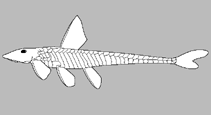 No image available for this species;
drawing shows typical species in Loricariidae.
Images Google
drawing shows typical species in Loricariidae.
Classification / Noms Noms communs | Synonymes | Catalog of Fishes(Genre, Espèce) | ITIS | CoL | WoRMS | Cloffa
> Siluriformes (Catfishes) > Loricariidae (Armored catfishes) > Hypoptopomatinae
Etymology: Curculionichthys: Derived from the from the Latin 'curculionem' (elongated snout) and from the Greek 'ichthys' (fishes), in reference to the relatively elongated snouts of the fish species included in this genus; monolechis: Name from the Greek word 'monos' meaning one or single, and 'lekos' for plate, referring to the single rostral plate; noun in apposition.
Etymology: Curculionichthys: Derived from the from the Latin 'curculionem' (elongated snout) and from the Greek 'ichthys' (fishes), in reference to the relatively elongated snouts of the fish species included in this genus; monolechis: Name from the Greek word 'monos' meaning one or single, and 'lekos' for plate, referring to the single rostral plate; noun in apposition.
Environnement : milieu / zone climatique / profondeur / gamme de distribution Écologie
; eau douce démersal. Tropical
Distribution Territoires | Zones FAO | Écosystèmes | Occurrences | Carte par point | Introductions | Faunafri
South America: Suriname and French Guiana.
Taille / Poids / Âge
Description synthétique Clés d'identification | Morphologie | Morphométrie
Vertèbres: 29. This species is distinguished from its congeners by having the following characters: rostral plate single (vs. paired, but variably single in insperatus, luteofrenatus, oliveirai, karipuna); differs from its congeners (except luteofrenatus, piracanjuba, scaius) by having more numerous premaxillary teeth, 20-28 (vs. 6-19) and (except with luteofrenatus, scaius)
with more numerous dentary teeth, 19-25 (vs. 4-18); differs from luteofrenatus, coxipone by having fewer plates in median lateral series, 22-24 (vs. 25-27), from oliveirai, paresi by having more numerous lateral abdominal plates, 6-8 (vs. 4-5 and 4-6, respectively); further differs from insperatus, sabaji, sagarana by having a single series of large median ventral plates (vs. usually three or more regular series of median ventral plates, or small plates irregularly distributed); differs from piracanjuba, scaius by having a longer caudal penduncle, 27.0-31.6% SL (vs. 20.6-25.0 and 25.4-26.8% SL, respectively) and from luteofrenatus, oliveirai by having narrower cleithral width, 22.3-23.7% SL (vs. 23.-25.2 and 23.8-26.8% SL, respectively); further diagnosed from the geographically closer species C. karipuna, by having a shorter head, 29.2-35% SL (vs. 36.4-44.1% HL), larger suborbital depth, 23.0-26.1% HL (vs. 13.3-22.9% HL), total vertebrae 29 (vs. 27-28), more numerous premaxillary teeth 20-28 (vs. 11-17), and at least 5% genetic distance in gene coI (Ref. 130866).
This species was collected in rivers and small- to medium-sized rainforest creeks in areas of rocky rapids and sandbanks. The extinction risk of this species is estimated to be low despite incomplete knowledge of its populational trends and geographic distribution. The species is known from at least 16 localities in the Saramacca River of Suriname and the Marowijne
(¼Maroni) in Suriname and French Guiana, with an estimated Extension of Occurrence (EOO) of 56,513 km2, based on the minimum convex polygon around known localities. It seems to be abundant and despite logging and gold mining being widespread in the area, no specific threats were identified in the region, which is largely forested. Thus, for these reasons, this species is tentatively categorized as Least Concern (LC) according to the IUCN categories and criteria
(IUCN Standards and Petitions Subcommittee, 2019) (Ref. 130866).
Cycle de vie et comportement reproducteur Maturité | Reproduction | Frai | Œufs | Fécondité | Larves
Référence principale
Téléchargez vos références | Références | Coordinateur : Fisch-Muller, Sonia | Collaborateurs
Morais, A. de, S.P. Gamarra and R.E. Reis, 2024. A new species of Curculionichthys (Siluriformes: Loricariidae) from the Saramacca and Marowijne River basins, Suriname and French Guiana. Ichthyology & Herpetology 112(1):60-68. (Ref. 130866)
CITES
Not Evaluated
Menace pour l'homme
Harmless
Utilisations par l'homme
Pêcheries: sans intérêt
FAO - Publication: search | FishSource |
Plus d'informations
Écologie trophique
Aliments (proies)
Composition du régime alimentaire
Consommation alimentaire
Rations alimentaires
Prédateurs
Aliments (proies)
Composition du régime alimentaire
Consommation alimentaire
Rations alimentaires
Prédateurs
Écologie
Écologie
Écologie
Dynamique des populations
Paramètres de croissance
Âges / tailles maximales
Longueur-poids rel.
Rel. longueur-longueur.
Fréquences de longueurs
Conversion de masse
Recrutement
Abondance
Paramètres de croissance
Âges / tailles maximales
Longueur-poids rel.
Rel. longueur-longueur.
Fréquences de longueurs
Conversion de masse
Recrutement
Abondance
Cycle de vie
Reproduction
Maturité
Maturité/épines rel.
Fécondité
Frai
Agrégats de frai
Œufs
Développement de l'œuf
Larves
Dynamique des populations larvaires
Reproduction
Maturité
Maturité/épines rel.
Fécondité
Frai
Agrégats de frai
Œufs
Développement de l'œuf
Larves
Dynamique des populations larvaires
Anatomie
Surface branchiale
Cerveau
Otolithe
Surface branchiale
Cerveau
Otolithe
Physiologie
Composition corporelle
Nutriments
Consommation d'oxygène
Type de natation
Vitesse de nage
Pigments visuels
Son de poisson
Maladies et parasites
Toxicité (CL50)
Composition corporelle
Nutriments
Consommation d'oxygène
Type de natation
Vitesse de nage
Pigments visuels
Son de poisson
Maladies et parasites
Toxicité (CL50)
Génétique
génôme
Génétique
Hétérozygotie
Héritabilité
Diversité génétique
génôme
Génétique
Hétérozygotie
Héritabilité
Diversité génétique
Liées à l'homme
Systèmes d'aquaculture
Profils d'aquaculture
Souches
Cas de ciguatera
Timbres, pièces de monnaie, divers
Systèmes d'aquaculture
Profils d'aquaculture
Souches
Cas de ciguatera
Timbres, pièces de monnaie, divers
Outils
E-book | Guide de terrain | Générateur de fréquences de longueur | Outil de dynamique de population | Carte par point |
Capture-MSY |
Articles particuliers
Télécharger en XML
Sources Internet
AFORO (otoliths) | Aquatic Commons | BHL | Cloffa | Websites from users | FishWatcher | CISTI | Catalog of Fishes: Genre, Espèce | DiscoverLife | ECOTOX | FAO - Publication: search | Faunafri | Fishipedia | Fishtrace | GloBI | Google Books | Google Scholar | Google | IGFA World Record | OneZoom | Open Tree of Life | Otolith Atlas of Taiwan Fishes | PubMed | Reef Life Survey | Socotra Atlas | TreeBase | Arbre de Vie | Wikipedia: aller à, chercher | World Records Freshwater Fishing | Zoobank | Zoological Record
Estimations basées sur des modèles
Indice de diversité phylogénétique (Réf. 82804): PD50 = 0.5001 [Uniqueness, from 0.5 = low to 2.0 = high].
Bayesian length-weight: a=0.00977 (0.00434 - 0.02202), b=3.06 (2.87 - 3.25), in cm total length, based on LWR estimates for this (Sub)family-body shape (Ref. 93245).
Niveau trophique (Réf. 69278): 2.7 ±0.1 se; based on size and trophs of closest relatives
Résilience (Réf. 120179): Haut, temps minimum de doublement de population inférieur à 15 mois (Preliminary K or Fecundity.).