



Centromochlus akwe Coelho, Chamon & Sarmento-Soares, 2021
Загрузить свой Фото и Видео
Изображение на Google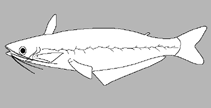 No image available for this species;
drawing shows typical species in Auchenipteridae.
Изображение на Google
drawing shows typical species in Auchenipteridae.
Классификация / Имена народные названия | синонимы | Catalog of Fishes(род, виды) | ITIS | CoL | WoRMS | Cloffa
> Siluriformes (Catfishes) > Auchenipteridae (Driftwood catfishes) > Centromochlinae
Etymology: Centromochlus: Greek, kentron = sting + Greek, mochlos, -ou = lever, crowbar (Ref. 45335); akwe: Named after the Akwê (Xerente self-denomination) indigenous people.
Etymology: Centromochlus: Greek, kentron = sting + Greek, mochlos, -ou = lever, crowbar (Ref. 45335); akwe: Named after the Akwê (Xerente self-denomination) indigenous people.
Окружающая среда: среда / климатическая зона / пределы глубины / диапазон распространения экология
; пресноводный донно-пелагический. Tropical
распространение Территории | регионы FAO | Экосистемы | места находок | карта точек | интродукции | Faunafri
South America: Brazil.
Размер / Вес / Возраст
Краткое описание определительные ключи | морфология | морфометрия
This species is distinguished from Centromochlinae by having a vermiculated color pattern on the dorsum (vs. dorsum uniform in all Centromochlinae, except Tatia brunnea, T. dunni, and T. meridionalis). It is distinguished from these three aforementioned species by having the eye ventrolaterally displaced on head in a way that almost the entire eye is visible in ventral view (vs. eye displaced dorsolaterally and not visible in ventral view). It shares derived characters with other Centromochlus species such as the ventrolateral position of eye socket, a sphenotic notched for the exit of infraorbital canal, and with posterior serrations along pectoral-fin spine numerou. It is distinguished from its congeners by having the pectoral-fin spine with dark bars, alternating with light bars (vs. pectoral-fin spine with light and uniform color); further differs except C. carolae by the ventral surface of head moderate to largely pigmented (vs. ventral surface of head unpigmented in C. heckelii, C. existimatus, C. orca, C. musaicus, C. schultzi or with few scattered dark chromatophores in C. macracanthus and C. melanoleucus); differs from C. carolae by the presence of vermiculated color pattern or scattered chromatophores on lateral surface of the body that extends to the caudal peduncle (vs. lateral surface of the body with distinct demarcation between dark and light areas continuous posteriorly onto the caudal peduncle whereas the dark pigmentation extends nearly to the ventral midline); differs from C. schultzi by lacking dark large and rounded blotches over a pale background on head and trunk (vs. present; and by the smaller length of the dorsal-fin spine 18.1-27.1% of SL (vs. more than 27% of SL in C. macracanthus, C. heckelii, C. existimatus), and pectoral-fin spine 24.2-32.2% of SL (vs. more than 33% of SL in C. macracanthus, C. heckelii, C. existimatus) (Ref. 123897).
Cross section: oval.
Cross section: oval.
This species was found hidden in crevices within laterititic bedrock substrate covered by alluvial sediment, typical of the median portion of the Araguaia River basin and were manually collected and sometimes it was necessary to break the rocks to remove specimens that were hidden. The laterite is a geomorphological formation that originates from the weathering of lateritic crusts that cover the geological units, and is common at the middle and lower rio Araguaia stretches. Several species of Siluriformes that occur syntopically with this species were also collected: Centromochlus schultzi, Tatia intermedia, Auchenipterichthys longimanus, Rhinodoras boehlkei, Platydoras armatulus, Rhamdia quelen, Leporacanthicus galaxias, Peckoltia vittata, P. sabaji, Parancistrus aurantiacus, Pseudacanthicus sp., and Spectracanthicus javae. Specimens were collected in the twilight and daytime, with most of these collected during the morning and at periods of capture, the collected specimens were in lethargic condition (Ref. 123897).
Жизненный цикл и брачное поведение половая зрелость | размножение | нерест | икра | Плодовитость | личинки
Основная ссылка
Загрузите свои рекомендации | ссылки | координатор : Ferraris, Jr., Carl J. | соавторы
Coelho, F.L., C.C Chamon and L.M. Sarmento-Soares, 2021. A new species of driftwood catfish Centromochlus Kner, 1858 (Siluriformes, Auchenipteridae, Centromochlinae) from Tocantins-Araguaia River drainage. Zootaxa 4950(1):149-165. (Ref. 123897)
CITES
Not Evaluated
Угроза для людей
Harmless
Использование человеком
FAO - Publication: search | FishSource |
дополнительная информация
Трофическая экология
Пищевые предметы (добыча)
состав пищи
потребление пищи
Продовольственные пайки
хищники
Пищевые предметы (добыча)
состав пищи
потребление пищи
Продовольственные пайки
хищники
экология
экология
экология
Динамика численности населения
Параметры роста
Макс. возраст / размер
Отношение длины к весу.
Отношение длины к длине.
Размерный состав
Преобразование массы
пополнение
численность
Параметры роста
Макс. возраст / размер
Отношение длины к весу.
Отношение длины к длине.
Размерный состав
Преобразование массы
пополнение
численность
Жизненный цикл
размножение
половая зрелость
Зрелость/Жиры относительно.
Плодовитость
нерест
Нерестовые скопления
икра
Развитие икры
личинки
динамика численности личинок
размножение
половая зрелость
Зрелость/Жиры относительно.
Плодовитость
нерест
Нерестовые скопления
икра
Развитие икры
личинки
динамика численности личинок
Анатомия
жаберная область
Мозг
Отолит
жаберная область
Мозг
Отолит
Физиология
Состав тела
Питательные вещества
Потребление кислорода
Тип плавания
Скорость плавания
Зрительные пигменты
Звук рыбы
Болезни и паразиты
Токсичность (LC50s)
Состав тела
Питательные вещества
Потребление кислорода
Тип плавания
Скорость плавания
Зрительные пигменты
Звук рыбы
Болезни и паразиты
Токсичность (LC50s)
генетика
Геном
генетика
Гетерозиготность
наследуемость
Генетическое разнообразие
Геном
генетика
Гетерозиготность
наследуемость
Генетическое разнообразие
Связанные с человеком
Системы аквакультуры
особенности рыбоводства
степень растяжения
Случаи заболевания сигуатерой
Марки, монеты и прочее.
Системы аквакультуры
особенности рыбоводства
степень растяжения
Случаи заболевания сигуатерой
Марки, монеты и прочее.
инструменты
Специальные отчеты
Проверить содержание в аквариумах | Проверить опубликованные видовые данные | Проверить опубликованные данные по аквакультуре
Скачать в формате XML
ресурсы в Интернет
AFORO (otoliths) | Aquatic Commons | BHL | Cloffa | Websites from users | Проверить FishWatcher | CISTI | Catalog of Fishes: род, виды | DiscoverLife | ECOTOX | FAO - Publication: search | Faunafri | Fishipedia | Fishtrace | GloBI | Google Books | Google Scholar | Google | IGFA World Record | OneZoom | Open Tree of Life | Otolith Atlas of Taiwan Fishes | PubMed | Reef Life Survey | Socotra Atlas | TreeBase | Tree of Life | Wikipedia: Вперёд, поиск | | Zoobank | Зоологическая летопись
Оценки, основанные на моделях
|
Индекс филогенетического разнообразия (ссылка 82804) |
PD50 = 0.5078 [Uniqueness, from 0.5 = low to 2.0 = high]. |
| Bayesian length-weight | a=0.00490 (0.00196 - 0.01224), b=3.11 (2.90 - 3.32), in cm total length, based on LWR estimates for this (Sub)family-body shape (Ref. 93245). |
|
Трофический уровень (ссылка 69278) |
3.3 ±0.4 se; based on size and trophs of closest relatives |
|
устойчивость к внешним воздействиям (ссылка 120179) |
высокий, минимальное время удвоения популяции до 15 месяцев (Preliminary K or Fecundity.). |
|
Уязвимость рыбной ловли (Ref. 59153) |
Low vulnerability (12 of 100). 🛈 |